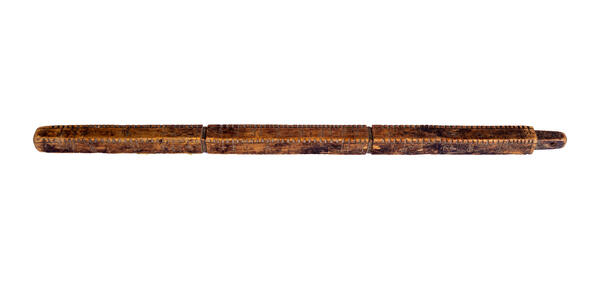
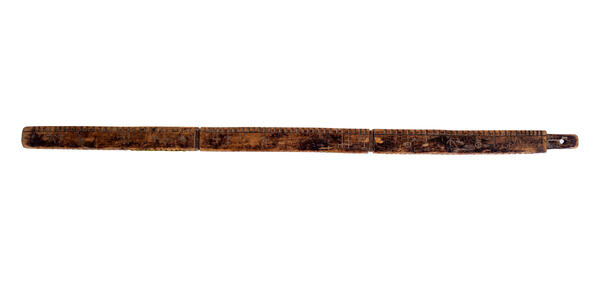
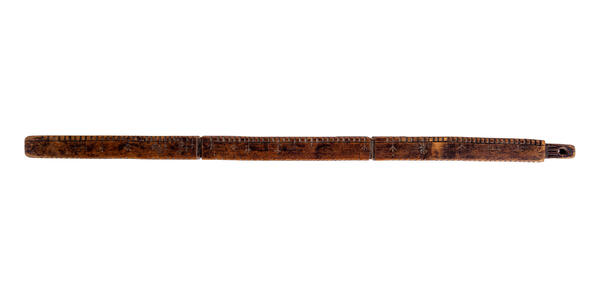
The Pomorsky calendar became part of the museum collections of the Ethnography Department of the Russian Museum in 1909 thanks to the collector Feodor Antonovich Kalikin, a connoisseur of Russian culture and Old Russian art.
Calendars were four- or six-sided bars, sometimes with a thickening in the center, on which important information for peasants was marked with notches and special signs: the beginning and end of agricultural work, the period of hunting and fishing, the days of church and family holidays. Such calendars were called “svyatsy” or folk peasant calendars.
Calendars were divided into months by leaving blank space between slits or oblique crosses. A hexagonal calendar had two months on each side, while a tetrahedral calendar had three. Sometimes the names of months were carved in a shortened form. Notches on the sides corresponded to the number of days in a month. The beginning of the year in calendars usually fell on September 1, less often on March 1, as evidenced by different markings. Days and months in calendars were usually counted from left to right, less often — alternately.
Of particular interest are the marks and signs that indicate holidays and other memorable days on the calendar. Major church feasts on most calendars were marked with crosses in a circle. Crosses with an arch, a simple arch, simple crosses or a straight vertical line denoted lesser important or minor feasts, as well as the commemoration of a saint or a venerated icon. Some of the feasts were marked with Cyrillic letters: for example, the letter “B” (buki) denoted the feasts of the Mother of God and the days connected with Her revered icons.
A pictographic type of writing in the form of drawings, which appeared long before writing, was also used on such calendars. For example, the drawing of a horse above Yegoriev Day (April 23) signaled the first pasturing in the field after the winter period; the days of summer (June 12, Peter the Turn) and winter (December 12, Spiridon the Sunreturn) solstices were marked by a pictograph of the sun. The beginning of plowing (May 1, Yeremey the Harnesser) and the beginning of haymaking (July 8, the day of Kazan Mother of God, or Prokopyev Day) were represented respectively by drawings of a plough and a rake.
The most recent pictograph refers to the feast of the Synaxis of the Three Hierarchs — Basil the Great, Gregory the Theologian, John Chrysostom (January 30): three crosses coming out of one point.