The first track roads appeared around stone quarries, mines and coal mines. Mentions of them date back to the mid-16th century. The so-called rails were wooden bars — “lezhni” in Russian. On such a track, a horse could carry a load four times larger than on an ordinary dirt road. However, the wooden bars quickly wore out, and the carts went off tracks. To reduce the wear of wooden bars, they were reinforced with iron or cast-iron strips. To prevent the carts from going off the track, the bars also had special edges.
The first rails were made mainly of cast iron. However, it was found that steel rails wear out less often and more evenly than cast iron ones. The latter very soon ceased to be used on railways. Even in the early years of the development of railways, Russian engineers opted for a broad-gauge railway system. Such rails were manufactured at the Lyudinovsky Plant and laid on the Petersburg—Moscow line. Subsequently, this design was used in railway tracks worldwide.
One of the first cast-iron tracks with a length of about 160 m was built at the Alexander Plant in Petrozavodsk (the Onega Plant) in 1788. In 1837, the Petersburg — Tsarskoe Selo (now the town of Pushkin) railway was built with a length of 27 km. This track had no practical significance: it was constructed only to gain experience. The rails were double-headed, reinforced with wedges in cast-iron cushions, which were attached to 3-meter-long sleepers with long flexible rods.
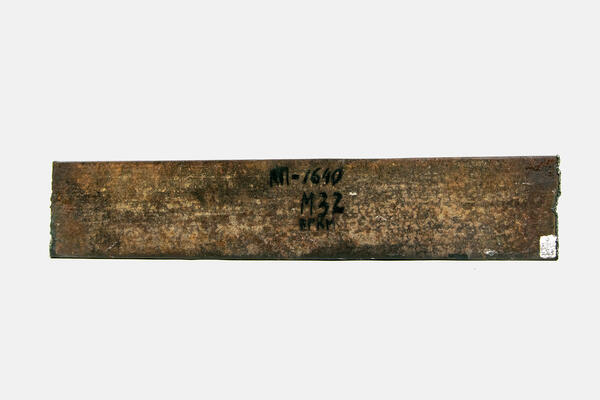
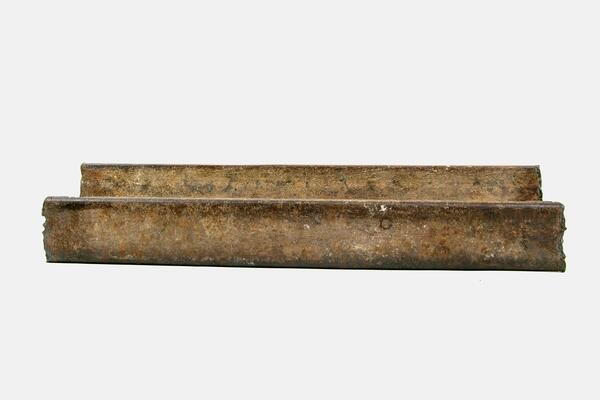
The railway industry was one of the main ones in the Soviet Union. In April 1929, the construction of the Kuznetsk Metallurgical Plant was started near the village of Telbes near Kemerovo. Soon Telbesstroy was renamed Kuznetskstroy. The exhibit is a fragment of the rails of a narrow-gauge railway with the manufacturer’s marking “KUZ.M.Z. named after Stalin” — Kuznetsk Metallurgical Plant. The fragment was cut out during the disassembly of a narrow-gauge railway track on the territory of the Yamalo-Nenets Autonomous Okrug. Such rails were used in the construction of the Chum—Labytnangi—Salekhard track.