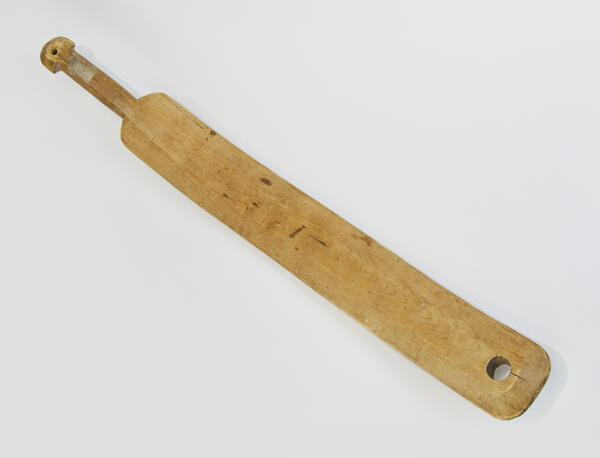
A rubel or mangle board is a wooden board with carved transverse grooves. This household item was used for beating (washing) and smoothing clothes. Hand-squeezed laundry was wound on a roller or rolling pin and rolled out with a rubel. Before the invention of irons, Russian women used to stretch and roll their laundry until it became soft. For this purpose, they used a ruble — an item no rural household could do without.
Rubels were made of hardwood: oak, rowan, beech, maple, birch. Its working surface is covered in trapezoidal grooves made with an ax. The name “rubel” comes from the word “rubit” which means to chop or to cut. The smooth side on the back is decorated with geometric or floral carvings, paintings or sculptures. The decorated ironing tool served as a talisman of the house and household, it was often passed on as an heirloom.
It was customary for young men
to present girls with rubles as gifts. Such rubels had a date and a name carved
onto them. This household object varied in size, shape, style of carving and
decoration, depending on the region. In everyday life, it was used not to
smooth out clothing — sometimes it was used for washing clothes. The washed and
dried garment (underwear, clothes, tablecloths or towels) was folded several
times and carefully and tightly wound on a special roller. If there was no such
roller in the household, the usual rolling pin for rolling out the dough was
used. As a result, a tight, dense and crease-free bundle should have been
formed. The rubel was placed on top and rolled from the edge of the table along
the bundle applying as much pressure as possible. The ribbed surface of the
rubel kneaded the stiff and coarse fabric and made it smooth. Residual water
was squeezed out of the laundry, and after a rather long rolling process, the
laundry became smooth as if steamed. Rolled out in this
way, it became soft and snow-white, acquired such a fresh and neat appearance
that minor defects from washing (pellets, irregularities, small debris) became
invisible. The process itself was embodied in the proverb “If not by washing,
then by rolling”.