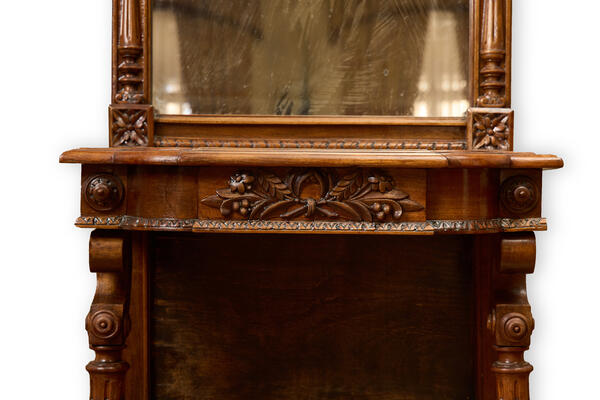
A mirror with a pier table, or trumeau mirror, was considered an essential attribute of a woman’s bedroom for several centuries in a row. This piece of furniture was used to store ladies’ trifles and cosmetics, and wash bowls were placed on it. For many centuries, the trumeau mirror looked more like a tall upright mirror in which a person was reflected full-length.
In French, trumeau means “space between windows”, as it was customary to fit the mirror and a pier table in the gap between windows or doors. It is for this reason that trumeau mirrors were also called “pier mirrors”. It could be suspended, placed against a wall or mounted on a small dresser or table.
The trumeau mirror is believed to have been designed during the early Rococo period by Robert de Cotte, the architect of French King Louis XIV. “One of the tasks of architects of the time was to find a way of placing mirrors over fireplaces… In the inventories of Parisians’ property such novelties are mentioned from the end of the 17th century, but they became especially widespread during the Regency, making their way into the homes of the urban bourgeoisie from the second half of the 18th century,” from the material by Svetlana Damirovna Borodina, editor-in-chief of the “World of Art” magazine and Elena Anatolievna Vlasova, the chief curator of the fund of the International Institute of Antiques ASG.
In Russia, mirrors and trumeau mirrors came into fashion much later than in Europe. Imports were mostly limited to small-sized items. The situation changed after the production of mirrors was established under Peter the Great. In the 18th century, the mirror turned from a luxury item into an everyday element of furnishings, and its appearance also changed. It became larger and had massive frames.
In royal palaces and the chambers of nobles, mirrors were used to decorate walls and fireplaces. They had not only a decorative but also a practical function. Such interior items created an illusion of expanding space and added light, as even a small candle flame, which was repeatedly reflected in the mirrors, illuminated the room well.
Trumeau mirrors became popular in Russia in the
19th century in a similar way to ordinary mirrors. They were commonly found in
the interior of ceremonial rooms. Along with wall mirrors, they gave the room
an elegant look and reflected the objects that were located in the room,
thereby visually increasing their number. In the early 20th century, trumeau
mirrors lost their exotic appeal and became a common household item.