

Psyche mirrors have a unique design. Their oval wooden frame is fixed to a table or a base resembling a small easel using two hinged vertical bars. As a result, the mirror can be tilted. This design is extremely convenient because it allows the user to adjust the mirror as required and look at the reflection from the desired angle.
The mirror derives its name from the Greek goddess Psyche. She was known as the goddess of the soul and breath and was depicted as a butterfly or a beautiful woman with butterfly wings.
Psyche mirrors appeared in France in the late 18th century. At the end of the Gallant Age, this essential element of a boudoir was part of a lady’s dressing table. Later, the design of a psyche mirror was also used for making floor mirrors.
Psyche mirrors were a wonderful interior design idea. Some wooden frames were valuable artworks on their own, and a large mirror could create the illusion of more space and optimize the lighting. During the hours of darkness, such mirrors created a mesmerizing effect by reflecting the flickering flame of candelabra flanking the frame on special stands.
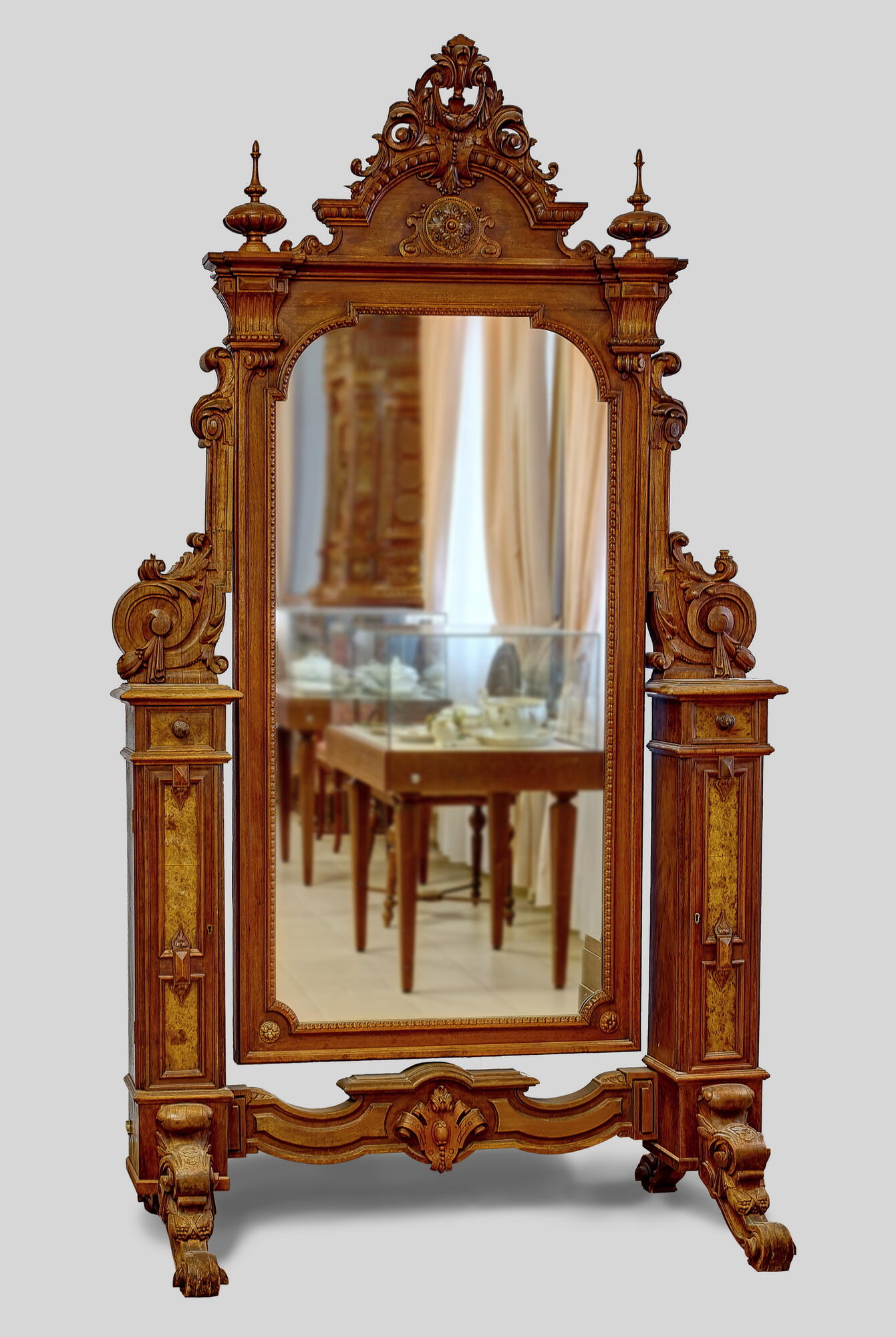
The floor-standing psyche mirror from the museum’s collection was produced when art was dominated by the style of historicism. Artists and decorators turned their attention to previous eras. They made active use of the classical order borrowed from Ancient Greek architecture as well as the shapes and elements of Baroque-style decoration.
Artists often combined elements from different historical styles in a single work. This approach is known as eclecticism, one of the movements of historicism. The mirror from the museum’s collection is an example of such eclectic art: its shapes and décor show the influence of different styles and eras.
The mirror has a wooden frame with a profiled cornice at the top. It is flanked by two side cabinets, which are attached using hinges. Behind the doors of the two cabinets, there are shelves and drawers for keeping various small items.
The décor of the top of the mirror combines large carved scrolls of Baroque-style acanthus leaves and elements of cut-through decoration. A unique effect is created through the combination of different types of wood.
The mirror derives its name from the Greek goddess Psyche. She was known as the goddess of the soul and breath and was depicted as a butterfly or a beautiful woman with butterfly wings.
Psyche mirrors appeared in France in the late 18th century. At the end of the Gallant Age, this essential element of a boudoir was part of a lady’s dressing table. Later, the design of a psyche mirror was also used for making floor mirrors.
Psyche mirrors were a wonderful interior design idea. Some wooden frames were valuable artworks on their own, and a large mirror could create the illusion of more space and optimize the lighting. During the hours of darkness, such mirrors created a mesmerizing effect by reflecting the flickering flame of candelabra flanking the frame on special stands.
The floor-standing psyche mirror from the museum’s collection was produced when art was dominated by the style of historicism. Artists and decorators turned their attention to previous eras. They made active use of the classical order borrowed from Ancient Greek architecture as well as the shapes and elements of Baroque-style decoration.
Artists often combined elements from different historical styles in a single work. This approach is known as eclecticism, one of the movements of historicism. The mirror from the museum’s collection is an example of such eclectic art: its shapes and décor show the influence of different styles and eras.
The mirror has a wooden frame with a profiled cornice at the top. It is flanked by two side cabinets, which are attached using hinges. Behind the doors of the two cabinets, there are shelves and drawers for keeping various small items.
The décor of the top of the mirror combines large carved scrolls of Baroque-style acanthus leaves and elements of cut-through decoration. A unique effect is created through the combination of different types of wood.