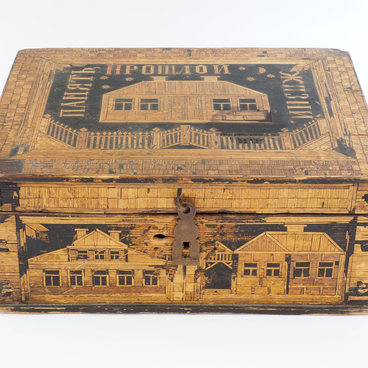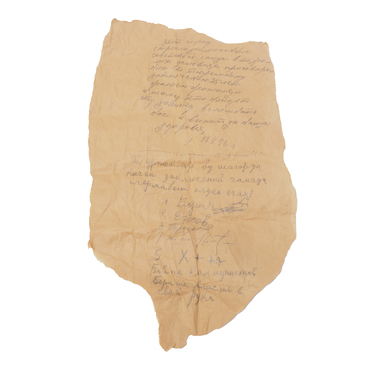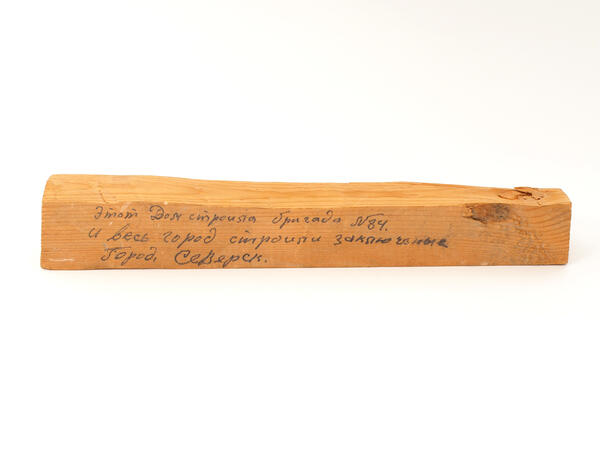
Even today, the residents of Seversk often find ‘letters from the past’ in their homes — the short notes left by those who built the city in the 1950s. The museum collection contains a wooden block with the inscription: ‘This house was built by squad No.84, and the whole city was built by the prisoners. The city. Seversk.’
Over the past few years, people have found many similar letters in various houses of Seversk during remodeling — under the wallpaper or between window frames.
Seversk belongs to the cities that were built according to the post-war type of construction: at first, a city-forming enterprise was designed and built, and then residential and municipal buildings and infrastructure appeared around it. The enterprise developed quickly and set a high pace for the city: it had to be built in a short time in the place surrounded by the swamps and taiga. Many people of different nationalities and social backgrounds were involved in the building of Seversk.
Prisoners were the most numerous category of workers in the first years of the construction of the ‘Zauralsky Machine-Building Plant’ (one of the secret names of the future Siberian Chemical Combine).
In 1946-1949, the labor camp ‘A’ was located in the Chekist settlement; a Kharkiv mine plant worked at this place during the Great Patriotic War. People convicted for the betrayal of Motherland served their sentences here.
Correctional labor camp ‘A’ was liquidated by order of the USSR Ministry of Internal Affairs in the spring of 1949. At the same time, the camp with all the property and staff was at the disposal of the administration of the Construction Directorate.
The construction of secret facilities could not be entrusted to people convicted of political crimes, so most of the convicts were convoyed to the Irkutsk region. New prisoners convicted of criminal offenses replaced them. New labor camp zones were built. The first convoy with more than four thousand people in it arrived at the camp in July 1949. There were more than eleven thousand people at the end of 1949.
With the help of prisoners’ labor, various important objects of the city, apartment buildings, administrative and cultural buildings, roads, and canals were built.
Over the past few years, people have found many similar letters in various houses of Seversk during remodeling — under the wallpaper or between window frames.
Seversk belongs to the cities that were built according to the post-war type of construction: at first, a city-forming enterprise was designed and built, and then residential and municipal buildings and infrastructure appeared around it. The enterprise developed quickly and set a high pace for the city: it had to be built in a short time in the place surrounded by the swamps and taiga. Many people of different nationalities and social backgrounds were involved in the building of Seversk.
Prisoners were the most numerous category of workers in the first years of the construction of the ‘Zauralsky Machine-Building Plant’ (one of the secret names of the future Siberian Chemical Combine).
In 1946-1949, the labor camp ‘A’ was located in the Chekist settlement; a Kharkiv mine plant worked at this place during the Great Patriotic War. People convicted for the betrayal of Motherland served their sentences here.
Correctional labor camp ‘A’ was liquidated by order of the USSR Ministry of Internal Affairs in the spring of 1949. At the same time, the camp with all the property and staff was at the disposal of the administration of the Construction Directorate.
The construction of secret facilities could not be entrusted to people convicted of political crimes, so most of the convicts were convoyed to the Irkutsk region. New prisoners convicted of criminal offenses replaced them. New labor camp zones were built. The first convoy with more than four thousand people in it arrived at the camp in July 1949. There were more than eleven thousand people at the end of 1949.
With the help of prisoners’ labor, various important objects of the city, apartment buildings, administrative and cultural buildings, roads, and canals were built.