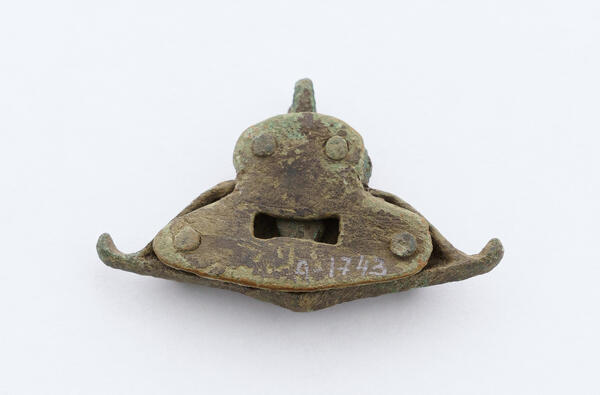
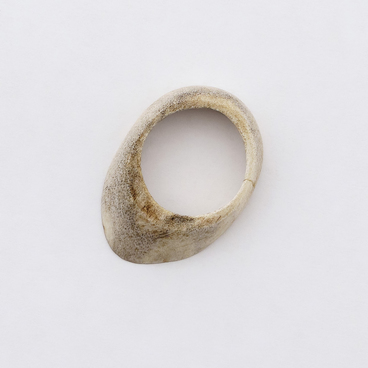
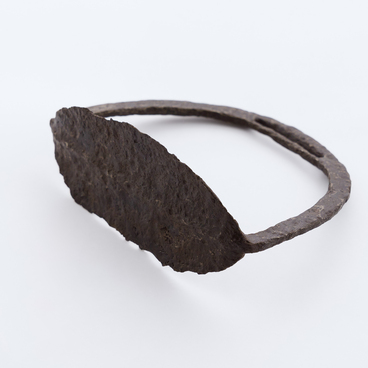
The pouch clasp on display at the State Museum-Reserve “Kulikovo Field” in the main hall “Rus and Horde: 14th Century Warfare” is a detail from a costume from the 14th–15th centuries. It is made of a copper-based alloy and has a cover shaped like a three-pronged crescent, on the front of which a curved dragon without wings is depicted biting its own tail, a symbol of eternity and continuity.
In European clothing of the 13th century, holes or slits resembling pockets began to appear. Through these side openings, bags or keys could be reached, which were worn under clothes and hung from the belt. It was not until the 17th century that actual pockets began to be sewn onto clothes. In medieval times, the function of pockets was fulfilled by a small pouch that was worn around the waist on a belt. During the time of the Battle of Kulikovo, items like a comb, a fire striker, or a flint for fire lighting, needles, or keys could be stored in such a pouch.
The entire surface of pouches could be decorated with embossing or appliqué. Embossed leather is created by taking a pre-soaked piece of leather, placing it on a wooden mold with a carved pattern or image, and pressing the ornament using a bone folder. After the embossing is complete, the leather and mold are dried, then the dry piece is cut, depending on the product. There are many examples of leather art, which can be found in all kinds of designs — from simple geometric shapes and floral patterns to images of animals and birds. Of course, clasp overlays and fasteners made from bronze or silver alloys were used as décor and also provided functionality. Inside, a waist pouch could have several compartments.
In the era of the Battle of Kulikovo, there was hardly a Russian or Golden Horde warrior without a waist pouch. This could be used for carrying a whetstone pouch for sharpening a sword, a saber, or arrows. There, one could also carry rivets, straps, or cloth cords for repairing armor, and thread with needles. A spare bowstring and money were also common items found in waist pouches. Other items like a comb, scissors, and bone sticks for writing were also useful in the field.