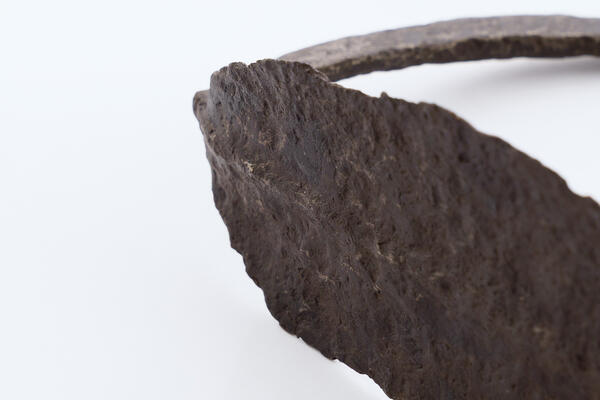
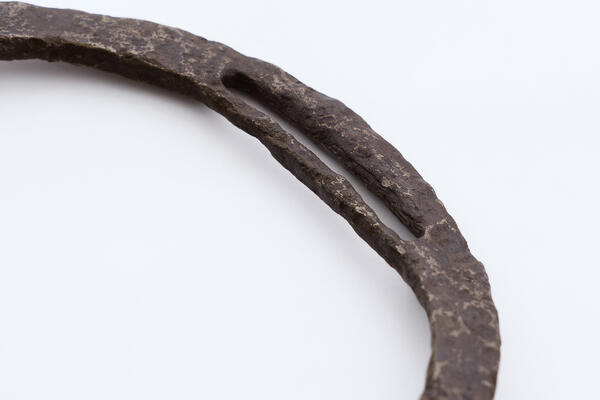
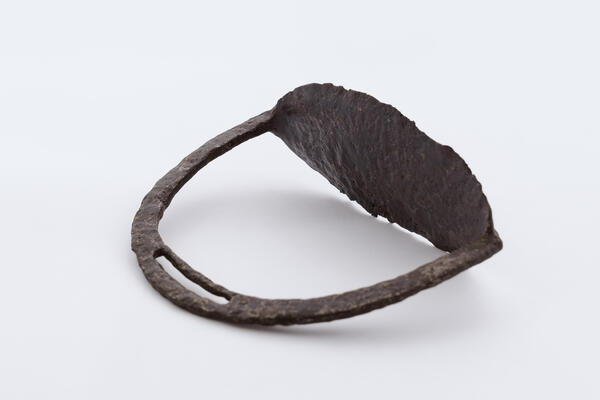
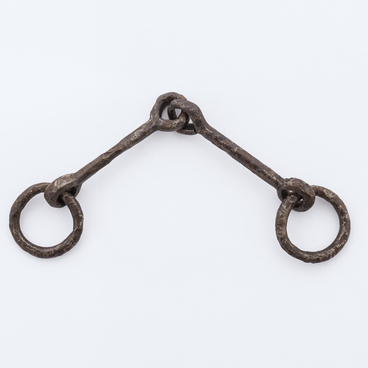
The stirrup displayed in the main hall “Rus and Horde: 14th Century Warfare” at the State Museum-Reserve “Kulikovo Field” is a part of horse equipment — a detail of a saddle from the 12th–14th centuries. The stirrup has the shape of an arch and features a wide, straight footrest and a narrow, rectangular loop for the strap.
Traditionally, a stirrup consists of shackles and a footrest. It was an essential part of horse equipment that made riding easier and served as a support for the rider.
Stirrups were not invented until long after humans began riding horses. Scientists cannot say for certain where or when the first stirrups emerged. The precursor of the stirrup was a light, belt-like footrest that helped people mount their horses more easily. Stirrups gained popularity when the solid, modern saddle was developed. The first stirrups and saddles were crude and varied in design.
The introduction of stirrups had a significant impact on the development of weaponry and combat strategies. Riders needed to not only remain seated in the saddle but also engage in combat, such as shooting with a bow, striking with a spear, or slashing with a sword or saber. For instance, a thrust with a spear could not only dislodge another horseman but also cause the rider to fall off his own horse. Stirrups ensured a more secure grip in the saddle and with a slashing blow created additional support, providing a more powerful strike while minimizing the risk of falling off one’s horse.
Archaeological evidence suggests that stirrups were made from wood, bone, non-ferrous metals, and even precious materials such as silver. However, iron was commonly used for their construction.
The stirrup on display is made from iron. As a starting point for the manufacturing of this stirrup, a blacksmith used an iron bar. First, a foot rest was formed, then both shackles were made, and then the entire structure was shaped into an arch, with the end of the shackle welded to the foot rest by forging. When the base of the structure was completed, the blacksmith carved out a rectangular space at the top of the arch to allow for the insertion of a leather or fabric strap to attach to the saddle.