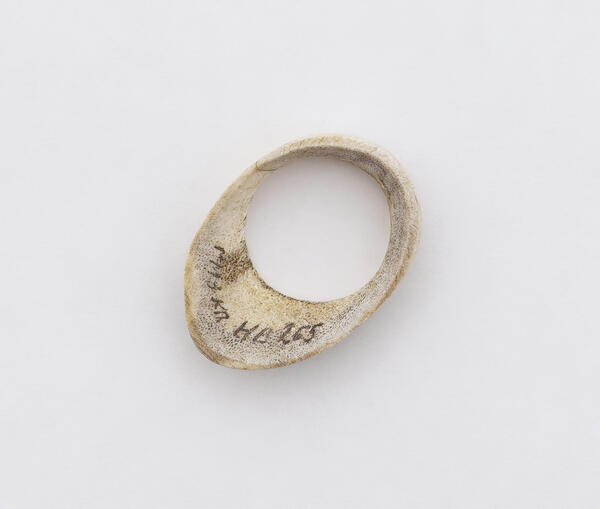
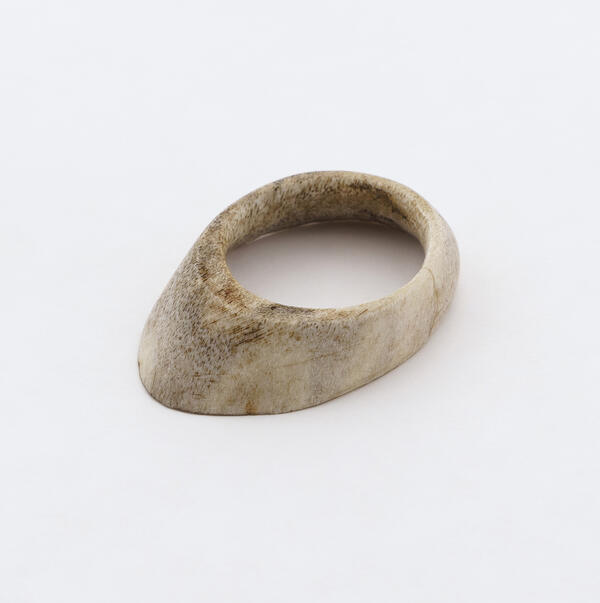
The State Museum-Reserve “Kulikovo Field” features a thumb ring displayed in its main hall “Rus and Horde: 14th Century Warfare”. It was used to protect the thumb from the bowstring during a thumb draw. It is a replica made from tubular bone of a large animal, shaped like a truncated cone with an offset to one side.
Thumb rings differ in shape from regular rings. Typically, they have the form of a cylinder or cone and a petal-like design. When used for shooting, the ring was placed on one’s thumb, with the “petal” facing forward. Over millennia, the usage of these rings remained relatively unchanged. Since the size of the ring needed to be comfortable enough to fit on the thumb, all rings were custom-made.
The thumb ring, also known as the archer’s ring, is an accessory used in archery. It is placed on the thumb of the dominant hand, leaving the nail and knuckle exposed. This design protects the thumb from injury caused during a thumb draw.
As a rule, thumb rings were made from bone, rarer from stone. However, they were sometimes more than just tools — they were also considered luxury items. Some thumb rings were made from silver or semiprecious stones like jade, jasper, and agate.
The displayed ring protects the thumb when pulling and releasing the bowstring. It allows archers to use bows with higher tension and improves shot accuracy by ensuring that the string touches the ring at only one point, rather than two or three as with the European (Mediterranean) grip, thereby making shooting easier.
This invention illustrates how archery evolved during the Middle Ages. It was not typical of nomadic cultures like that of the Golden Horde. Such devices are primarily found at the monuments of sedentary groups.