#1
Gunlock, case-shot, flail weight
#11
#2
#5
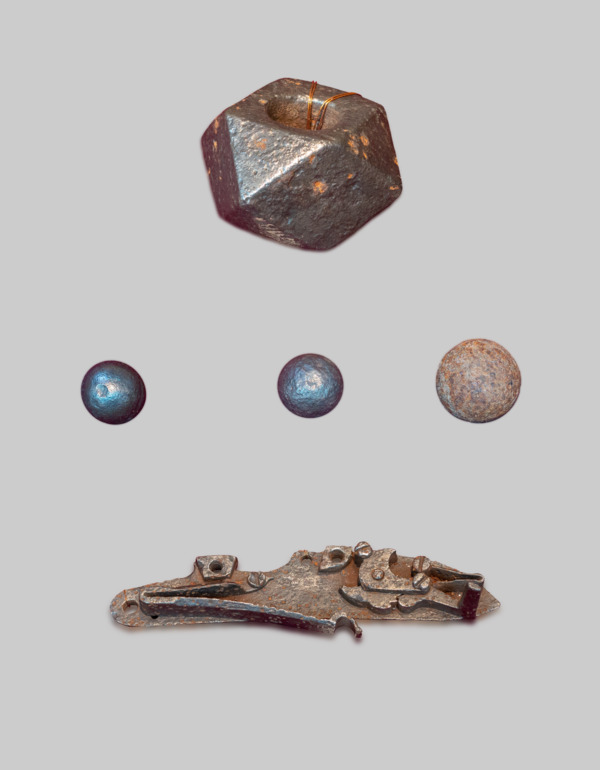
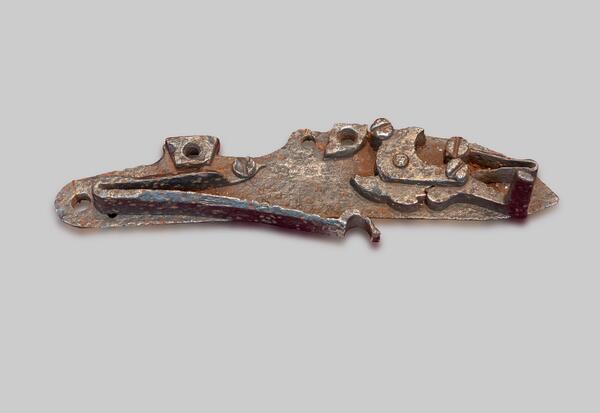
The flintlock dating back to early XIX century and found in Sosnovka village of Krapivinsky district, Kemerovo region, was a true French flintlock. What remained of the flintlock are the lock spring, the tumbler and some other elements, but the trigger and the frizzen were lost.
Certain sources call such locks French, or French-style locks as the French artist and gunsmith Marin de Bourgeois from the Norman city of Lisieux, was deemed to have invented it. The inventor combined the advantages of the Mediterranean and Baltic locks in one.
The flintlock cock was located on the outside face of the lock plate while the main spring – on the inside one. The mainspring impacted the cock through a special element called tumbler. On one side of the tumbler there was a ledge for the tail side of the mainspring, on the other side there were notches to provide half-cock and full-cock. The trigger was released with a trigger sear.
In earlier designs of the flint locks the sear was located horizontally. Later a new internal vertical sear was introduced to engage the tumbler, making the process easier. The tumbler inserts fixed both the tumbler and the releasing lever inside the lock. It was attached to the lock plate with the screws.
With the passing of time, a battery was borrowed from later flintlock developments – a unit combining the flashpan cover and the frizzen. That simplified the design significantly and improved its reliability. In such lock the pan cover had its own V-shaped spring on the outside face of the lock plate.
The flintlock has certain disadvantages. A strong strike of the trigger against the battery shook the firearms and deteriorated the accuracy of fire. The ignition reliability depended on correct fixing of the frizzen in the hammer jaws and flint grinding. The result of vertical sear use was light trigger and that made the firearms insufficiently safe.
Apart from that the flintlock guns had the disadvantages typical for any other muzzle-loading arms: wind and atmospheric precipitation impact on the priming powder, potential burning by the ignited priming powder and by the powder gases coming through the touchhole. However the simplicity and reliability of the flintlock design allowed using it in the army, civil and hunting guns for over several centuries.
Certain sources call such locks French, or French-style locks as the French artist and gunsmith Marin de Bourgeois from the Norman city of Lisieux, was deemed to have invented it. The inventor combined the advantages of the Mediterranean and Baltic locks in one.
The flintlock cock was located on the outside face of the lock plate while the main spring – on the inside one. The mainspring impacted the cock through a special element called tumbler. On one side of the tumbler there was a ledge for the tail side of the mainspring, on the other side there were notches to provide half-cock and full-cock. The trigger was released with a trigger sear.
In earlier designs of the flint locks the sear was located horizontally. Later a new internal vertical sear was introduced to engage the tumbler, making the process easier. The tumbler inserts fixed both the tumbler and the releasing lever inside the lock. It was attached to the lock plate with the screws.
With the passing of time, a battery was borrowed from later flintlock developments – a unit combining the flashpan cover and the frizzen. That simplified the design significantly and improved its reliability. In such lock the pan cover had its own V-shaped spring on the outside face of the lock plate.
The flintlock has certain disadvantages. A strong strike of the trigger against the battery shook the firearms and deteriorated the accuracy of fire. The ignition reliability depended on correct fixing of the frizzen in the hammer jaws and flint grinding. The result of vertical sear use was light trigger and that made the firearms insufficiently safe.
Apart from that the flintlock guns had the disadvantages typical for any other muzzle-loading arms: wind and atmospheric precipitation impact on the priming powder, potential burning by the ignited priming powder and by the powder gases coming through the touchhole. However the simplicity and reliability of the flintlock design allowed using it in the army, civil and hunting guns for over several centuries.
#6
Full name Gunlock
Date early XIX century
Technique fitter’s work, forging, riveting, assembly
Place Russia
Dimensions 16,3×3,8×3,9 cm
Copyright Kuznetsk fortress
Collection Arms collection of Kuznetsk fortress museum
Restorers Scheglakov A.P.
Goskatalog Number 10516349
Date early XIX century
Technique fitter’s work, forging, riveting, assembly
Place Russia
Dimensions 16,3×3,8×3,9 cm
Copyright Kuznetsk fortress
Collection Arms collection of Kuznetsk fortress museum
Restorers Scheglakov A.P.
Goskatalog Number 10516349
#12
Case-shot
#3
#7
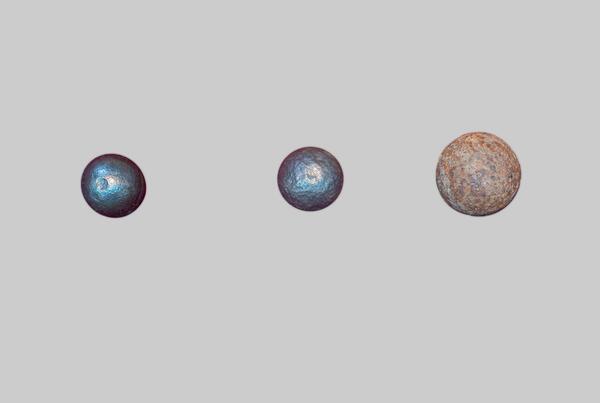
Collection of weapons of Kuznetsk fortress museum contains case-shot bullets, a kind of artillery shells. It consists of a thon-wall cylinder container with spheral bullets. Case-shot does not have any shell burster or an ignition tube. When a shot is fired, the pressure of powder gases causes the explosion of the container, and the bullets shoot out from the muzzle in wide sheaf. A component of a case-shot is a cast ball of scrap iron with uneven surface, 4 cm in size. The case-shot bullets were found in Kuznetsk, in the site of the Swamp Citadel – a fortification dating end XVIII — early XIX century.
In 1621, Military Regulations on Military, Cannon and Other Matters related to War Science were issued, compiled by OnIsim Mikhailov. The regulations comprised 663 ‘orders’ with quite a detailed description of the status, organization and military use of artillery. The author also mentioned the powder and ‘faceted iron birdshot’ ratio in the shell — ‘a handful of birdshot for a pound of powder’. We can suppose that most likely, he described a prototype of a case-shot grenade or a shrapnel shell.
In those times the artillery guns were muzzle-loading, with a smoothbore barrel. They were loaded with cast iron cannonballs, cast iron spheric powder shells filled in with smoke rifle powder and case-shot. Ammunition weighing up to one ‘pood “(Russian unit of weight -16,38 kg) were called grenades in the Russian army, and those heavier than one pood were called bombs.
In 1784, a British officer Henry Shrapnel suggested an improvement for the grenades and bombs by putting spheric bullets mixed with powder inside the shells. Another important feature of the guns using such ammunition was the fact that the length of the ignition case primer could be easily changed right before the shot. It allowed calculating approximate trajectory and time of the shell explosion. It was assumed that such ammunitions will be mainly used against infantry and cavalry But the British Military Ministry only accepted the proposed ammunitions for service in November 1803.
Case-shot turned to be especially efficient upon changing the combat tactics in open battlefield from linear to perpendicular. The bullets laid in an explosive frame spread over a certain sector from the gun bore and inflicted maximal damage to the enemy.
In 1621, Military Regulations on Military, Cannon and Other Matters related to War Science were issued, compiled by OnIsim Mikhailov. The regulations comprised 663 ‘orders’ with quite a detailed description of the status, organization and military use of artillery. The author also mentioned the powder and ‘faceted iron birdshot’ ratio in the shell — ‘a handful of birdshot for a pound of powder’. We can suppose that most likely, he described a prototype of a case-shot grenade or a shrapnel shell.
In those times the artillery guns were muzzle-loading, with a smoothbore barrel. They were loaded with cast iron cannonballs, cast iron spheric powder shells filled in with smoke rifle powder and case-shot. Ammunition weighing up to one ‘pood “(Russian unit of weight -16,38 kg) were called grenades in the Russian army, and those heavier than one pood were called bombs.
In 1784, a British officer Henry Shrapnel suggested an improvement for the grenades and bombs by putting spheric bullets mixed with powder inside the shells. Another important feature of the guns using such ammunition was the fact that the length of the ignition case primer could be easily changed right before the shot. It allowed calculating approximate trajectory and time of the shell explosion. It was assumed that such ammunitions will be mainly used against infantry and cavalry But the British Military Ministry only accepted the proposed ammunitions for service in November 1803.
Case-shot turned to be especially efficient upon changing the combat tactics in open battlefield from linear to perpendicular. The bullets laid in an explosive frame spread over a certain sector from the gun bore and inflicted maximal damage to the enemy.
#8
Full name Case-shot
Date late XVIII - early XIX century
Place Russia
Technique casting
Dimensions diameter- 4 cm
Copyright Kuznetsk fortress
Collection Kuznetsk fortress
Restorers Scheglakov A.P.
Goskatalog Number 10800535
Date late XVIII - early XIX century
Place Russia
Technique casting
Dimensions diameter- 4 cm
Copyright Kuznetsk fortress
Collection Kuznetsk fortress
Restorers Scheglakov A.P.
Goskatalog Number 10800535
#13
Flail weight
#4
#9
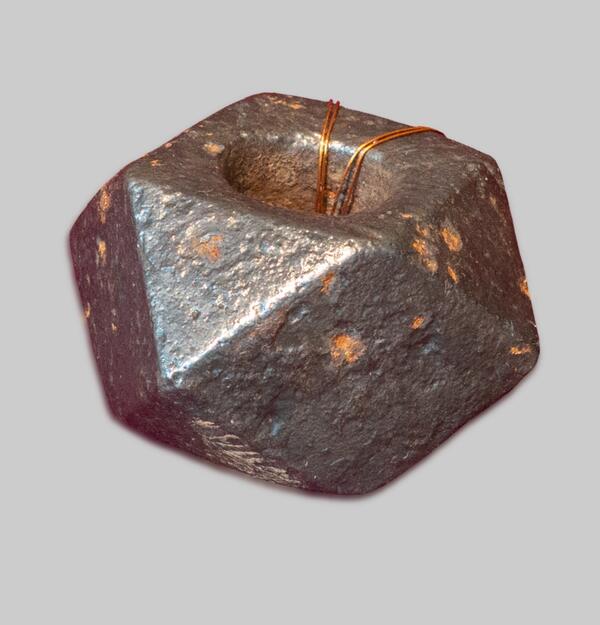
Flail weight from the museum collection was found during excavations in the village of Shestaki, Belovsky district, Kemerovo region. It is a polyhedron flattened from above and from below, with a cylinder aperture inside.
A flail is a close combat cold weapon consisting of several parts. The weight is a heavy piece of forged iron with a through hole where supposedly a suspension device was attached – a belt, a swingle or a strong rope. The swingle could be attached to a wooden handle (kistenIsche). The weight resembles a balance weight of a very simple balance scale – a weight beam. As the aperture is widened, it can be supposed that the weight was either used repeatedly or was initially forged for a flail.
The flail with a metal weight was most popular in Russia in the XII–XIII cent. According to the Russian and Soviet archaeologist Anatoly Kirpichnikov, the flail in Ancient Russia was first of all deemed to be an item of military equipment of a mounted warrior used as an auxiliary weapon. In a short battle with a mounted enemy a flail could allow making a quick and sudden strike neutralizing the adversary.
In Siberia, the flail started to spread since the time of Yermak”s military expeditions. The weapon was used by the Russian service class people. Later, over XVIII -early XX cent., flails were widely used by the civilian population of the Russian Empire as a self-protection weapon.
‘As a rule, cab drivers had no fire weapons with them but they always had an axe or a flail in their horse carts or at the head of sleigh. The story went that there was a situation when a robber attacked a cab driver the latter immediately hit him with the flail in the head and fractured the scull’
There exists a version that the Russian name (kistEn) is of Turk origin: kistän is translated as ‘cudgel’, ‘stick’. According to another version, ‘kistEn’ in Russian resembles the words ‘wrist’ or ‘hand’: it was on the wrist that the flail loop – temlyAk – was put. It is also possible that the name of the weapon comes from its resemblance with fringes (kIsti), i.e., bunches of fibre or laces decorating the belts. Apart from that, the researchers propose another version of the weapon name originating from ‘kysten’ and Old Slavic ‘kydati’. The latter is linked to relevant word in Sanscrit meaning ‘tear, throw’.
A flail is a close combat cold weapon consisting of several parts. The weight is a heavy piece of forged iron with a through hole where supposedly a suspension device was attached – a belt, a swingle or a strong rope. The swingle could be attached to a wooden handle (kistenIsche). The weight resembles a balance weight of a very simple balance scale – a weight beam. As the aperture is widened, it can be supposed that the weight was either used repeatedly or was initially forged for a flail.
The flail with a metal weight was most popular in Russia in the XII–XIII cent. According to the Russian and Soviet archaeologist Anatoly Kirpichnikov, the flail in Ancient Russia was first of all deemed to be an item of military equipment of a mounted warrior used as an auxiliary weapon. In a short battle with a mounted enemy a flail could allow making a quick and sudden strike neutralizing the adversary.
In Siberia, the flail started to spread since the time of Yermak”s military expeditions. The weapon was used by the Russian service class people. Later, over XVIII -early XX cent., flails were widely used by the civilian population of the Russian Empire as a self-protection weapon.
‘As a rule, cab drivers had no fire weapons with them but they always had an axe or a flail in their horse carts or at the head of sleigh. The story went that there was a situation when a robber attacked a cab driver the latter immediately hit him with the flail in the head and fractured the scull’
Old-timers remember the cases of using flails while transporting the goods from Kuznetsk to Tomsk
There exists a version that the Russian name (kistEn) is of Turk origin: kistän is translated as ‘cudgel’, ‘stick’. According to another version, ‘kistEn’ in Russian resembles the words ‘wrist’ or ‘hand’: it was on the wrist that the flail loop – temlyAk – was put. It is also possible that the name of the weapon comes from its resemblance with fringes (kIsti), i.e., bunches of fibre or laces decorating the belts. Apart from that, the researchers propose another version of the weapon name originating from ‘kysten’ and Old Slavic ‘kydati’. The latter is linked to relevant word in Sanscrit meaning ‘tear, throw’.
#10
Full name Flail nut
Date late XVIII- early XIX century
Technique iron, forging
Place derevnya Shestaki, Belovskij rajon, Kemerovskaya oblast', Russia
Dimensions 5,5×5,5×4 cm
Copyright Kuznetsk fortress
Collection Weaponry collection of Kuznetsk fortress museum
Restorers Scheglakov A.P.
Date late XVIII- early XIX century
Technique iron, forging
Place derevnya Shestaki, Belovskij rajon, Kemerovskaya oblast', Russia
Dimensions 5,5×5,5×4 cm
Copyright Kuznetsk fortress
Collection Weaponry collection of Kuznetsk fortress museum
Restorers Scheglakov A.P.
read morehide
00:00
00:00
1x
3
 Point your smartphone camera to open in the app
Open in app
Share