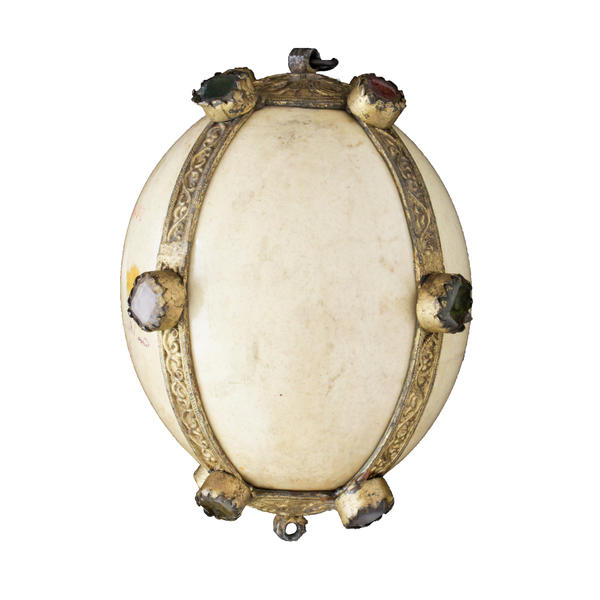
The perfectly preserved ostrich egg came to the Arkhangelsk Provincial Museum (now the Arkhangelsk Regional Museum) from the sacristy of the abolished Solovetsky Monastery in 1923. Together with other objects, it was selected by members of a special commission of the People’s Commissariat of Education (Narcompros) in 1922 for the museum. In May 1923, a terrible fire occurred in the Solovetsky Monastery, and the fragile object left in the sacristy of the cathedral miraculously survived.
A real ostrich egg of yellowish colour is enclosed in a decorative frame of yellow metal, which repeats its shape. The frame consists of two round convex plates connected by four narrow metal strips.
Twelve coloured glass pieces imitating precious stones are attached to the frame. They are encased in high metal settings that hold them with their solid frames with a serrated edge.
On the upper and lower plates there are holes for suspension: the top for attaching the entire structure to the chandelier, a decorative tassel is attached on the bottom. The details of the frame are decorated with embossed floral ornaments and gilding.
Ostrich eggs are a decorative detail in churches, meant to be suspended from a chandelier. In Russian it is called “strofokafmilov egg”, “strofokamil” being an old Russian word for ostrich. The word appears to be of Greek origin. Translated into Russian, “στρουθοκάμηλος” means “ostrich”. A real (or artificial) ostrich egg was decorated with metal, sometimes precious, and attached at the bottom of the chandelier, often complemented by tassels of silk and gold threads.