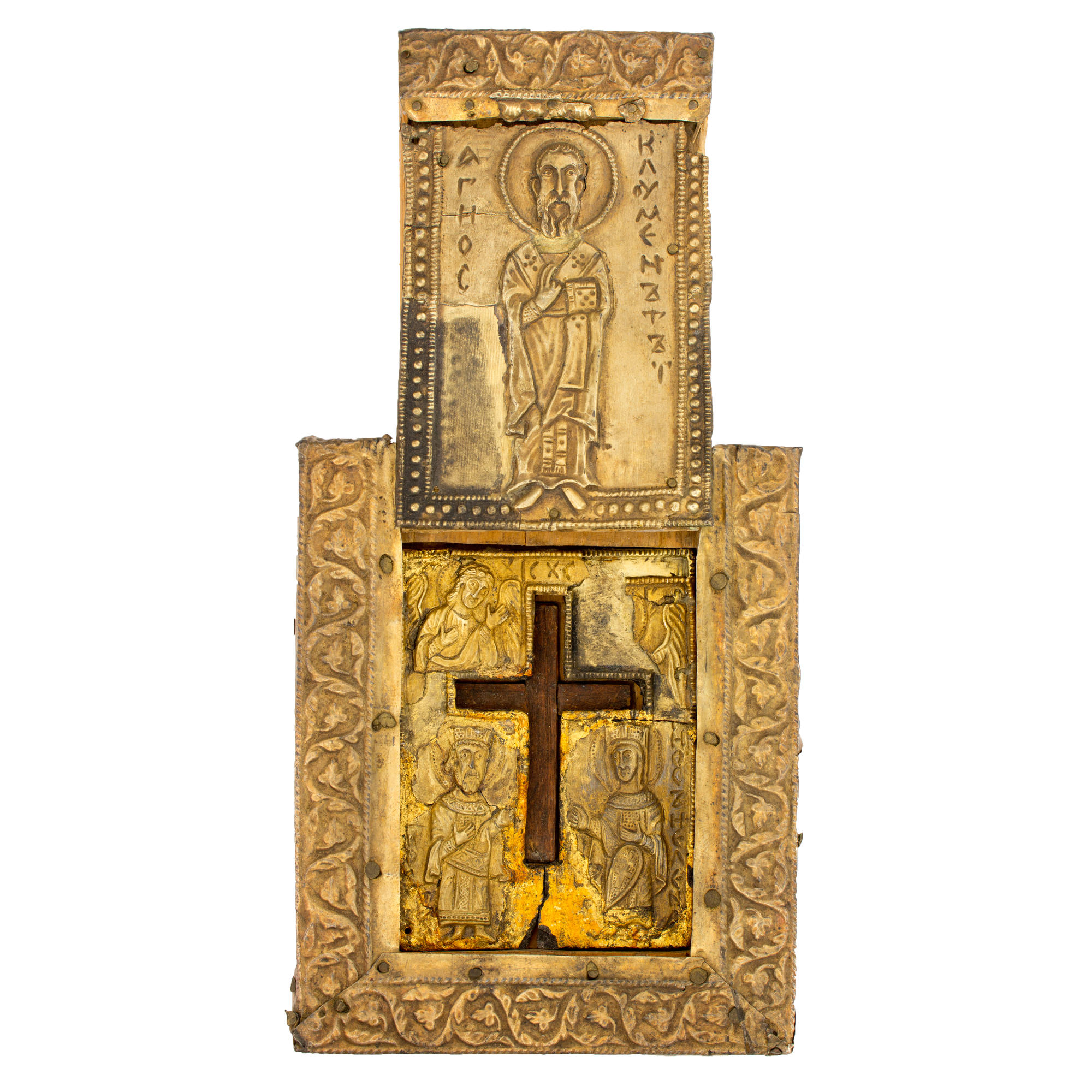


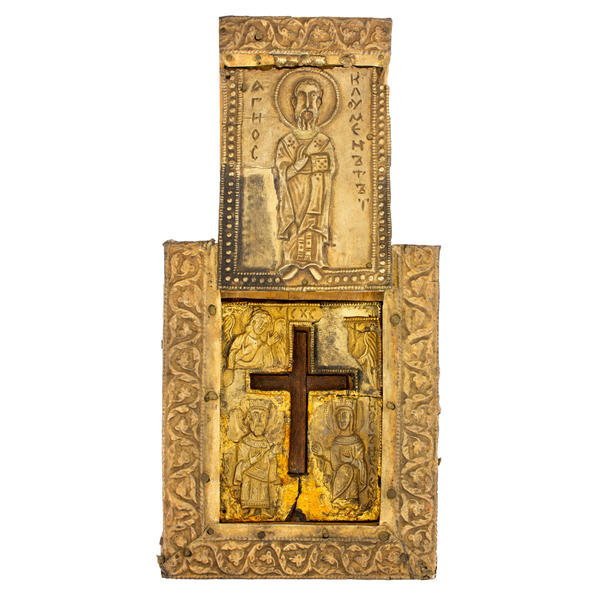
The reliquary is a repository for particles of the cross. It is a wooden box with a retractable lid and a cross-shaped alcove at the bottom of the ark, into which a four-pointed wooden cross is inserted. The object was made in Novgorod in the first half of the 12th century and is a rare relic, the oldest Russian cross reliquary of the pre-Mongol period. The master who cut the reliquary was definitely well acquainted with the Byzantine examples of the 11th century.
The reliquary was kept in the sacristy of the Holy Trinity Antonievo-Siysky Monastery. It entered the museum in the early 1920s after the monastery was closed. In 1974, the reliquary was exhibited in the USSR Academy of Arts — at the exhibition of works restored at the Grabar Conservation Centre. Later it was exhibited in Leningrad at the State Russian Museum.
The ark is covered with silver gilded plates with a stamped image of St. Clement, Pope of Rome, on the lid. On the sides of the figure of the saint are Slavic inscriptions. Inside the ark, on both sides of the cross-shaped alcove, the images of Saints Constantine and Helena, as well as half-length images of two angels, are engraved. Constantine and Helena are depicted in royal robes, Constantine is on the right, Helena is on the left of the Cross.
The reliquary was restored in the Antonievo-Siysky Monastery at the turn of the 16th-17th centuries. This is evidenced by a copper gilded basma along the edges of the reliquary, decorated with an ornament of a winding vine stylized to look antique.
Pope Clement (92-101) was a disciple and associate of the Apostle Peter, who was widely revered in Russia. According to the legend, for the preaching of Christianity, Clement was expelled from Rome by Emperor Trajan and sent to hard labour in the quarries of Crimea. For continuing the Christian service in exile, he was drowned in the sea near Chersoneses. Clement was especially loved in Novgorod. His memory is celebrated on November 25 (December 7).
The reliquary was kept in the sacristy of the Holy Trinity Antonievo-Siysky Monastery. It entered the museum in the early 1920s after the monastery was closed. In 1974, the reliquary was exhibited in the USSR Academy of Arts — at the exhibition of works restored at the Grabar Conservation Centre. Later it was exhibited in Leningrad at the State Russian Museum.
The ark is covered with silver gilded plates with a stamped image of St. Clement, Pope of Rome, on the lid. On the sides of the figure of the saint are Slavic inscriptions. Inside the ark, on both sides of the cross-shaped alcove, the images of Saints Constantine and Helena, as well as half-length images of two angels, are engraved. Constantine and Helena are depicted in royal robes, Constantine is on the right, Helena is on the left of the Cross.
The reliquary was restored in the Antonievo-Siysky Monastery at the turn of the 16th-17th centuries. This is evidenced by a copper gilded basma along the edges of the reliquary, decorated with an ornament of a winding vine stylized to look antique.
Pope Clement (92-101) was a disciple and associate of the Apostle Peter, who was widely revered in Russia. According to the legend, for the preaching of Christianity, Clement was expelled from Rome by Emperor Trajan and sent to hard labour in the quarries of Crimea. For continuing the Christian service in exile, he was drowned in the sea near Chersoneses. Clement was especially loved in Novgorod. His memory is celebrated on November 25 (December 7).