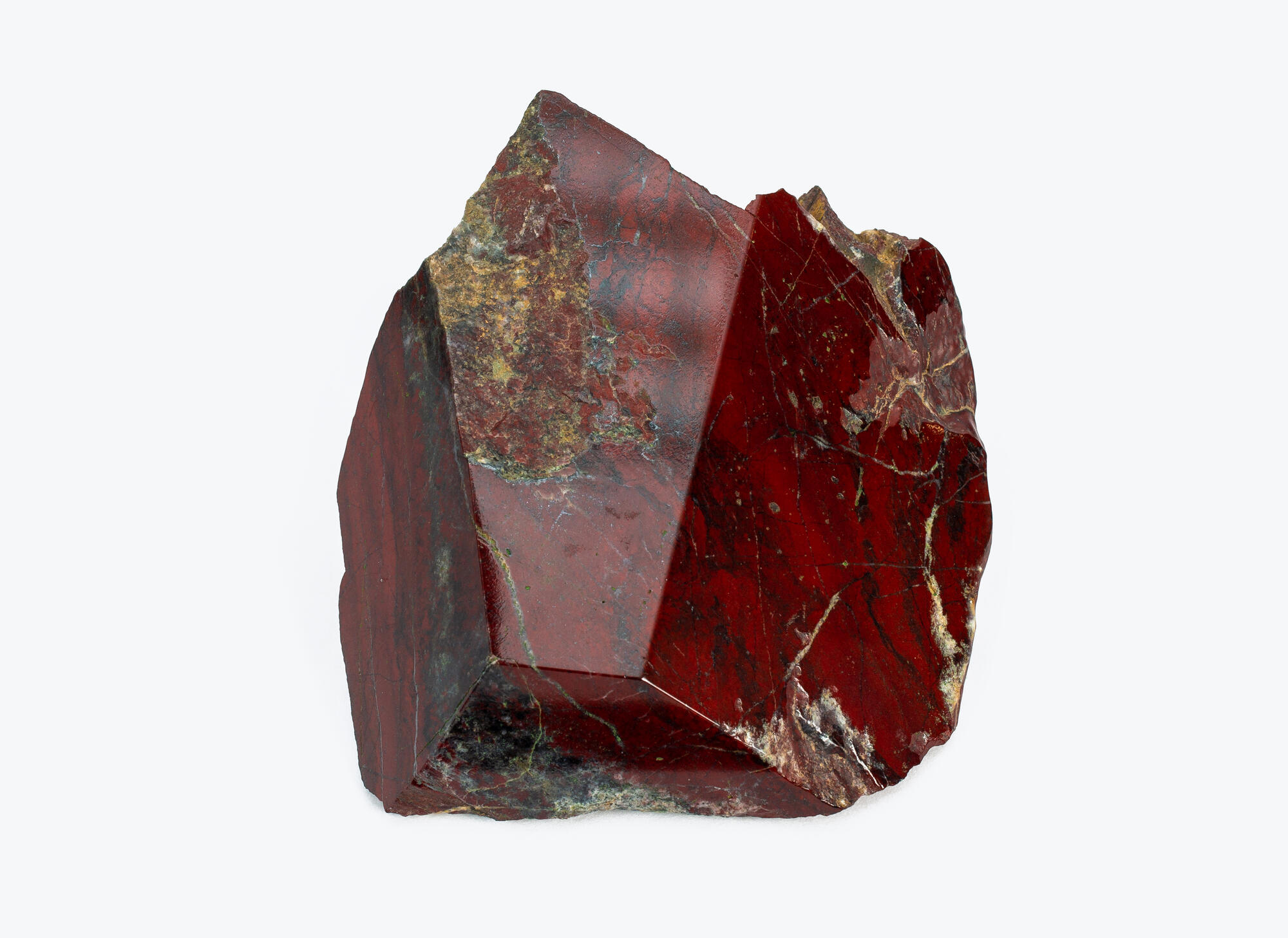


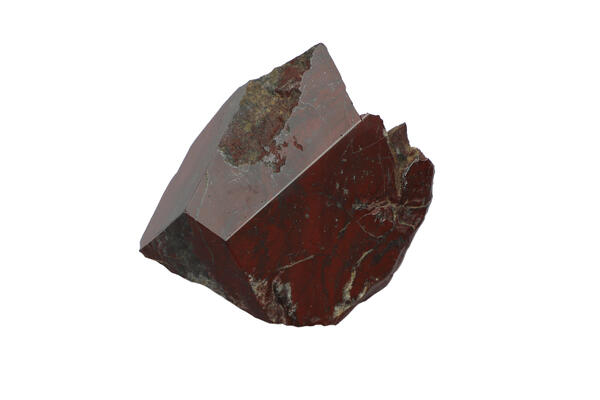
The collection of the Verkhnyaya Pyshma Historical Museum houses a small piece of a rare rock called jasper. Its name is translated from Greek as ‘spotted or speckled stone.’
There are more than 100 known varieties of jasper. In nature, these stones have red to dark blue shades and various structure: striped, with a mesh pattern, or with white or black spots. Monochromatic jasper is considered very rare.
In the Urals, there is a ‘jasper belt’ — a narrow area of deposits, which is about 1200 kilometers long. It passes through the territory of the Sverdlovsk and Chelyabinsk regions, the Republic of Bashkortostan and further south, through the Orenburg region.
Millions of years ago, in the area of the modern Ural Mountains, there was a sea surrounded by many volcanoes. Due to their constant eruptions, marine animals died, and their skeletons, mixed with lava, settled on the ocean floor. Over time, the mass turned into stone and acquired the structure of a silicon rock. This is how layers of jasper appeared on the site of the sea.
In terms of chemical composition, jasper is represented by quartz grains cemented by clay. It is composed of quartz and chalcedony, which make the stone especially hard, as well as of oxides of iron and manganese — they determine the color and pattern of the mineral.
People began to find and use jasper since the Neolithic period, in the 6th — 4th millennium BC. Due to its solid and hard surface, the stone became widely used in the production of tools, as well as arrowheads and spears — this is proved by the archaeological finds at the sites of Neanderthal camps in different regions.
Jasper deposits are found all over the world. In the Urals, the mineral was discovered by miners: Kirill Obvishchev, as well as his father and his son Fyodor and Pyotr Babin. In the mid-18th century, they found stones of green and red brindle colors on the Tura River. The lower the workers went downstream, the more jasper they found.
Now there are large and well-known deposits in European countries — the Czech Republic, Germany, France, as well as in the USA, India, Egypt and Russia. In Russia, jasper is mined in the Urals and Altai. It is used to make jewelry, vases and decorative figurines.
There are more than 100 known varieties of jasper. In nature, these stones have red to dark blue shades and various structure: striped, with a mesh pattern, or with white or black spots. Monochromatic jasper is considered very rare.
In the Urals, there is a ‘jasper belt’ — a narrow area of deposits, which is about 1200 kilometers long. It passes through the territory of the Sverdlovsk and Chelyabinsk regions, the Republic of Bashkortostan and further south, through the Orenburg region.
Millions of years ago, in the area of the modern Ural Mountains, there was a sea surrounded by many volcanoes. Due to their constant eruptions, marine animals died, and their skeletons, mixed with lava, settled on the ocean floor. Over time, the mass turned into stone and acquired the structure of a silicon rock. This is how layers of jasper appeared on the site of the sea.
In terms of chemical composition, jasper is represented by quartz grains cemented by clay. It is composed of quartz and chalcedony, which make the stone especially hard, as well as of oxides of iron and manganese — they determine the color and pattern of the mineral.
People began to find and use jasper since the Neolithic period, in the 6th — 4th millennium BC. Due to its solid and hard surface, the stone became widely used in the production of tools, as well as arrowheads and spears — this is proved by the archaeological finds at the sites of Neanderthal camps in different regions.
Jasper deposits are found all over the world. In the Urals, the mineral was discovered by miners: Kirill Obvishchev, as well as his father and his son Fyodor and Pyotr Babin. In the mid-18th century, they found stones of green and red brindle colors on the Tura River. The lower the workers went downstream, the more jasper they found.
Now there are large and well-known deposits in European countries — the Czech Republic, Germany, France, as well as in the USA, India, Egypt and Russia. In Russia, jasper is mined in the Urals and Altai. It is used to make jewelry, vases and decorative figurines.