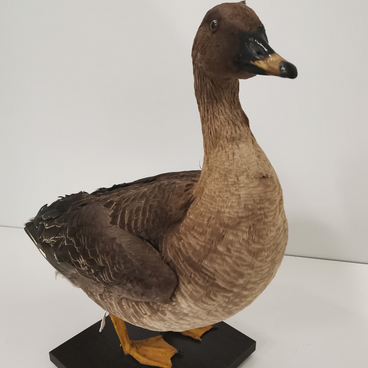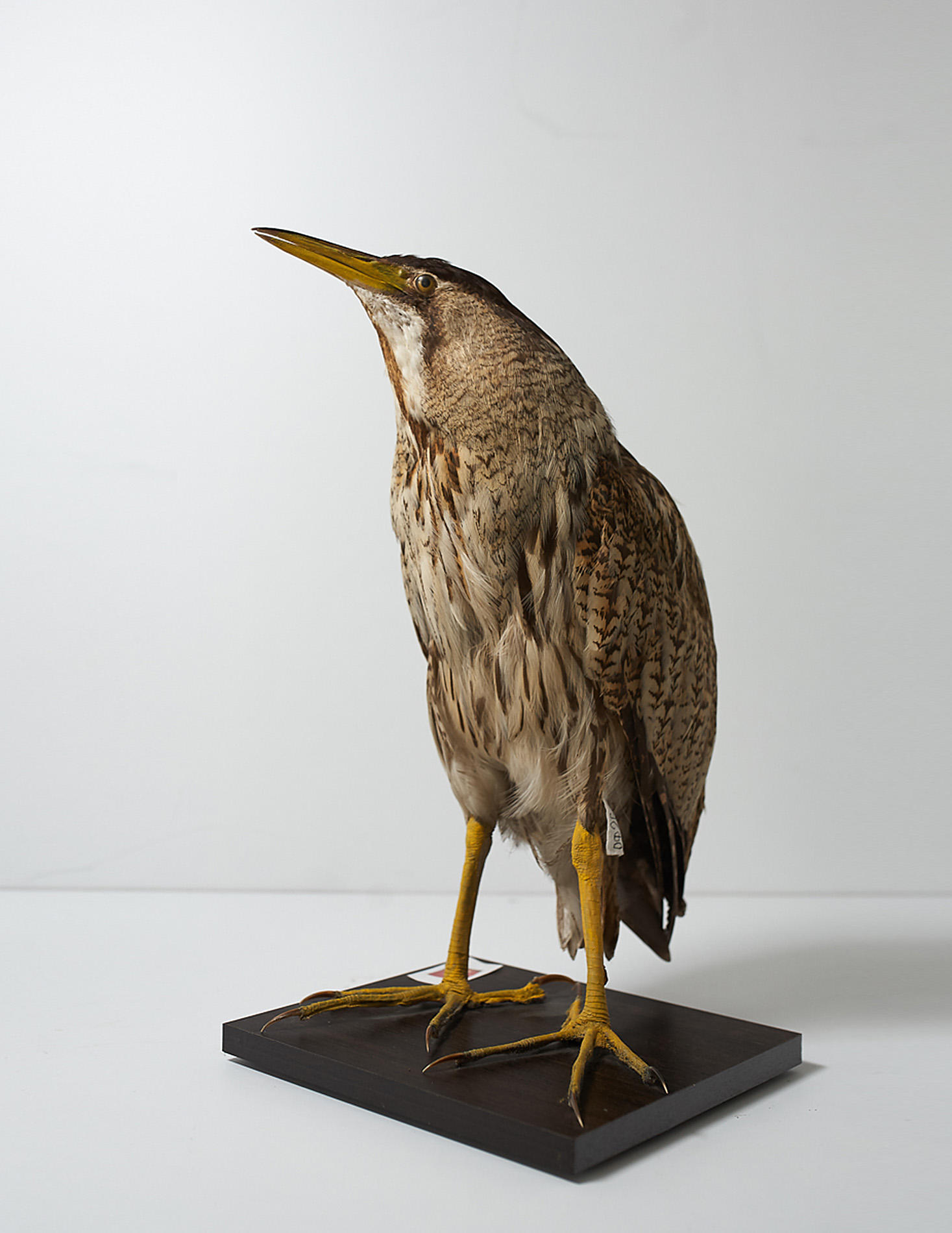


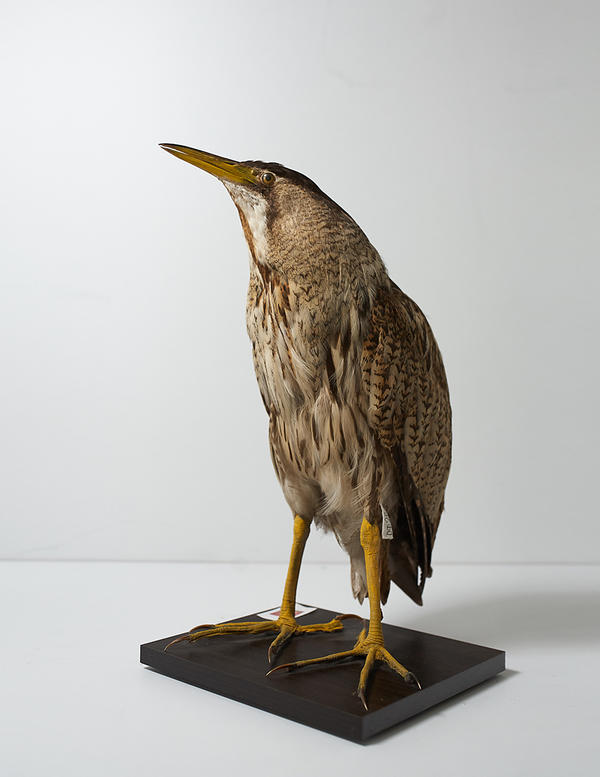
Bittern belongs to the same biological family as herons. The height of an adult bird is about 70 cm, the weight of the female is 1 kg; the male is twice as heavy. Its legs are not long, allowing it to wander in shallow water; however, bittern does not dare to go deeper. Therefore, it lives in thickets of alder, willow and reed on the banks of quiet rivers and lakes, abandoned peat bogs, reed floodplains and swamps. Its wings reach up to 1.3 m in width. Bittern migrates to the south in winter, returning home in April to May to build a nest on some quiet island. Its nest looks like a simple bunch of reed stalks and leaves with a hole on top. In that hole, the bird will lay up to 6 eggs.
Bittern feeds on fish and frogs, catching them from an ambush with its serrated beak. It ravages neighboring nests, so it does not go far from its own nest. It feeds its hatchlings with tadpoles. Bittern is difficult to notice even standing very close by. From its snow-white relative familiar to all, it differs not only in size, but also in color. The feathers on its back are black with yellow rims, and the feathers on its belly are ocher colored with transverse stripes. Its legs are light green, and its beak is black. At the slightest danger, bittern stands bolt upright, raises its beak high and freezes. In this position, it merges with the thickets completely, and is able to remain motionless for hours. However, at the same time it vigilantly monitors fish and amphibians swimming nearby and is capable of attacking at any second.
Not everyone is lucky to see this bird, but many have heard it. Bittern’s voice coming from the foggy swamp can come as a serious scare. It resembles the splashing of feet on water, the dull bull roar, the gurgling of water, the sighs of mermaids, the crying of children. It is possible that many of the stories that tourists tell about the “unknown creatures” wandering around their tents by night are caused by these strange sounds. The bird emits them inflating its esophagus and turning it into an excellent resonator. The Russian form of its name is clearly derived from the words “howl” and “yell”.
In fact, bittern is harmless if you don’t touch it. But it can also seriously injure your hands and eyes with its sharp beak, if it gets cornered. So it’s better not to touch it, especially bearing in mind that the bird is listed in the Red Book of Russia and Kemerovo Region.
Bittern feeds on fish and frogs, catching them from an ambush with its serrated beak. It ravages neighboring nests, so it does not go far from its own nest. It feeds its hatchlings with tadpoles. Bittern is difficult to notice even standing very close by. From its snow-white relative familiar to all, it differs not only in size, but also in color. The feathers on its back are black with yellow rims, and the feathers on its belly are ocher colored with transverse stripes. Its legs are light green, and its beak is black. At the slightest danger, bittern stands bolt upright, raises its beak high and freezes. In this position, it merges with the thickets completely, and is able to remain motionless for hours. However, at the same time it vigilantly monitors fish and amphibians swimming nearby and is capable of attacking at any second.
Not everyone is lucky to see this bird, but many have heard it. Bittern’s voice coming from the foggy swamp can come as a serious scare. It resembles the splashing of feet on water, the dull bull roar, the gurgling of water, the sighs of mermaids, the crying of children. It is possible that many of the stories that tourists tell about the “unknown creatures” wandering around their tents by night are caused by these strange sounds. The bird emits them inflating its esophagus and turning it into an excellent resonator. The Russian form of its name is clearly derived from the words “howl” and “yell”.
In fact, bittern is harmless if you don’t touch it. But it can also seriously injure your hands and eyes with its sharp beak, if it gets cornered. So it’s better not to touch it, especially bearing in mind that the bird is listed in the Red Book of Russia and Kemerovo Region.