The Mesozoic Era is often referred to as a thermoera due to the fact that a warm tropical climate reigned throughout the Earth. At the time, dinosaurs lived everywhere, even on the territory of modern Antarctica.
The diet of the giant reptiles had always been full of fresh and tasteful greens due to the lack of seasonal changes. The body of the sauropod was just perfectly adapted to the environment — its long neck, up to 11 meters long, made it possible to calmly crop multiple trees without leaving the spot. The mass of individual animals reached up to 35 tons.
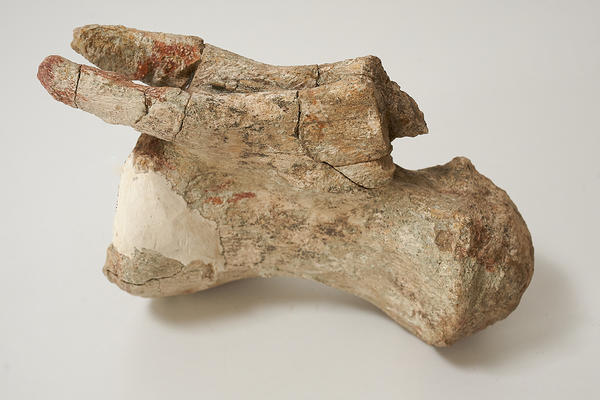
The caudal vertebra of the ancient lizard was discovered by archaeologists of the Kemerovo Oblast Museum of Local History in the summer of 2018 during excavations in the village of Shestakovo. The find weights 5 kg and at the very first glance, it becomes clear how enormous its owner was.
Of course, it was a common thing to come across the fossil remains of dinosaurs during Antiquity and Middle Ages, but for the time being they remained unidentified. The first record of them appeared only in 1699 in the work of the Welsh scientist Edward Lluyd.
The bones of the largest known sauropod were excavated in Australia in 2004, the animal’s body length was 30 m long. A 90-metre long series of tracks with a characteristic claw on the thumb was discovered in Morocco in 1979. The Guinness Book of Records estimated that Breviparopus (that is the name given to the owner of the tracks) was 48 m long based on the size of the trail — 115×90 cm, but not a single animal fragment was ever found.
The supercontinent Gondwana located in the southern hemisphere is considered to be the birthplace of the prosauropods. From there they settled around the world. The evolution of the sauropods demonstrates the amazing possibilities of adapting to changing living conditions resulting in extraordinary variety of species. Their ancestors walked on two legs, then they began to use both methods of movement, and afterwards they finally started walking on four limbs.
The sauropods have become one of the most recognizable groups of dinosaurs in popular culture due to their immense size. They had thick, elephant-like legs and a relatively small head, which was only 1/200 of total body capacity. Oddly enough, their skulls are very rarely found, therefore, only a third of species appearance has been reconstructed.
The sauropods fed on conifers and ferns. They moved in herds for more effective defense against predators. Smaller species fled, while larger ones rose to their hind legs and met the enemy with their front claws. They defended themselves with the help of a powerful whip-like tail, which was also used during the mating period — deafening blows to the ground made with it helped the male win the female’s affection.
Various reptiles were decorated with spikes and crests. This visually increased their size and could serve as means for recognition by relatives as one of their own or indicate attainment of puberty.
Like other dinosaurs, the sauropods disappeared from the face of the Earth as a result of the great mass extinction that marked the end of the Mesozoic Era. The global catastrophe was apparently caused by the fall of a gigantic celestial body from outer space on our planet.
The diet of the giant reptiles had always been full of fresh and tasteful greens due to the lack of seasonal changes. The body of the sauropod was just perfectly adapted to the environment — its long neck, up to 11 meters long, made it possible to calmly crop multiple trees without leaving the spot. The mass of individual animals reached up to 35 tons.
The caudal vertebra of the ancient lizard was discovered by archaeologists of the Kemerovo Oblast Museum of Local History in the summer of 2018 during excavations in the village of Shestakovo. The find weights 5 kg and at the very first glance, it becomes clear how enormous its owner was.
Of course, it was a common thing to come across the fossil remains of dinosaurs during Antiquity and Middle Ages, but for the time being they remained unidentified. The first record of them appeared only in 1699 in the work of the Welsh scientist Edward Lluyd.
The bones of the largest known sauropod were excavated in Australia in 2004, the animal’s body length was 30 m long. A 90-metre long series of tracks with a characteristic claw on the thumb was discovered in Morocco in 1979. The Guinness Book of Records estimated that Breviparopus (that is the name given to the owner of the tracks) was 48 m long based on the size of the trail — 115×90 cm, but not a single animal fragment was ever found.
The supercontinent Gondwana located in the southern hemisphere is considered to be the birthplace of the prosauropods. From there they settled around the world. The evolution of the sauropods demonstrates the amazing possibilities of adapting to changing living conditions resulting in extraordinary variety of species. Their ancestors walked on two legs, then they began to use both methods of movement, and afterwards they finally started walking on four limbs.
The sauropods have become one of the most recognizable groups of dinosaurs in popular culture due to their immense size. They had thick, elephant-like legs and a relatively small head, which was only 1/200 of total body capacity. Oddly enough, their skulls are very rarely found, therefore, only a third of species appearance has been reconstructed.
The sauropods fed on conifers and ferns. They moved in herds for more effective defense against predators. Smaller species fled, while larger ones rose to their hind legs and met the enemy with their front claws. They defended themselves with the help of a powerful whip-like tail, which was also used during the mating period — deafening blows to the ground made with it helped the male win the female’s affection.
Various reptiles were decorated with spikes and crests. This visually increased their size and could serve as means for recognition by relatives as one of their own or indicate attainment of puberty.
Like other dinosaurs, the sauropods disappeared from the face of the Earth as a result of the great mass extinction that marked the end of the Mesozoic Era. The global catastrophe was apparently caused by the fall of a gigantic celestial body from outer space on our planet.