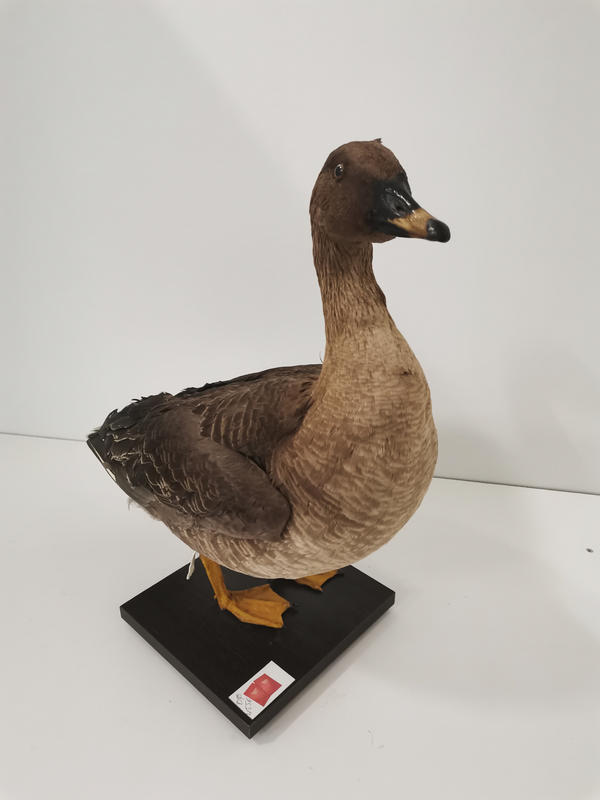
Bean Goose belongs to the group of Anseriformes, the family of Anatidae. It is quite a big bird. Its body length is 65-85 cm, the weight varies from 2.5 to 4.5 kg, the wingspan reaches 1.75 m. Females are smaller than males, this is the only external difference between them.
The name of the species is associated with the word ‘barn’, meaning a fenced area where grain is stored, which suggests the food preferences of the birds. However, they have nothing against fresh young grass, reed shoots and berries, they especially like blueberries and cranberries.
The diet of chicks, that need protein, includes clams, crustaceans and insects. But with age, vegetarian preferences win the final victory.
Feathers on the back of the Bean Geese are dark brown with light rims, saturated with fat along the entire length. Black beak with an orange-red stripe in the middle and bright paws, the color of which depends on the habitat, stand out sharply against the background of the unshowy feathers. The voice of the Bean Goose is sharp, abrupt, it is answered to by geese of other breeds. A flying flock makes a low-frequency monotonous cackling, which can be heard even from a great distance.
Birds graze on meadows throughout the day and only at dusk they return to the water for rest. They feel confident on land, can walk for a long time and even know how to run fast. The Bean Geese walk straight, with an air of importance, they do not waddle, like ducks, and run away in case of danger.
Couples get married once for a lifetime. Bean Geese choose partners during winter season and move north early in spring, when the snow is beginning to melt. Flocks go on a journey under the leadership of an experienced leader. The birds need to run to take off. The most daring and strong individuals fly in the front, securing the relatives, in the event of an impending danger the leader soars up sharply.
The geese fly, often echoing each other. The flock can reach an altitude of up to 10 kilometers. In such a rarefied air a human would fall unconscious. The birds arrive to North Europe in early April, while those who choose cooler regions — Taimyr, Spitzbergen, Kolyma — should not be expected before the end of May.
In the new place the couples begin to arrange their nests. The spouses cover the bottom with moss, last year’s grass, lichen, as well as feathers, torn from their own bodies. The work takes about three weeks.
Finally, eggs appear in the nest, usually there are 4-6 of them, the maximum being 9. At first they have a delicate yellowish tint, but in the process of incubation they change color and get covered with gray spots. The chicks hatch in 25 days.
During that period adults mew. Mewing starts in summer and ends in autumn. Bean Geese join together in groups for the duration of such difficult periods of time to protect themselves against predators.
By the age of one month and a half the chicks start to fly, and their parents regain the freedom to leave the nest for some time. Geese migrate across river valleys and flow meadows until it is time to return to the south.
The name of the species is associated with the word ‘barn’, meaning a fenced area where grain is stored, which suggests the food preferences of the birds. However, they have nothing against fresh young grass, reed shoots and berries, they especially like blueberries and cranberries.
The diet of chicks, that need protein, includes clams, crustaceans and insects. But with age, vegetarian preferences win the final victory.
Feathers on the back of the Bean Geese are dark brown with light rims, saturated with fat along the entire length. Black beak with an orange-red stripe in the middle and bright paws, the color of which depends on the habitat, stand out sharply against the background of the unshowy feathers. The voice of the Bean Goose is sharp, abrupt, it is answered to by geese of other breeds. A flying flock makes a low-frequency monotonous cackling, which can be heard even from a great distance.
Birds graze on meadows throughout the day and only at dusk they return to the water for rest. They feel confident on land, can walk for a long time and even know how to run fast. The Bean Geese walk straight, with an air of importance, they do not waddle, like ducks, and run away in case of danger.
Couples get married once for a lifetime. Bean Geese choose partners during winter season and move north early in spring, when the snow is beginning to melt. Flocks go on a journey under the leadership of an experienced leader. The birds need to run to take off. The most daring and strong individuals fly in the front, securing the relatives, in the event of an impending danger the leader soars up sharply.
The geese fly, often echoing each other. The flock can reach an altitude of up to 10 kilometers. In such a rarefied air a human would fall unconscious. The birds arrive to North Europe in early April, while those who choose cooler regions — Taimyr, Spitzbergen, Kolyma — should not be expected before the end of May.
In the new place the couples begin to arrange their nests. The spouses cover the bottom with moss, last year’s grass, lichen, as well as feathers, torn from their own bodies. The work takes about three weeks.
Finally, eggs appear in the nest, usually there are 4-6 of them, the maximum being 9. At first they have a delicate yellowish tint, but in the process of incubation they change color and get covered with gray spots. The chicks hatch in 25 days.
During that period adults mew. Mewing starts in summer and ends in autumn. Bean Geese join together in groups for the duration of such difficult periods of time to protect themselves against predators.
By the age of one month and a half the chicks start to fly, and their parents regain the freedom to leave the nest for some time. Geese migrate across river valleys and flow meadows until it is time to return to the south.