Stone carving art has become a kind of symbol of Tuvan culture along with throat singing and shamanism. The earliest works date from the late 19th and early 20th centuries, but the traditions of creating small sculptures date back to the legendary Scythian animal style. Art historians claim that the figures carved by Tuvan craftsmen can compete with the best European products of this kind.
The most common ornamental stone in Tuva is agalmatolite, or “chonar-dash” in Tuvan, which means “stone that can be cut”. It is easy to work, which makes it possible to apply intricate patterns.
Another carvable stone is serpentinite. It is usually black or greenish-black. Compared with agalmatolite, serpentinite is much harder, so it is more difficult to work, requiring a lot of skill and patience.
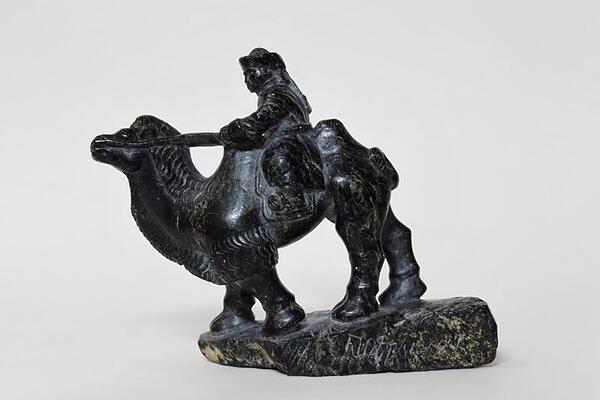
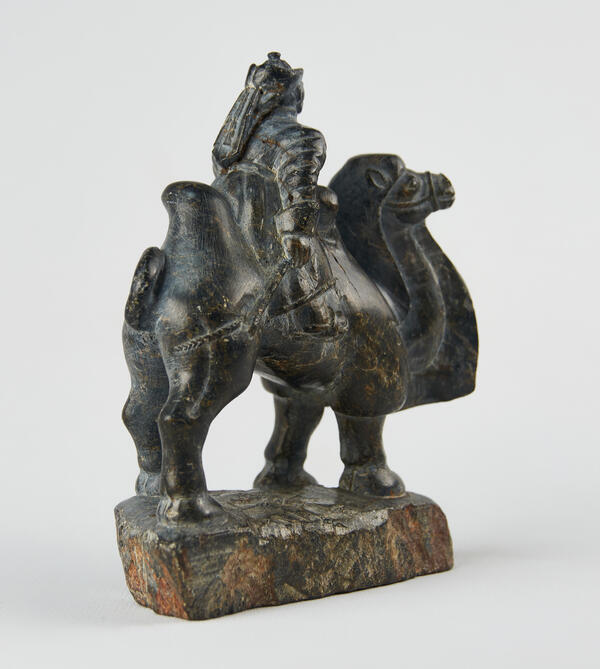
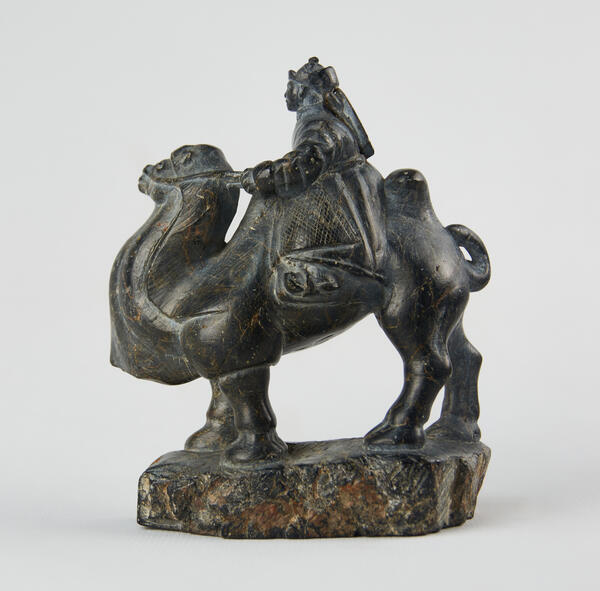
The National Museum of the Republic of Tuva displays the sculptural composition “Camel Rider” made of serpentinite by Mongush Cherzy, one of the founders of stone-carving art of Tuva. Since the 1960s, Cherzy created a lot of sculptures from this stone.
As Mongush Cherzy was born and grew up in a Tuvan yurt, which was the center of the richest layers of the Tuvan people’s traditional culture, he knew the whole range of household utensils, the whole structure of national clothes. Therefore, the rider is presented in the national clothes, where the finest details are shown: the ovuuza headdress, fur coat with a belt, leather shoes with a raised toe.
The decorative and stylized image of the camel is
characteristic of Mongush Cherzy’s work, which symbolizes endurance and
fortitude. The craftsman skillfully conveys the monumental nature of the
camel’s image and its strength by boldly distorting the proportions of the animal’s
body. The camel’s massive limbs appear to have become rooted to the ground. The
camel’s powerful neck is accentuated by a stylized depiction of its hair. The
image of a rider with a camel reflects a philosophical understanding of nomadic
life, filled not only with hard work, but also with unconditional freedom.