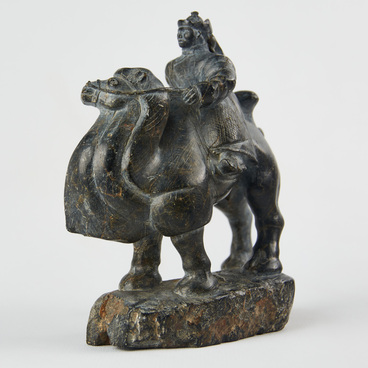
Tuvans always carefully treated headdresses as objects connected with a person’s mind and thoughts, or even with their well-being and life. Thus, a headdress could not be put on a low place. Its careless handling, according to the Tuvan beliefs, could have a negative effect on its owner. Boys were taught from childhood to treat carefully their own hats and with special reverence the hats belonging to their father or older men in the family.
In his yurt a Tuvan man always kept his hat in the place of honor, called dor. When visiting other homes, before taking off his hat, he would look for a sufficiently high and clean place for it, or at least a safe one. If, in his opinion, there was no such place, and the hat had to be removed (in everyday situations men did not wear hats, however on ceremonial occasions they had to have their hats on), he put it on his lap.
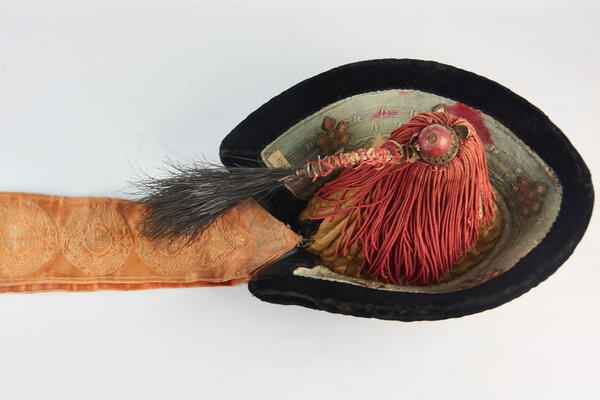
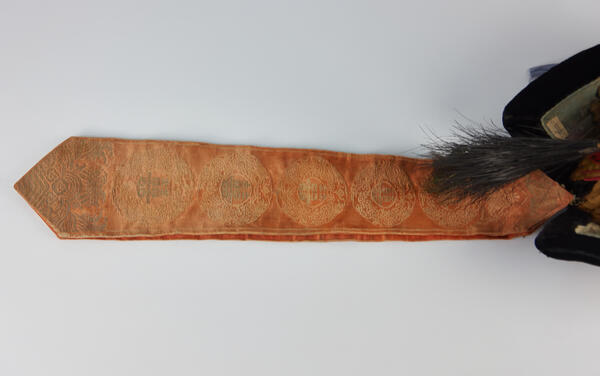
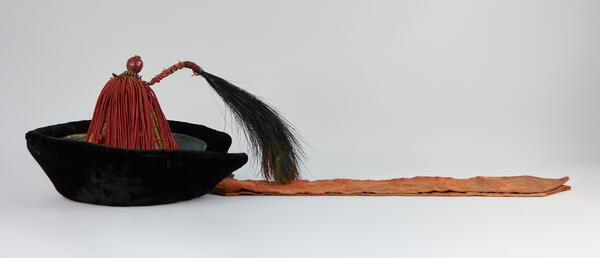
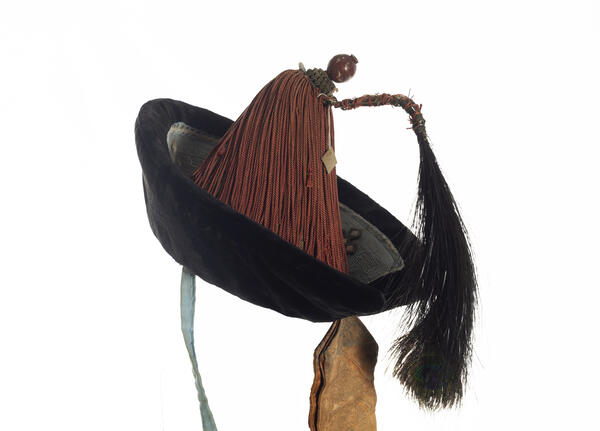
The headdress of a Tuvan noyan — the ruler of a kozhuun, a military-feudal appanage — was the one wearing of which was most regulated. It was a hat with a peaked crown and a flap of black velvet. The top of the hat had a distinctive chinze insignia in the form of a crimson ball made of wood in a metal stand called odaga.
According to the “Decree of the Chinese Chamber of External Affairs”, the princes who were ranked in the first six degrees were granted “…the right to wear a ruby ball on their hats and caps…” The Ambyn-noyan, as a hereditary prince of Tuva, had the right to wear the highest princely insignia — a hat with a ruby ball on the top. He had the fifth degree in the princely hierarchy, called gun (Tuvinians pronounced it like khun, for example khun-noyan).
Since the rank of a man was determined by the
precious stone ball, those who were not devoid of ambition tried to get this or
that gem on their hat. The right to wear a hat with a ruby ball was also
obtained by the noyan Haidyp Uger-daa, who paid for it. On the inside of the
hat there are three embroidered “knot of happiness” (olchei udazyny) patterns,
which mean a symbol of happiness and prosperity. The symbolic nature of the hat
is revealed not only by its shape but also by putting it only on the top of the
head.