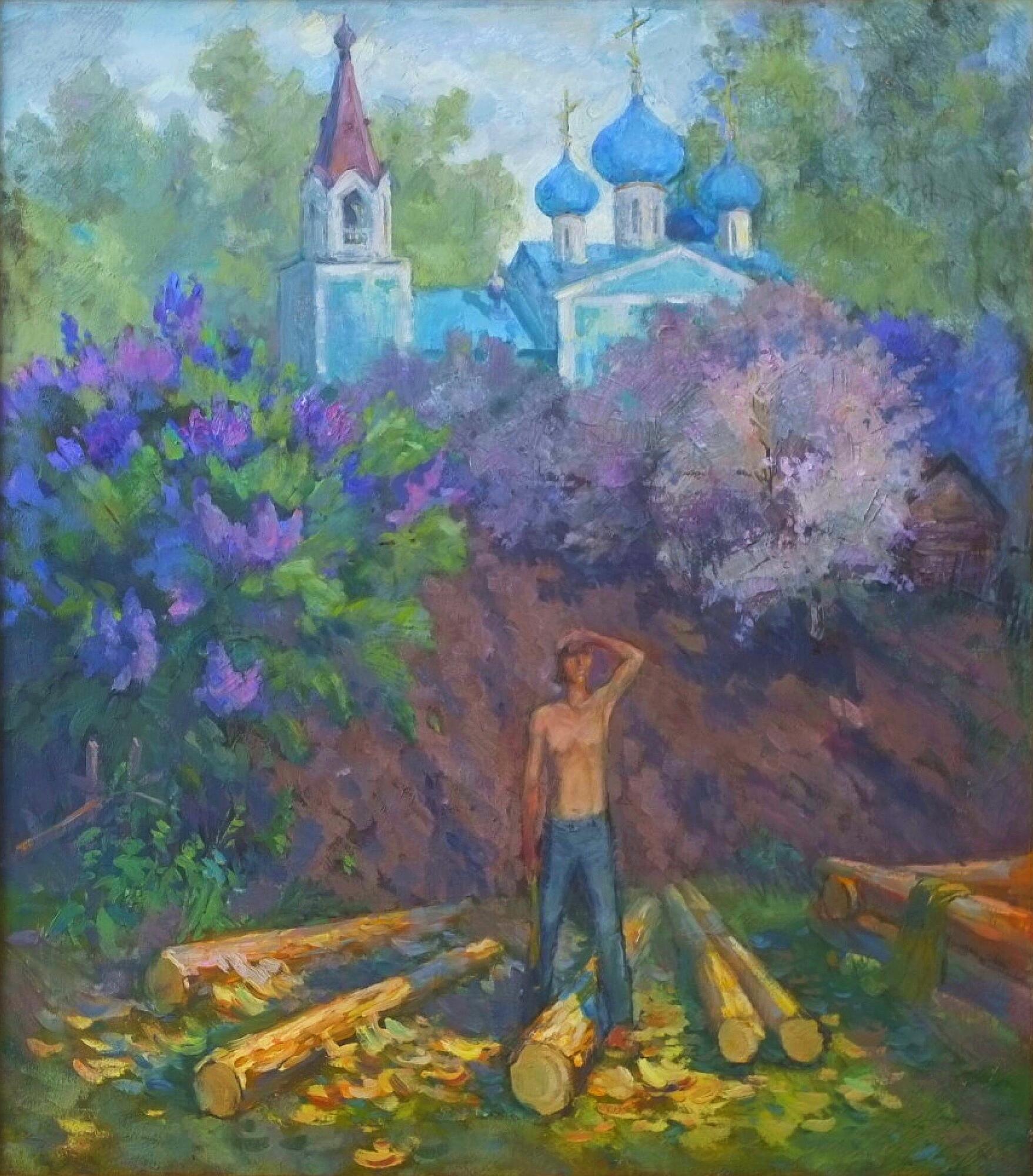


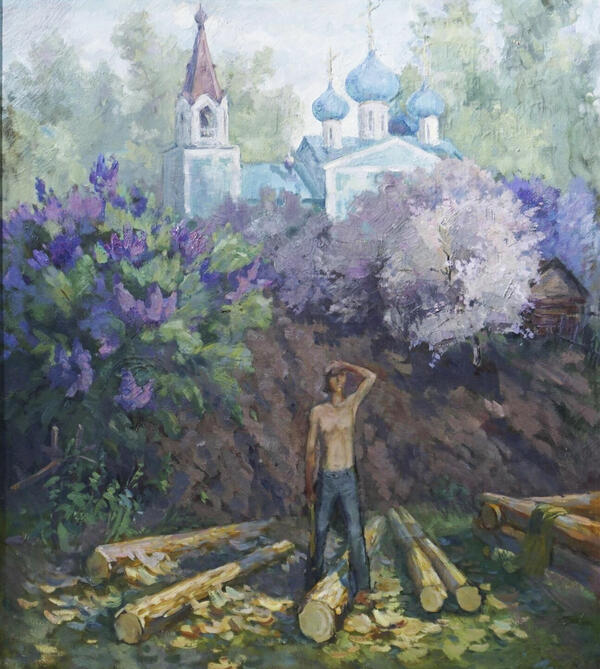
N.V. Sazhina (her full name is unknown), a painter from Nizhny Novgorod, used a simple genre plot for her painting ‘Renaissance’. In the foreground we can see a young man, naked to the waist, wearing blue jeans and holding an ax in his hands — he is hewing logs for the future house. Almost the entire middle distance is taken by lush thickets of lilacs, and the background shows a church with a high bell tower.
Everything in Sazhina’s painting really indicates this rebirth: the spring, the construction of a new house, and the youthfulness of the young man. The church in the background also suggests a spiritual renewal: this picture was painted in the 1990s, when Russia became a secular state anew, and the persecution of believers stopped.
Despite the fact that the painting depicts a village or a small locality, critics believe that it was the Nizhny Novgorod landscapes that Sazhina’s painting was inspired by. They came to this conclusion because of the image of the church, the outlines of which resemble the Church of the Transfiguration of the Savior in Starye Pechyory, located within the limits of the modern Nizhny Novgorod.
This church has an interesting history, as it was built on the site of a lost monastery. In the thirties of the 14th century, the monk Dionysius came here from the Kiev-Pechyorsk Lavra. On the way from the Volga’s lower basin, on the outskirts of the town he dug a cave for himself and settled alone on the right bank of the river. After a while, other monks settled near Dionysius the hermit. This is how the Pechyorsky Ascension Monastery was established, and it was one of the oldest in the Nizhny Novgorod territories.
In June 1597, a natural disaster of great magnitude occurred: a huge landslide came down to the Volga, and the river even changed its course. The bulk of the landslide spared nothing in its way, having destroyed almost all the monastery buildings and opened the entrances to the old caves. The stone Church of the Ascension, the heated church of the Most Holy Mother of God, the high bell tower, the monastery cookery, cells, and the fence were reduced to rubble. The monks had to look for a new place for the monastery, so they moved from the destroyed buildings to about one and a half kilometers up the Volga valley. Only the toponyms “Pechyora” and “Pechyorskaya Sloboda” have been left of the caves where Dionisius the hermit once lived.
Everything in Sazhina’s painting really indicates this rebirth: the spring, the construction of a new house, and the youthfulness of the young man. The church in the background also suggests a spiritual renewal: this picture was painted in the 1990s, when Russia became a secular state anew, and the persecution of believers stopped.
Despite the fact that the painting depicts a village or a small locality, critics believe that it was the Nizhny Novgorod landscapes that Sazhina’s painting was inspired by. They came to this conclusion because of the image of the church, the outlines of which resemble the Church of the Transfiguration of the Savior in Starye Pechyory, located within the limits of the modern Nizhny Novgorod.
This church has an interesting history, as it was built on the site of a lost monastery. In the thirties of the 14th century, the monk Dionysius came here from the Kiev-Pechyorsk Lavra. On the way from the Volga’s lower basin, on the outskirts of the town he dug a cave for himself and settled alone on the right bank of the river. After a while, other monks settled near Dionysius the hermit. This is how the Pechyorsky Ascension Monastery was established, and it was one of the oldest in the Nizhny Novgorod territories.
In June 1597, a natural disaster of great magnitude occurred: a huge landslide came down to the Volga, and the river even changed its course. The bulk of the landslide spared nothing in its way, having destroyed almost all the monastery buildings and opened the entrances to the old caves. The stone Church of the Ascension, the heated church of the Most Holy Mother of God, the high bell tower, the monastery cookery, cells, and the fence were reduced to rubble. The monks had to look for a new place for the monastery, so they moved from the destroyed buildings to about one and a half kilometers up the Volga valley. Only the toponyms “Pechyora” and “Pechyorskaya Sloboda” have been left of the caves where Dionisius the hermit once lived.