Maria Levitskaya, a remarkable painter, was born in the village of Mikhailovka in the Nizhny Novgorod region. In 1950, she studied to be a painter at the local Gorky School of Arts. Straight after graduation, she became a regular participant of regional exhibitions. For twenty years her paintings have been shown at important regional exhibitions ‘Big Volga’, where many talented painters from peripheral regions were discovered.
The neat ‘Sword Lilies’ is a still life painting, which is Levitskaya’s favorite genre, along with portraits. This genre’s main focus is to depict the objective world. The very name ‘still life’ comes from the French ‘nature morte’ or from the Italian ‘natura morta’, which can be translated as ‘dead nature’. Still life paintings depict inanimate objects, located in a realistic space, according to a certain composition.
‘Sword Lilies’ of Levitskaya belong to the subgenre of floral still life. It originated in Holland, which at the beginning of the 17th century became a center for trade in tulips that were considered exotic for that time. Many great painters, including the leaders of this genre Ambrosius Bosshart the Elder and Balthasar van der Ast, have tried their hands at making floral still life paintings.
Floral still life paintings were very popular not only in Holland, but throughout Europe. Tulip bulbs were so expensive that only very rich people could afford them. It was much easier to buy a painting with a luxurious bouquet, which would remain in full bloom for many years. Besides, in these works, painters could depict bouquets that would simply be impossible to get in reality, collecting plants that bloom in different seasons or generally come from different continents, on the same painting.
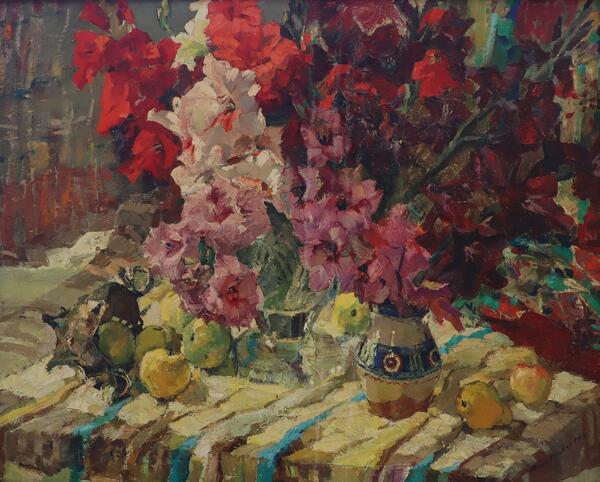
Obviously, in her still life ‘Sword Lilies’, Levitskaya decided to stick to a more realistic combination of plants. In the center of the canvas, there is a lush bouquet of sword lilies in a vase, which is standing on a table, surrounded by juicy yellowish-green apples. The color rhythm of this picture is based on nuanced transitions from cold tones to warm ones. The saturation and even the rave of color of the flower bouquet are balanced by the calm shades of the table, tablecloth and apples. Apples are simple in shape, but unusually rich in range and shades. Side light falls on them, emphasizing the shapes and making the colors glow.
The neat ‘Sword Lilies’ is a still life painting, which is Levitskaya’s favorite genre, along with portraits. This genre’s main focus is to depict the objective world. The very name ‘still life’ comes from the French ‘nature morte’ or from the Italian ‘natura morta’, which can be translated as ‘dead nature’. Still life paintings depict inanimate objects, located in a realistic space, according to a certain composition.
‘Sword Lilies’ of Levitskaya belong to the subgenre of floral still life. It originated in Holland, which at the beginning of the 17th century became a center for trade in tulips that were considered exotic for that time. Many great painters, including the leaders of this genre Ambrosius Bosshart the Elder and Balthasar van der Ast, have tried their hands at making floral still life paintings.
Floral still life paintings were very popular not only in Holland, but throughout Europe. Tulip bulbs were so expensive that only very rich people could afford them. It was much easier to buy a painting with a luxurious bouquet, which would remain in full bloom for many years. Besides, in these works, painters could depict bouquets that would simply be impossible to get in reality, collecting plants that bloom in different seasons or generally come from different continents, on the same painting.
Obviously, in her still life ‘Sword Lilies’, Levitskaya decided to stick to a more realistic combination of plants. In the center of the canvas, there is a lush bouquet of sword lilies in a vase, which is standing on a table, surrounded by juicy yellowish-green apples. The color rhythm of this picture is based on nuanced transitions from cold tones to warm ones. The saturation and even the rave of color of the flower bouquet are balanced by the calm shades of the table, tablecloth and apples. Apples are simple in shape, but unusually rich in range and shades. Side light falls on them, emphasizing the shapes and making the colors glow.