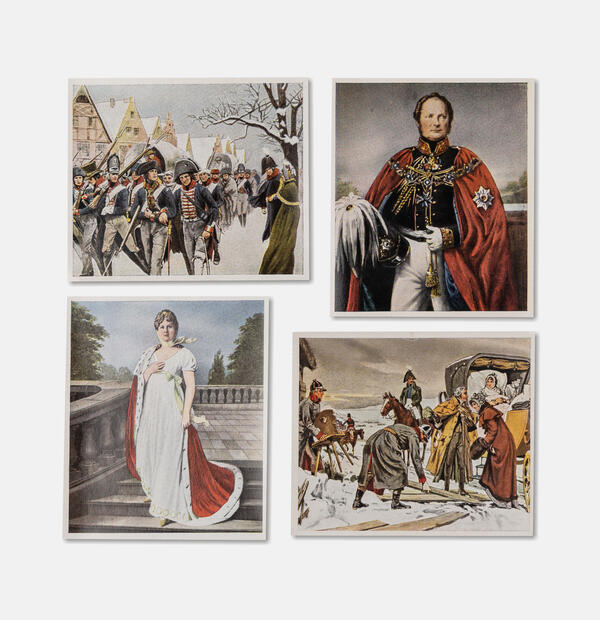
In the first half of the 20th century, tobacco manufacturers put special collectible picture cards into cigarette packages. They were kept in special Cigaretten-Bilderdienst albums, with each album intended for a particular series of pictures. Popular themes included German history, famous personalities, standard bearers, and German cities, among others. In the 1940s, these items were actively used for propaganda purposes, which had not happened before. Reemtsma, one of the biggest tobacco and cigarette manufacturers in Europe, which is based in Hamburg and is still in operation today, also produced such albums.
The museum houses several pictures from the series “Bilder Deutscher Geschichte” — “Pictures of German History” — which was popular in 1936. It illustrated the events that took place in the history of Germany from the Middle Ages up to the year 1914. The cards were printed in color, with a description of the displayed event provided both below the image and on the reverse side. Collectors kept the pictures in an album that was made of sturdy cardboard and designed for 200 cards.
The picture cards from the museum’s collection depict Germany’s most famous woman and most beloved queen — Luise Auguste Wilhelmine Amalie, Duchess of Mecklenburg-Strelitz, who became Queen Consort of Prussia after marrying King Frederick William III. To say that the memory of Queen Louise was and still is cherished by the Germans would be an understatement. The people loved Queen Louise for her simple, gentle, and kind personality. For her contemporaries, she represented femininity, selflessness, and wisdom. Her warm and sincere relationship with her husband and devotion to her children, which was unusual at that time, earned her the love of the people during her lifetime and a cult status after her death.
Queen Louise visited Cranz and stayed at the forester’s cottage in 1807 on her way from Königsberg to Memel. Her difficult journey continued along the snow-covered and nearly impassable road on the Curonian Spit as the royal family was forced to flee from Napoleon’s troops after the conclusion of the Treaties of Tilsit with France which were humiliating and disadvantageous for Prussia.
The Queen Consort was married to King Frederick William III. Their son Wilhelm became the first German Emperor, and his image is also represented in the card collection.
Cigarette picture cards told the story of an entire
nation.