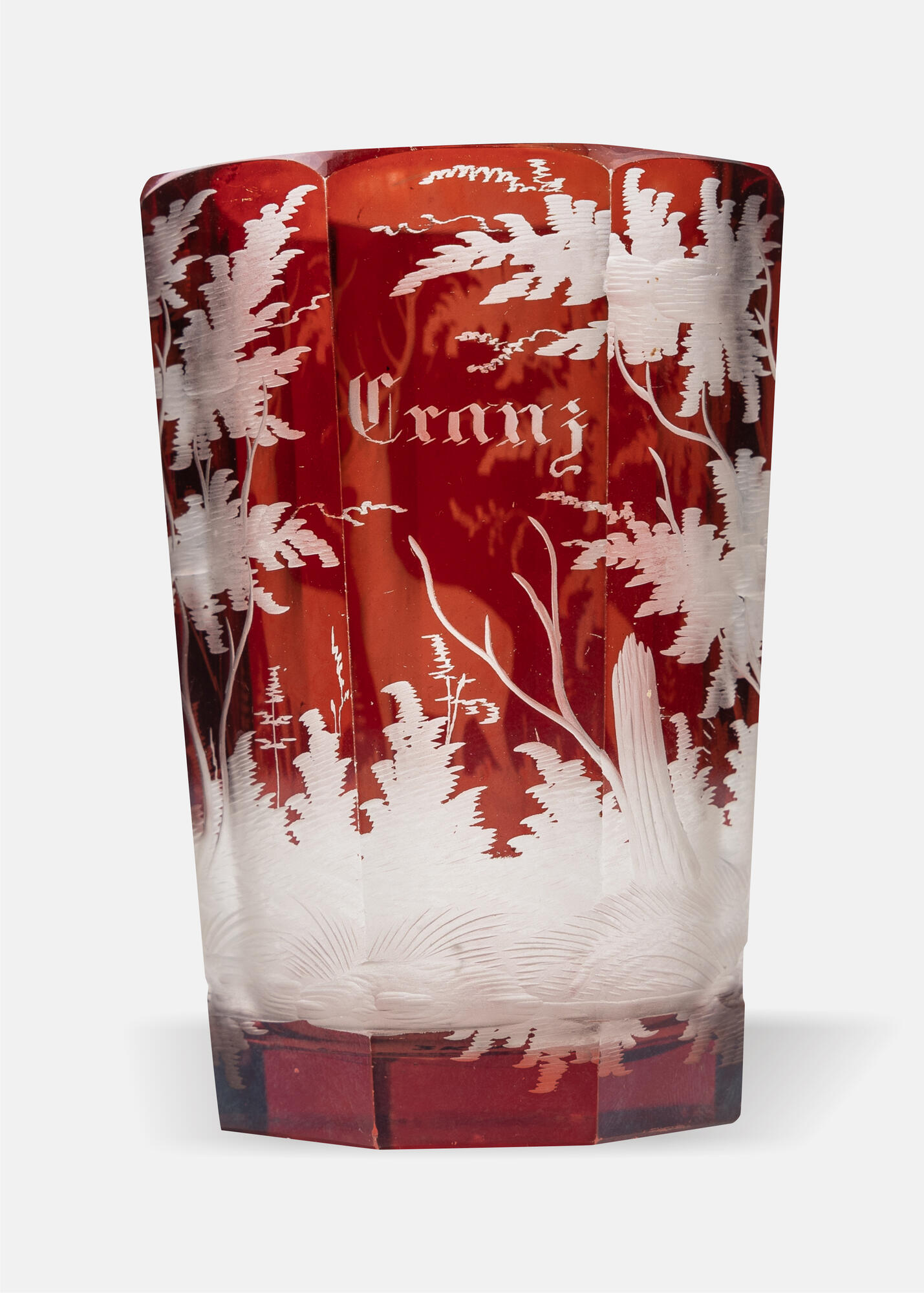


This red faceted glass with white etched images of a deer and trees was produced in Germany at the beginning of the 20th century. This item traveled a long way, first during the evacuation of civilians from East Prussia to Germany, and then, after the end of the war, when it was returned to Cranz, nowadays known as Zelenogradsk, at the request of the owner.
The story of this exhibit of the Zelenogradsk Museum of Local Lore was told by Frau Rebentisch in the “Samlandbrief” magazine. On February 2, 1945, Armin Toll from Pilkoppen turned 15 years old. He studied at a school in Cranz and lived in the apartment of Frau Fellechner. His mother visited him on his birthday, and the same day he was evacuated along with the landlady. He brought along very few possessions in his backpack — only the most valuable and dearest things that reminded him of his native land. Among them were three glasses with the inscription “Cranz”. The glasses were made of Bohemian glass, which had been valued highly since the time it appeared.
In the 13th century, Bohemian glassblowers discovered a way to make glass transparent and sparkling in sunlight and candle flames. By conducting experiments, they achieved the desired effect by adding lead oxide to the heated mass. Thus, a new standard of Bohemian glass was created. The same craftsmen invented the technology of glass polishing and cutting methods which made the products shine brilliantly.
In 2005, Armin Toll gave these glasses to Ulla Rebentisch, the manager of the Bad Bertrich Hotel in Mosel. The hotel’s breakfast room is decorated in the style of Armin Toll’s “Curonian Room”. There is a Curonian pennant and portraits of the inhabitants of the Curonian Spit, and the glasses from Cranz also used to be kept there.
In 2018, Ulla Rebentisch got in touch with Andrey
Martynyuk, the former curator of the Zelenogradsk Museum of Local Lore, and
brought these glasses back to Cranz. It was a very timely gift, as the museum’s
administration was planning to open a special exhibition on Cranz mineral
water.