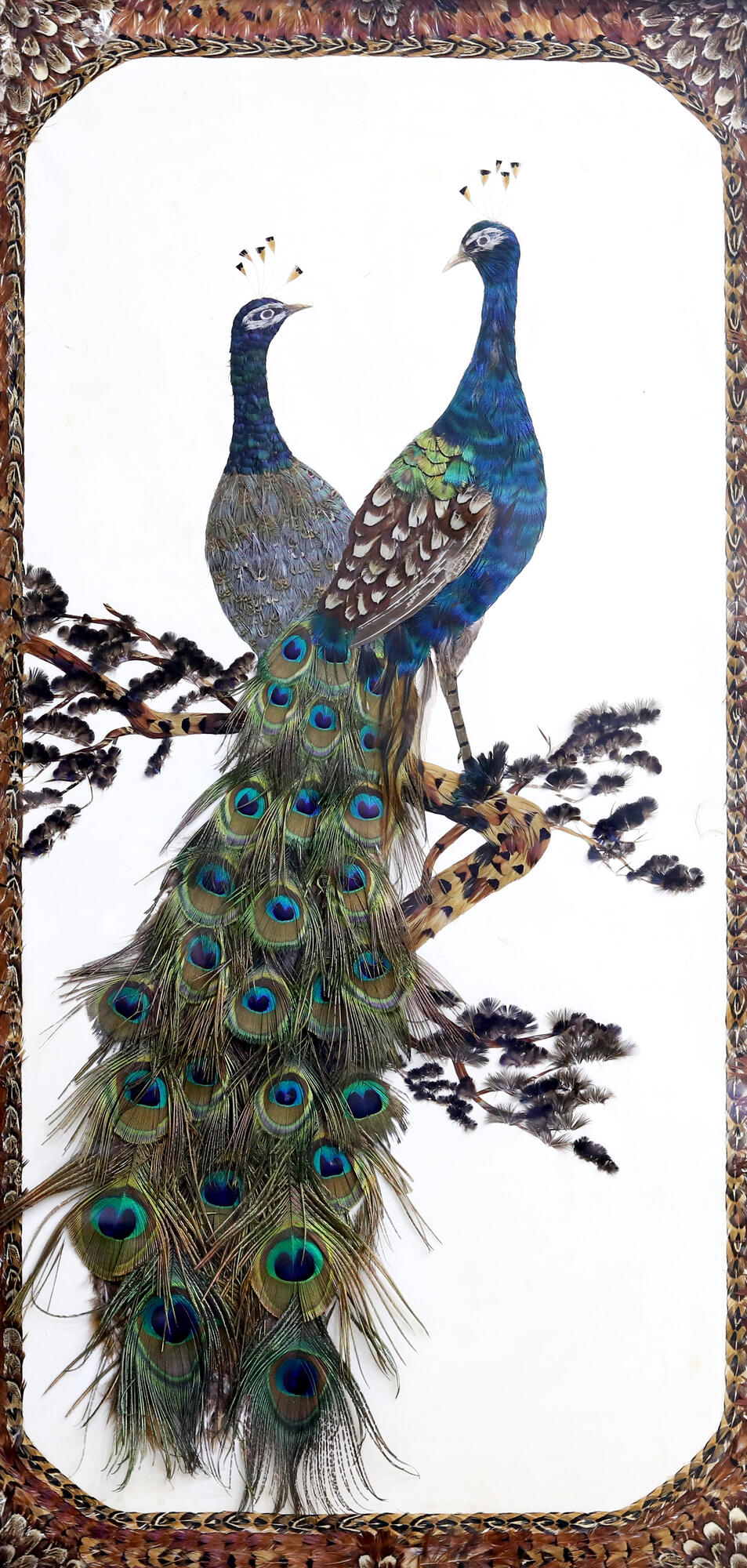


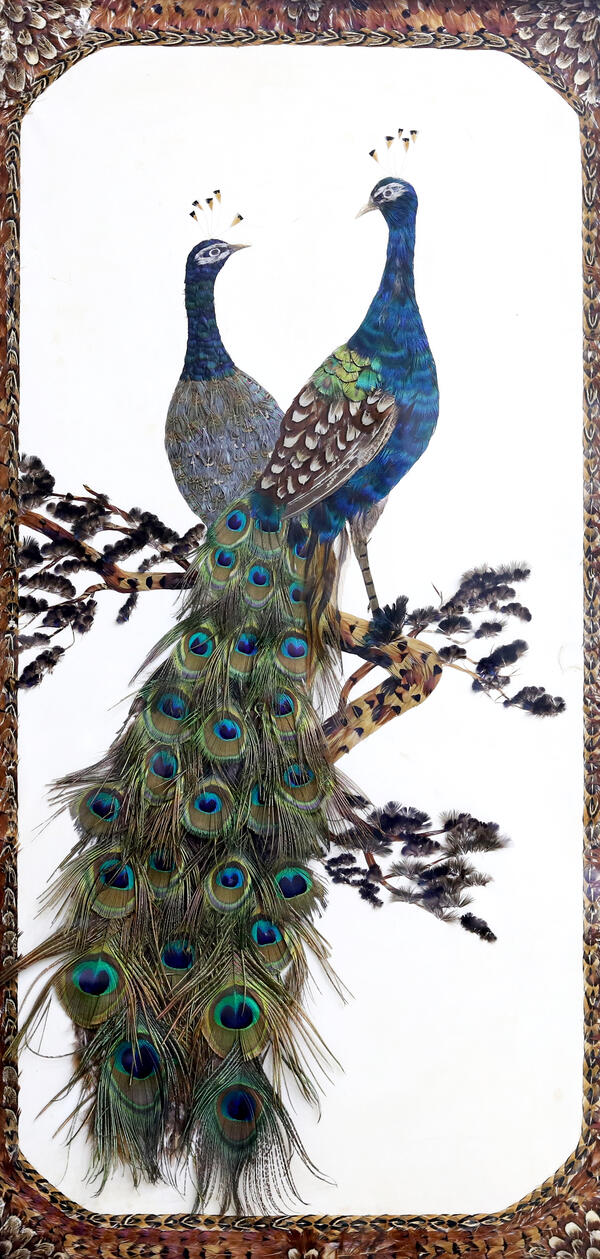
In front of us is an artistic applique. On a white background, two peacocks, a female and a male, are depicted sitting on a tree branch, their heads turned towards each other. The male peacock has bright plumage, a long tail. When it unfolds in the form of a fan, the bird makes an exciting impact. The color of the picture goes from light dark turquoise to light dark brown and dark blue. Along the edges of the panel there is a feather ornament. A tree branch and leaves are also skillfully made of feather.
The art of applique work in Korea at the end of the existence of the Silla state (668-936) reached a high level of craftsmanship and was widespread, like weaving. In the 17th-19th centuries, such items were produced in large quantities for the market, where they were purchased by wealthy citizens. Intricate ornamental compositions were in demand for decorating the inner chambers of houses. For the front rooms, small panels were made in the form of scrolls, imitating painting in the genre of ‘flowers-birds’. As time went on, applique found its place and was actively used not only in paintings, but also in furniture decor using decoupage technique, acquiring a new name — ‘onlay’.
Special attention should be paid to the paper on which the applique is glued. This type of paper — hanji — originated in Korea around the 1st century BC. The process of its manufacture differed from the usual one in that it was produced by hand exclusively from natural components of mulberry trees. When using only water strained through burnt buckwheat or rice straw, the final material could be stored for several hundred years if covered with a special varnish. Only natural dyes were used to color the hanji paper. The oldest Korean manuscript was found almost a thousand years later, and it turned out to be in very good condition.
During the Goryeo Dynasty (918–1392) and the Joseon Dynasty (1392–1910), hanji paper was used in handicrafts for making fans, all kinds of appliqués, scrolls, boxes, clothes, shoes, and other household items. In the 20th century, with the cheap rice paper market evolution, hanji practically ceased to exist. But now it is being revived and is beginning to be in demand not only as paper, but also as a raw material for wallpaper, lanterns, furniture, bedspreads, cosmetics and electronics.
The work was purchased from Pak Son Sung, a representative of the ‘Vneshtorg Rynrada’ trading company, DPRK.
The art of applique work in Korea at the end of the existence of the Silla state (668-936) reached a high level of craftsmanship and was widespread, like weaving. In the 17th-19th centuries, such items were produced in large quantities for the market, where they were purchased by wealthy citizens. Intricate ornamental compositions were in demand for decorating the inner chambers of houses. For the front rooms, small panels were made in the form of scrolls, imitating painting in the genre of ‘flowers-birds’. As time went on, applique found its place and was actively used not only in paintings, but also in furniture decor using decoupage technique, acquiring a new name — ‘onlay’.
Special attention should be paid to the paper on which the applique is glued. This type of paper — hanji — originated in Korea around the 1st century BC. The process of its manufacture differed from the usual one in that it was produced by hand exclusively from natural components of mulberry trees. When using only water strained through burnt buckwheat or rice straw, the final material could be stored for several hundred years if covered with a special varnish. Only natural dyes were used to color the hanji paper. The oldest Korean manuscript was found almost a thousand years later, and it turned out to be in very good condition.
During the Goryeo Dynasty (918–1392) and the Joseon Dynasty (1392–1910), hanji paper was used in handicrafts for making fans, all kinds of appliqués, scrolls, boxes, clothes, shoes, and other household items. In the 20th century, with the cheap rice paper market evolution, hanji practically ceased to exist. But now it is being revived and is beginning to be in demand not only as paper, but also as a raw material for wallpaper, lanterns, furniture, bedspreads, cosmetics and electronics.
The work was purchased from Pak Son Sung, a representative of the ‘Vneshtorg Rynrada’ trading company, DPRK.