The spindle is the oldest known spinning tool, with origins stretching back to prehistoric times. Among the Slavs, it was used to spin thread from natural fibers.
The Russian word for the spindle “vereteno” derives from an Indo-European root meaning “something that rotates” — a fitting etymology, as rotation lies at the very heart of spinning. This ancient craft involves drawing out individual fibers from prepared tow and twisting them together to form a strong, continuous thread. A tow refers to clean, carefully combed fibers, such as wool or flax, rolled into a smooth, even bundle and typically held on a distaff.
The twisting action that binds the fibers into thread is created by spinning the spindle around its axis. As it rotates, the fibers are first stretched and then spirally twisted, resulting in a durable, uniform strand. There were two primary spinning techniques: suspended and supported spinning. In suspended spinning, the spindle hangs freely in the air as the spinner draws fiber downward, allowing gravity to assist in drafting the thread. In supported spinning, by contrast, the spindle rests on the ground or in a shallow wooden bowl or stand (often called a spinning plate), and the spinner pulls the fiber outward horizontally while twirling the spindle.
Traditionally, Slavic women pulled the fiber with their left hand and spun the spindle with their right — a technique still practiced by many contemporary hand-spinners. In some other cultures, however, the opposite (“mirror”) method is used.
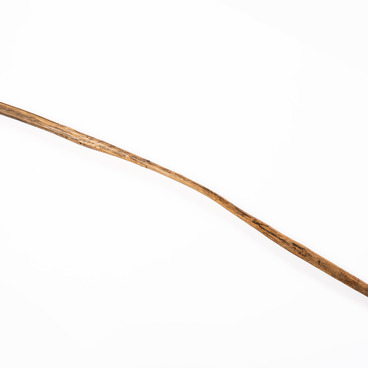
Spindles were typically carved from dry wood, most commonly birch. They ranged from 20 to 80 centimeters in length, with one or both ends sharpened to a point — a detail preserved even in folklore. The famous scene from the fairy tale “The Sleeping Princess”, in which the heroine pricks her finger on a spindle and falls into an enchanted sleep along with her entire kingdom, reflects this characteristic pointed tip.
The Unecha Museum of Local Lore houses a notable collection of spindles. Among them is a classic Russian example donated in 1989 by a resident of the Unechsky District. Believed to have been made in the early 20th century in the village of Pisarevka, it is a finely chiseled wooden rod with pointed ends and a pronounced central thickening. This bulge functioned as a flywheel: when set in motion, its added mass increased rotational inertia, allowing the spindle to spin longer and more steadily, greatly easing the spinner’s work.