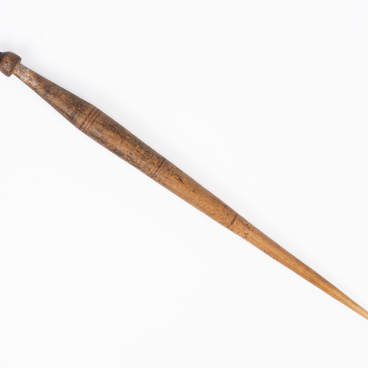
Just over a century ago, the yoke — or koromyslo in Russian — was a common sight in nearly every Russian household, not only in villages but also in towns. Today, both the object and the word itself are fading from everyday life and disappearing from modern Russian speech. Now, the yoke can be seen only in museums or in paintings by Russian realist artists.
Dictionaries define it as “a wooden device, shaped like a long stick or curved arc, used to carry two buckets or other loads suspended from its ends”. The Russian word “koromyslo” first appears in written records in the 15th century, though archaeologists have uncovered similar artifacts in cultural layers dating back to the 11th–14th centuries. Both the word and the object are of Slavic origin. Russian folklore is rich with riddles and proverbs about the yoke: “two brothers want to fight, but their arms are too short”; “between two seas, on meaty mountains, there’s a bent bridge”; “craft isn’t a yoke — it won’t pull your shoulders”.
The yoke itself is a very simple tool: a curved, flat wooden shaft with notches or hooks at each end for hanging buckets. It was typically made from linden or willow — woods prized for their flexibility. The blank was steamed, carefully bent into shape, and left to dry, ensuring resilience and comfort during use. In some regions, the center of the arc was reinforced with a metal plate for added strength, though in the Unecha region, this reinforcement was usually omitted.
Festive yokes were often carved or painted and reserved for special occasions like weddings or holidays. Everyday versions, by contrast, were plain and functional. Households kept the yoke by the stove or in the entryway, often with buckets resting on the bench beneath it — always within reach. A well-crafted yoke could last for decades.
Carrying water with a yoke was considered women’s work. Men typically carried buckets by hand — so much so that an old saying warned: “God forbid a man be seen with a yoke on his shoulder — they’ll laugh!”. In cities, the rocker fell out of use relatively early, as piped water appeared. But in rural areas, it remained in daily use well into the 1970s and 1980s.
The yoke on display at the Unecha Local Lore Museum is a well-worn, time-tested artifact. Its surface is cracked from years of use, and along the inner curve are small notches designed to prevent it from slipping off the shoulder. The bucket hooks are made of thick, bent wire.