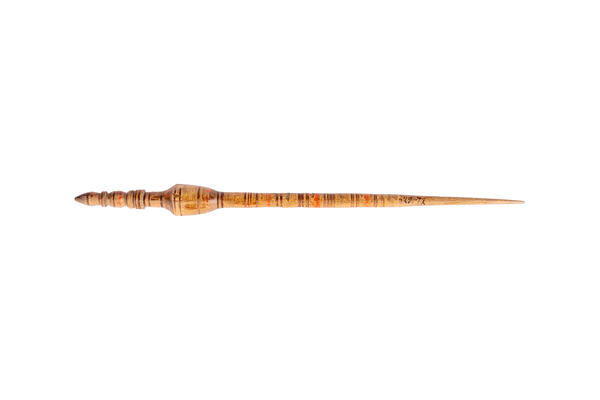
A spindle — a sharpened turned stick with a thickening in the middle — is one of the most ancient tools of hand spinning. Tow fibers were obtained by combing out flax, hemp or wool. They were fixed on the comb of a distaff and gradually drawn, winding it on a spindle. A loop was tied on the spindle (sometimes a special “beard” was made for this purpose) so that the thread would not slip off.
Typically, spindles were made from birch wood: a log was sawn across and then chopped lengthwise; the blanks were dried on the stove for a day and then sharpened with a chisel. The production was cheap, and a craftsman could make up to a hundred pieces a day.
The spindle’s function of twisting and winding as well as its sharpness are essential for the mythological image of the tool. The idea of twisting as a way of creating a new structure is reflected in the folk vocabulary, for example: to twist means “to dress up a bride”, “to dress up a dead man”. In riddles, the image of the spindle helps express the categories of time: “There is a house with 12 windows, in each window there are four maidens, each maiden has seven spindles, each spindle has a different name. — Year, months, weeks, days”. The sharpness of the spindle prompted its use in folk medicine: a sick person was poked three times in the side with three spindles, chasing away disease.
A woman’s life has been associated with the image of the spindle since birth. It was used to cut the umbilical cord of a newborn girl; a distaff with a spindle was placed under the cradle so that the nightly evil female spirit could play with it and not disturb the baby’s sleep. The spindle was hidden in the cradle itself, so that the child would not be replaced by evil spirits.
Spinning yarn on a spindle was associated with the ideas of fate, fortune, and wealth. The way a girl spun flax foretold her future: tight and evenly spun yarns boded well for marriage. Another custom was to take spindles with yarn from the father’s house to the husband’s family — it promised prosperity. New empty spindles taken from home could bring poverty. While brides twisted yarns they pronounced special sayings, and such enchanted spindles served as amulets against the evil eye.
On Holy Thursday, women spun yarn on spindles in reverse and tied them around their lower backs, arms, and legs to keep them free of pain.