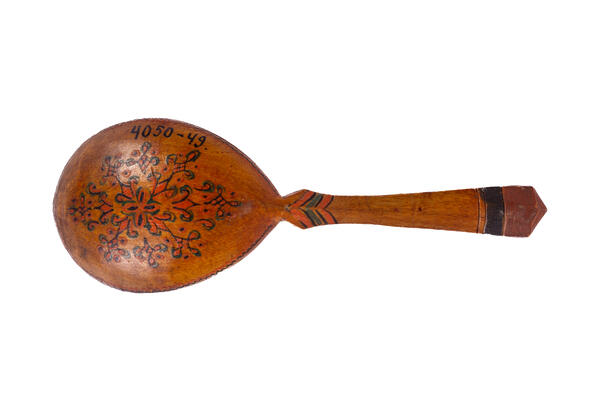
A spoon is a wooden, metal or bone bowl on a handle for scooping up liquid and crumbly food. Before the fork first appeared in the 17th century, it was the only utensil for eating food.
In the Russian North, spoons were made manually, using an axe and cutter knife. They had a flat handle and were covered with paintings and dedicatory inscriptions.
A spoon as a personal item has very rich symbolism, and various functions were realized both in everyday life and in rituals.
During a meal it was prohibited to clatter with spoons (“the evil one rejoices”), to put them as a bridge between the table and the edge of the plate (so that no unclean spirit could get into the food), to chew with a spoon in one hand (after scooping up food, the spoon was licked and put down on the table till the next scooping), to put an extra spoon on the table (“the unwashed or the wood spirit will come for food”). The girls made sure that their spoon did not run over the edge, otherwise they would marry a drinker.
The spoon appeared at least three times in the childbirth and christening ceremonies. While the wife was in labor, the husband was given a spoon and a plate with “porridge” of salt, pepper, vinegar, mustard, horseradish, and sugar to share the pain with the woman. During the christening, this spoon was placed on the highest shelf in the house so that the baby would “grow big”, or, for the same purpose, was tossed upward. The midwife was presented with a bowl of porridge, on top of which a spoon for collecting money was placed.
In the second week after Easter, a spring ritual took place: women ate fried eggs and then threw spoons upwards saying, “Grow up, flax, this healthy and tall”.
In wedding ceremonies, spoons symbolically “replaced” the young: they were tied together by the handles and, along with the wedding loaf and other utensils, sewn up into the festive tablecloth, which was opened by the spouses after bathhouse. To prevent the husband and wife from quarreling, they were given the same spoon to share.
At the wake, when the deceased invisibly continued to be present in the house, a spoon was placed for them with the handle pointing to the corner with icons. Sometimes wooden spoons were given in memory of the deceased.
On the eve of St. Philip’s fast, spoons were left on the table overnight, and in the morning they were examined: anyone whose utensil was knocked over on its back could expect death or misfortune. During the Epiphany divinations, the water in the bowl of the spoon was frozen: the ice frozen in a “hole” meant a grave, but a flat surface, especially with bubbles, meant long life and a good year.