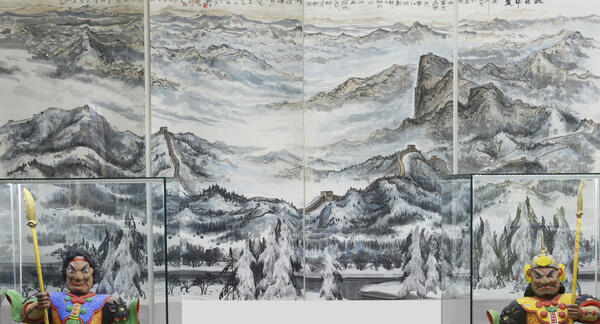
In front of us is a scroll consisting of four parts. On a yellow passe-partout made of fabric with floral designs, the Great Wall of China is depicted in a winding line against a white and gray background. Snow-covered trees stand in the foreground, with a brown brim around the edges. On both sides of the wall, there are mountains and gorges stretching to the horizon. At the top there is an inscription in hieroglyphs and five seals of the authors.
The Great Wall of China is surrounded with legends and fantastic versions of its creation. Someone is sure that it can be seen even from space, others — that human remains are embedded in its walls, others — that the builders were helped by a fire-breathing dragon. It is believed that its construction was associated with the defense of China against the horrifying northern tribes. For many centuries, soldiers marched along it, and now it attracts tourists from all over the world.
The style in which the work is created is traditional for China and is called ‘hokuga’. This term means national painting, free from European influence, it originated in the Middle Ages and literally means ‘country’s painting’. Pictures were painted on silk, and black ink on paper. Scrolls with portraits, landscapes, everyday scenes, illustrations of literary works were kept in precious boxes, taken out on special occasions and unwound from right to left, carefully revealing the contents of the canvas.
Hokuga combines painting poetry and calligraphy line dance. This style uses the same lines, techniques and materials. The Chinese consider their work finished only if it contains the author’s seal and lines that carry philosophical thought. The objects depicted in such paintings are in accordance with a certain meaning, and do not fit into real space. It is for this reason that the concept of linear perspective does not exist in the works of artists of the Celestial Empire, but the laws of a scattered perspective work in it. Objects that are closer to the viewer are performed in dark colors, those that are farther away are lighter.
It is worth noting that all artists use special tools when working: mineral-based paints, rice paper, ink and also brushes made of goat or wolf hair. For Chinese artists, it is much more important to remain faithful to the inward order, and not to accurately copy any object. Traditions that have existed for many centuries are inherited by artists, which helps to preserve this type of art. Each generation that works in the hokuga style brings something unique to it.
The ‘Great Wall of China’ scroll entered the Amur Regional Museum of Local Lore in 1989.
The Great Wall of China is surrounded with legends and fantastic versions of its creation. Someone is sure that it can be seen even from space, others — that human remains are embedded in its walls, others — that the builders were helped by a fire-breathing dragon. It is believed that its construction was associated with the defense of China against the horrifying northern tribes. For many centuries, soldiers marched along it, and now it attracts tourists from all over the world.
The style in which the work is created is traditional for China and is called ‘hokuga’. This term means national painting, free from European influence, it originated in the Middle Ages and literally means ‘country’s painting’. Pictures were painted on silk, and black ink on paper. Scrolls with portraits, landscapes, everyday scenes, illustrations of literary works were kept in precious boxes, taken out on special occasions and unwound from right to left, carefully revealing the contents of the canvas.
Hokuga combines painting poetry and calligraphy line dance. This style uses the same lines, techniques and materials. The Chinese consider their work finished only if it contains the author’s seal and lines that carry philosophical thought. The objects depicted in such paintings are in accordance with a certain meaning, and do not fit into real space. It is for this reason that the concept of linear perspective does not exist in the works of artists of the Celestial Empire, but the laws of a scattered perspective work in it. Objects that are closer to the viewer are performed in dark colors, those that are farther away are lighter.
It is worth noting that all artists use special tools when working: mineral-based paints, rice paper, ink and also brushes made of goat or wolf hair. For Chinese artists, it is much more important to remain faithful to the inward order, and not to accurately copy any object. Traditions that have existed for many centuries are inherited by artists, which helps to preserve this type of art. Each generation that works in the hokuga style brings something unique to it.
The ‘Great Wall of China’ scroll entered the Amur Regional Museum of Local Lore in 1989.