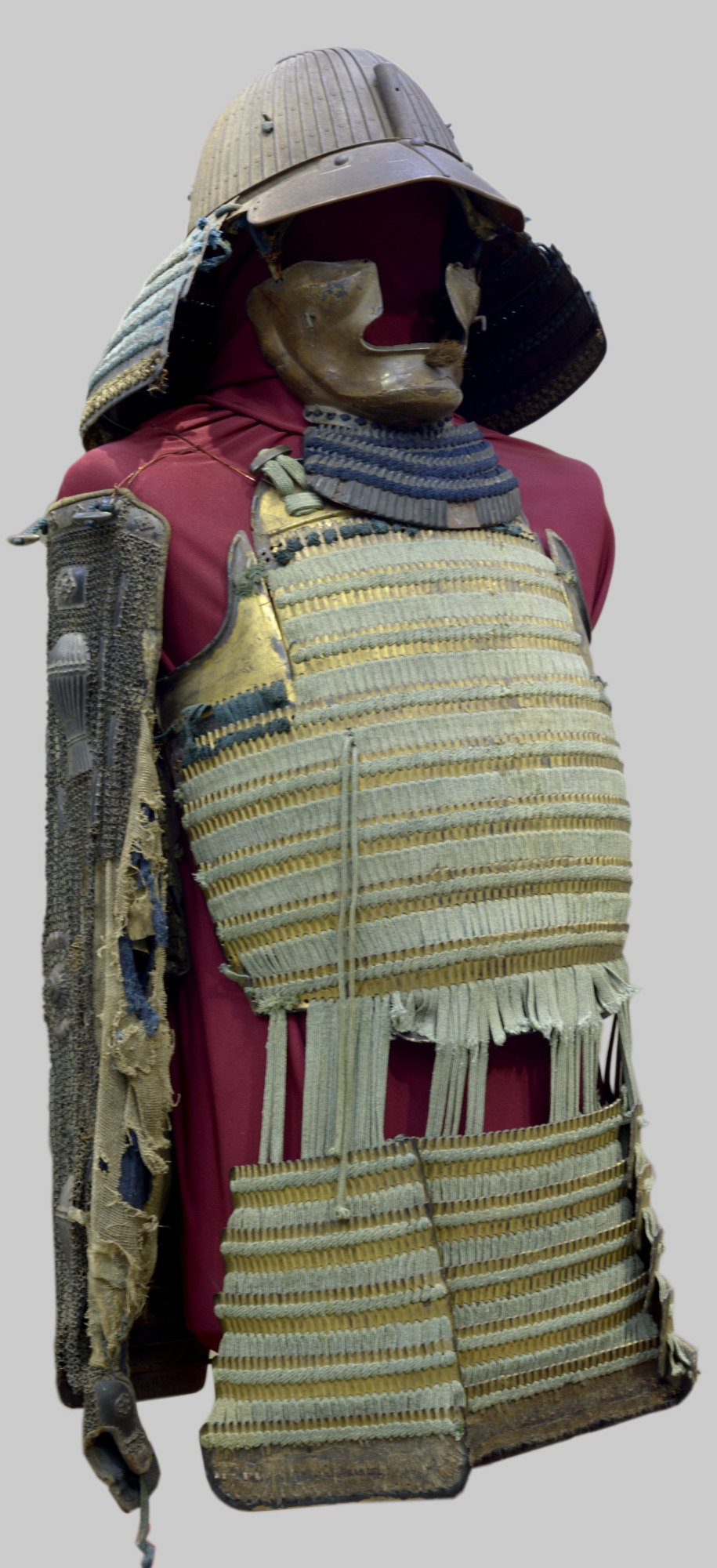


The exhibition ‘Art of the Orient’ displays the armor of a Japanese samurai dating from around the 18th century. They consist of two different parts: a breastplate with a side plates and a backplate. This type of armor is called ō-yoroi. A a skirt of six sections — kusazuri- is attached to them from the bottom. Under it is a cuisse — hai-date. The samurai’s arms are protected by sleeves that have metal inserts. A helmet kabuto is put on the head, it is called hoshi. To protect the neck, the helmet is supplied by several plates and a visor. A strap is used to attach it to the head. The mask covers the face.
Samurai armor is the general name for various types of armor that can be found in Japan. They all differed in their design features. Armor was made from metal plates, which were varnished. This was necessary to prevent the formation of rust, and leather was glued on top of the plates. In the classic version of the armor, the plates were not visible due to the silk lacing, which almost completely covered the surface.
Already in the 5th-6th century AD, one could find the main elements, as well as the general composition of samurai armor. Armor, fastened with silk or leather cords, consisted of 20 or more separate items. Moreover, their weight did not exceed 12 kilograms and the armor had multiple holes that allowed the soldier to breathe freely, which, given the Japanese climate, was extremely important.
Getting into such armor was not an easy task, and a special ritual appeared: first, they put on an underwear, then hats and gloves, then wristbands, an upper dress and protection of the lower limbs. The helmet was worn only when necessary, immediately before hostilities or during any special events. Dressed in armor, the samurai could not only fight while on the ground or on horseback but ran and even swam. At the same time, his body was reliably protected — armor, which did not hinder movements covered him like fish scales. Such equipment was usually put in a small chest during a campaign. To ensure that the armor was in perfect condition, it was monitored extremely carefully. The same rule was followed in handling weapons. As usual, the armor, which was made conscientiously, was passed on from generation to generation.
The armor was donated to the Amur Regional Museum of Local Lore by a resident of the city of Blagoveshchensk A.F. Svinkin in 2014.
Samurai armor is the general name for various types of armor that can be found in Japan. They all differed in their design features. Armor was made from metal plates, which were varnished. This was necessary to prevent the formation of rust, and leather was glued on top of the plates. In the classic version of the armor, the plates were not visible due to the silk lacing, which almost completely covered the surface.
Already in the 5th-6th century AD, one could find the main elements, as well as the general composition of samurai armor. Armor, fastened with silk or leather cords, consisted of 20 or more separate items. Moreover, their weight did not exceed 12 kilograms and the armor had multiple holes that allowed the soldier to breathe freely, which, given the Japanese climate, was extremely important.
Getting into such armor was not an easy task, and a special ritual appeared: first, they put on an underwear, then hats and gloves, then wristbands, an upper dress and protection of the lower limbs. The helmet was worn only when necessary, immediately before hostilities or during any special events. Dressed in armor, the samurai could not only fight while on the ground or on horseback but ran and even swam. At the same time, his body was reliably protected — armor, which did not hinder movements covered him like fish scales. Such equipment was usually put in a small chest during a campaign. To ensure that the armor was in perfect condition, it was monitored extremely carefully. The same rule was followed in handling weapons. As usual, the armor, which was made conscientiously, was passed on from generation to generation.
The armor was donated to the Amur Regional Museum of Local Lore by a resident of the city of Blagoveshchensk A.F. Svinkin in 2014.