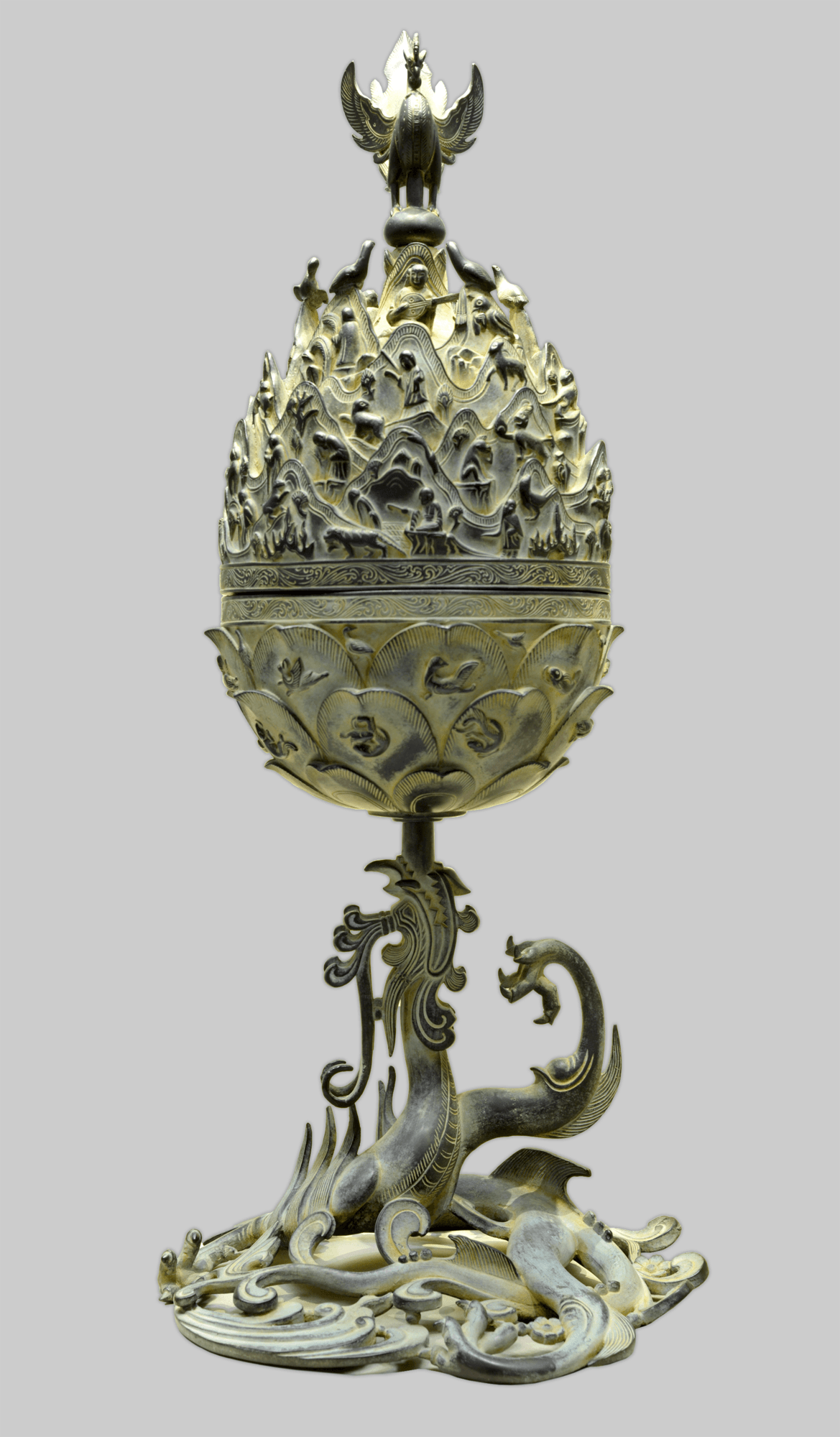


An authentic gilded bronze lotus-like incense burner was found in a village in South Korea in December 1993. Once there was a temple, which was surrounded by a covered gallery. Its inner gates were fastened with a single axis, on the territory there was a wooden pagoda, the main altar building and a room for sermons. The royal burials located nearby behind the fortress wall, the nature of the inscriptions and other historical facts — all this indicates that this temple was a memorial. It was built in honor of the late king, and the incense burner was considered a ritual object that was made of bronze and then gilded by amalgamation.
The lid of the incense burner, on which the phoenix spread its wings, is shaped like mountain ranges, where the imaginary world is inhabited by Taoist immortals. Between the mountain ranges are small holes for incense smoke. The design may have been inspired by Baksan Hyunno, an ancient Chinese incense burner that was made between the late Warring States period and the Han Dynasty. Baksan is considered a legendary mountain protruding from the sea, where the Chinese believed immortals lived.
Three-dimensional images of plants, people and animals are intertwined in the pattern made up of several large and small mountain peaks located on the surface of the cover. If you carefully examine the subject, you will notice that some people are meditating on the top of the mountain, others are walking through the forest, some, sitting on horses, shoot from a bow at a gallop, while turning their heads back. Someone is washing at the waterfall, someone is walking, leaning on a stick, and other people bowing, pay tribute to him. There is an image of fishermen catching fish from a cliff hanging over the lake, there are characters moving on elephants and horses.
As for animals, in addition to real ones, such as a bear, tiger, birds, deer, snake and wild boar, there are many made-up images. Rocks, trees, streams, waterfalls, lakes are visible between the mountain peaks. In addition, the incense burner is also decorated with a group of 5 people playing the gumoongoh zither, drums, the wanham string instrument, and the zhojok and beso, wind instruments that are typical of the Baekje kingdom. These decorative elements are surrounded by a landscape of trees, rocks and water, adding mystery to the experience of the incense burner. The dragon at the base of the incense burner holds this lotus bud firmly in its paw.
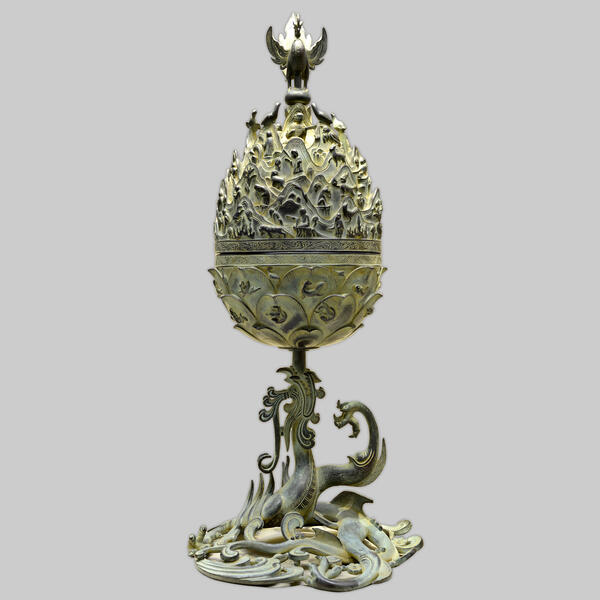
A modern bronze replica of the Baekje Kingdom incense burner was donated to the museum by the Governor of Chuncheon Nam-do Province of the Republic of Korea, Sim Dae Pien, on July 16, 1996.
The lid of the incense burner, on which the phoenix spread its wings, is shaped like mountain ranges, where the imaginary world is inhabited by Taoist immortals. Between the mountain ranges are small holes for incense smoke. The design may have been inspired by Baksan Hyunno, an ancient Chinese incense burner that was made between the late Warring States period and the Han Dynasty. Baksan is considered a legendary mountain protruding from the sea, where the Chinese believed immortals lived.
Three-dimensional images of plants, people and animals are intertwined in the pattern made up of several large and small mountain peaks located on the surface of the cover. If you carefully examine the subject, you will notice that some people are meditating on the top of the mountain, others are walking through the forest, some, sitting on horses, shoot from a bow at a gallop, while turning their heads back. Someone is washing at the waterfall, someone is walking, leaning on a stick, and other people bowing, pay tribute to him. There is an image of fishermen catching fish from a cliff hanging over the lake, there are characters moving on elephants and horses.
As for animals, in addition to real ones, such as a bear, tiger, birds, deer, snake and wild boar, there are many made-up images. Rocks, trees, streams, waterfalls, lakes are visible between the mountain peaks. In addition, the incense burner is also decorated with a group of 5 people playing the gumoongoh zither, drums, the wanham string instrument, and the zhojok and beso, wind instruments that are typical of the Baekje kingdom. These decorative elements are surrounded by a landscape of trees, rocks and water, adding mystery to the experience of the incense burner. The dragon at the base of the incense burner holds this lotus bud firmly in its paw.
A modern bronze replica of the Baekje Kingdom incense burner was donated to the museum by the Governor of Chuncheon Nam-do Province of the Republic of Korea, Sim Dae Pien, on July 16, 1996.