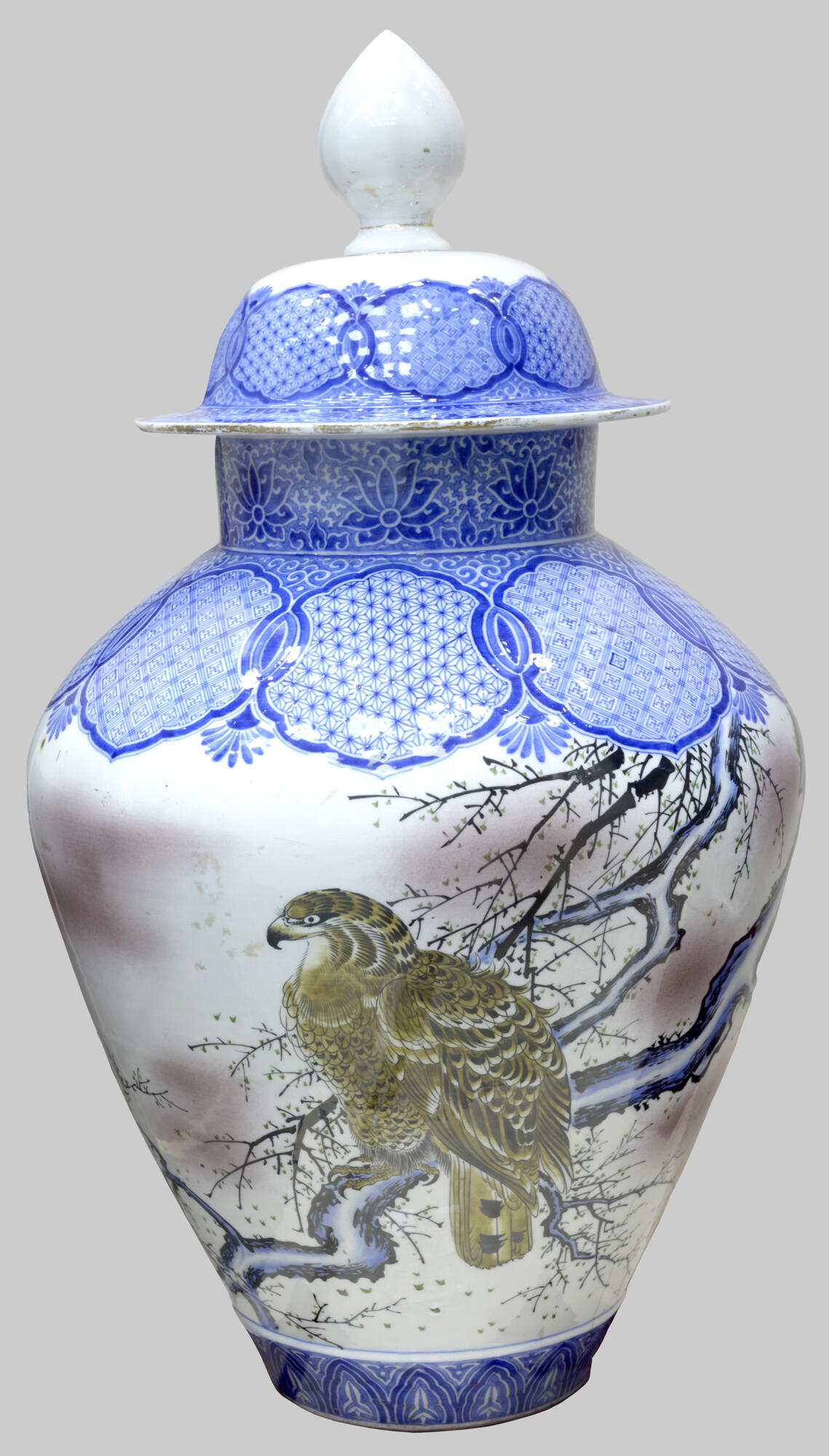


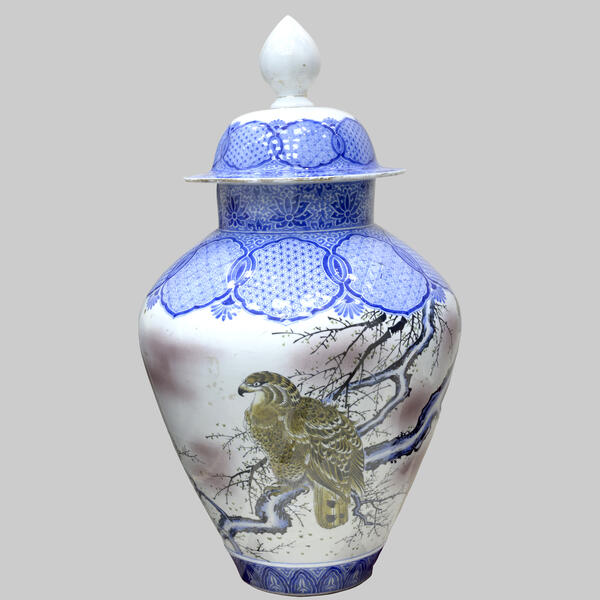
In front of us is a decorative faience vase in the form of an inverted cone with a narrowed base, extended ‘shoulders’ and a pileate lid. The painting on the vase’s body depicts an eagle sitting on a tree branch with two nestlings. Each eagle feather, tenacious legs, bent beak and a stern look are traced clearly. The upper part of the vase is painted with a blue pattern with flowers and ornaments in medallions. The images are monochrome, that is, each of them is done in one color.
It has not yet been possible to find out the place of this vase’s origin and the time when the first ones like it appeared. The most ancient of those known to science were made of clay and date back to the 3rd millennium BC, and the most frequently found on the market were made of porcelain, their age is no more than 300 years.
In ancient times, when people get acquainted with fire, they began to burn items of a simple form intended for everyday life — this is how ceramics appeared. Attempts by Europeans to find a porcelain recipe carefully guarded by the Chinese led to the invention of faience, which burned once, made a dull sound and was fragile. But it was called ‘soft china’ to emphasize the similarity of the products with Chinese items. A fancy ornament was applied to the walls of faience vases, they were painted by the best craftsmen. All over the world, faience figurines were popular, especially those depicting ladies and gentlemen, shepherds and shepherdesses.
For a long time, Russia bought earthenware in France and England, and only in the 18th century the first workshops opened in the country. The dishes of Russian craftsmen were very similar to porcelain, as they were fired at high temperatures and the painting was applied to the surface that was not yet fired. The walls of such items were thin, but they had one feature that distinguished them from porcelain — they weren’t transparent.
The so-called “proto-porcelain” began to be produced in China around the 1st century AD. Ritual and burial vessels were made from it, which were decorated with images of people and animals. Technologies improved, and by the 4th-6th centuries the items acquired a look that resembled rare seashells in smoothness and milky shade.
The name “porcelain” came to Russia from Farsi, where it sounded like “farfur” and meant “close to the emperor”. This emphasized that only the highest nobility could afford porcelain utensils.
Initially, Chinese vessels were used not so much to decorate a home as to store liquid or bulk substances. The vase on display is a plum vase. Such vases appeared in the Celestial Empire in the 7th century and were used as vessels for wine. In the 20th century, they began to be used for flowering plum branches. Later, such vessels turned into simply decorative items. A distinctive feature of this vessel is the presence of a low, not very wide neck, which resembles a human neck and seems to rest on the broad shoulders of the base.
It has not yet been possible to find out the place of this vase’s origin and the time when the first ones like it appeared. The most ancient of those known to science were made of clay and date back to the 3rd millennium BC, and the most frequently found on the market were made of porcelain, their age is no more than 300 years.
In ancient times, when people get acquainted with fire, they began to burn items of a simple form intended for everyday life — this is how ceramics appeared. Attempts by Europeans to find a porcelain recipe carefully guarded by the Chinese led to the invention of faience, which burned once, made a dull sound and was fragile. But it was called ‘soft china’ to emphasize the similarity of the products with Chinese items. A fancy ornament was applied to the walls of faience vases, they were painted by the best craftsmen. All over the world, faience figurines were popular, especially those depicting ladies and gentlemen, shepherds and shepherdesses.
For a long time, Russia bought earthenware in France and England, and only in the 18th century the first workshops opened in the country. The dishes of Russian craftsmen were very similar to porcelain, as they were fired at high temperatures and the painting was applied to the surface that was not yet fired. The walls of such items were thin, but they had one feature that distinguished them from porcelain — they weren’t transparent.
The so-called “proto-porcelain” began to be produced in China around the 1st century AD. Ritual and burial vessels were made from it, which were decorated with images of people and animals. Technologies improved, and by the 4th-6th centuries the items acquired a look that resembled rare seashells in smoothness and milky shade.
The name “porcelain” came to Russia from Farsi, where it sounded like “farfur” and meant “close to the emperor”. This emphasized that only the highest nobility could afford porcelain utensils.
Initially, Chinese vessels were used not so much to decorate a home as to store liquid or bulk substances. The vase on display is a plum vase. Such vases appeared in the Celestial Empire in the 7th century and were used as vessels for wine. In the 20th century, they began to be used for flowering plum branches. Later, such vessels turned into simply decorative items. A distinctive feature of this vessel is the presence of a low, not very wide neck, which resembles a human neck and seems to rest on the broad shoulders of the base.