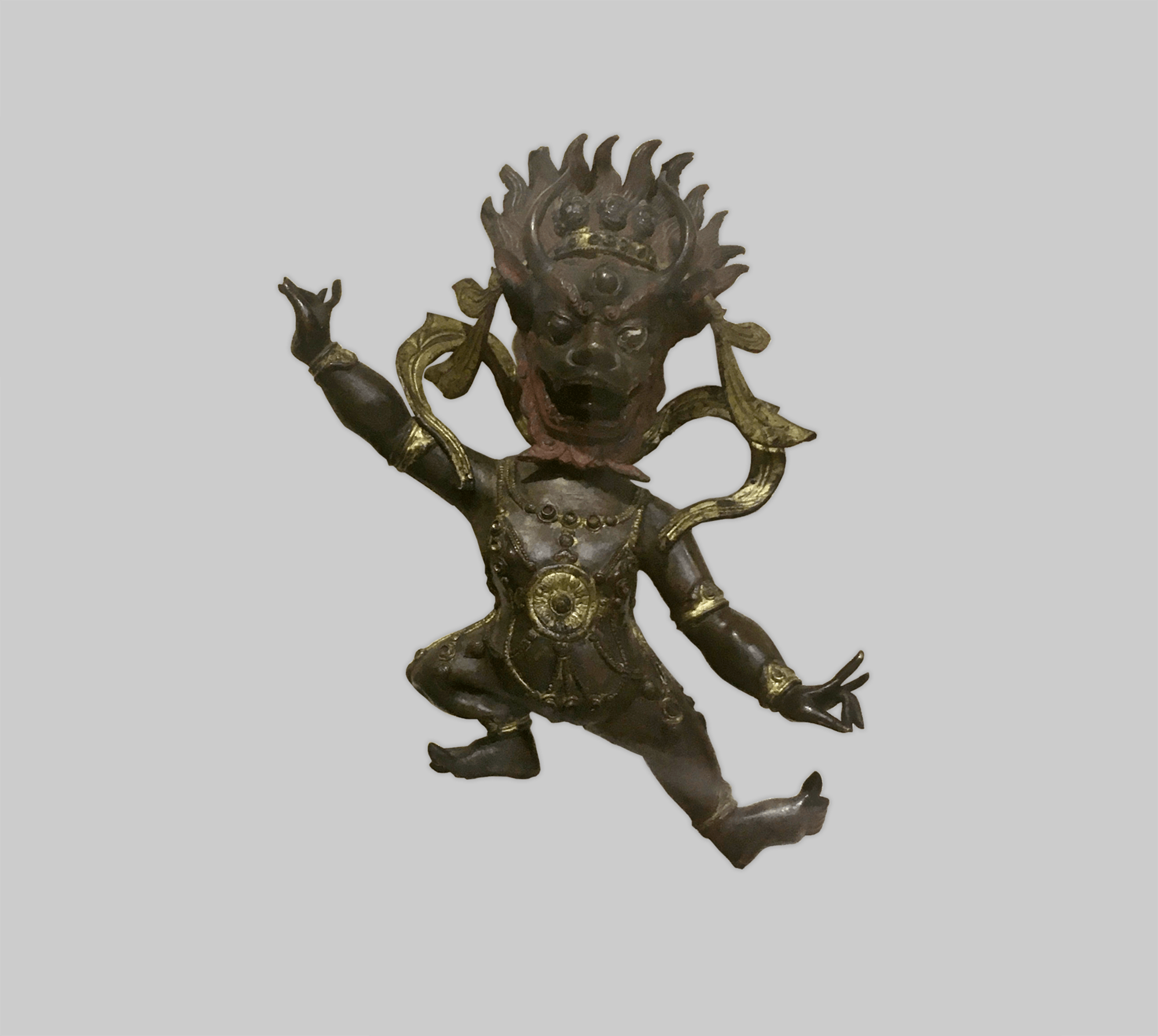


This Burmese statuette of the god of fire made of brown metal was transferred to the Amur Regional Museum of Local Lore in the 1940s — 1950s. The head of the figurine is similar to the head of a bull, occupies a third of the body and is not proportional to it. The hair is red, loose and pulled up. There are two horns on the head and an ornament in the form of a crown of skulls. There are three large protruding eyes on the face, one of which is located on the forehead, it gives intuition and foresight. The mouth is open, two upper and two lower canines are visible in it. The teeth are white, and the mouth is red, under which a red forked beard grows. Two semicircular arcs protrude from behind the head.
The left hand is directed down, the index finger and little finger are raised up, the middle finger is connected to the thumb, and the ring finger is slightly bent. The right hand with the same finger position is extended upward. The right leg is bent, as if a god is preparing to dance. Ring bracelets cover the elbows, wrists and ankles. The neck is adorned with a double chain with five connected prominent bars. In the center of the body is a large plate with a ball in the middle. Chains also go down from it, they all have a golden color.
The description of the statuette corresponds to the Buddhist deity Yama, which means ‘the lord of death, the lord of hell and the supreme judge of the afterlife.’ According to Buddhist philosophy, this is the ruler of the souls of the ancestors, who administers justice over them, just like the gods Osiris and Anubis in ancient Egyptian mythology, the ancient Greek Hades or the Slavic Veles.
According to the most ancient ideas in Indian mythology, he was associated with the Sun, which was considered the twin of the Moon. It is from here that his name comes — ‘Yama’ and is translated from Sanskrit as ‘twin’. Yama was mentioned in the ancient book ‘Rigveda’, a mythological and poetic collection of sacred hymns, in which he was a deity who renounced immortality and committed self-sacrifice for the appearance of man. Later, in philosophy, he was presented as the first person who knew death and opened the way to the world of the dead. Yama judges the soul of the deceased and makes a decision, based on which the soul should be reincarnated according to its karma accumulated in a past life, and continue its path in one of the worlds.
The left hand is directed down, the index finger and little finger are raised up, the middle finger is connected to the thumb, and the ring finger is slightly bent. The right hand with the same finger position is extended upward. The right leg is bent, as if a god is preparing to dance. Ring bracelets cover the elbows, wrists and ankles. The neck is adorned with a double chain with five connected prominent bars. In the center of the body is a large plate with a ball in the middle. Chains also go down from it, they all have a golden color.
The description of the statuette corresponds to the Buddhist deity Yama, which means ‘the lord of death, the lord of hell and the supreme judge of the afterlife.’ According to Buddhist philosophy, this is the ruler of the souls of the ancestors, who administers justice over them, just like the gods Osiris and Anubis in ancient Egyptian mythology, the ancient Greek Hades or the Slavic Veles.
According to the most ancient ideas in Indian mythology, he was associated with the Sun, which was considered the twin of the Moon. It is from here that his name comes — ‘Yama’ and is translated from Sanskrit as ‘twin’. Yama was mentioned in the ancient book ‘Rigveda’, a mythological and poetic collection of sacred hymns, in which he was a deity who renounced immortality and committed self-sacrifice for the appearance of man. Later, in philosophy, he was presented as the first person who knew death and opened the way to the world of the dead. Yama judges the soul of the deceased and makes a decision, based on which the soul should be reincarnated according to its karma accumulated in a past life, and continue its path in one of the worlds.