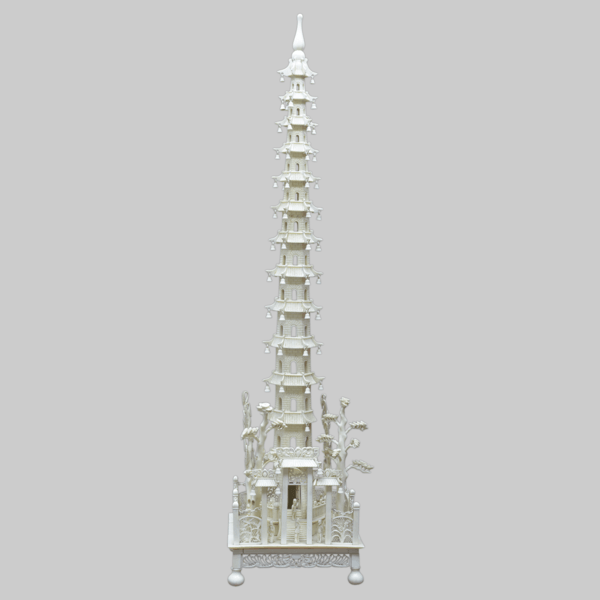
The pagoda shown on this model consists of thirteen tiers, located on a high square base, around the perimeter of which is a carved fence. A traditional Chinese ornament is carved in the intervals between its columns on a mesh background: flowers, trees, birds. The model is made from a single piece of elephant tusk in the shape of a hexagonal pyramid with prominent roof slopes, to which small bells are attached. On each side of all tiers there are high arched openings. In the foreground is the entrance to the pagoda along a wide staircase. Near the pagoda and on the ground floor, there are 23 figures of the temple devotees. Trees grow on the sides, between the fence and the first tier.
Ancient and new pagodas are present in Chinese monasteries and park. For the first time, according to historians, they appeared in the architecture of India. Pagodas have a special meaning for the Chinese — this is a sacred place regardless of religious teachings: Hindu, Taoist, Buddhist. The term ‘pagoda’ in Buddhism cannot be understood categorically, in their appearance they are very different, depending on location: in Cambodia, Laos, Sri Lanka, these were small rooms in which relics and shrines were kept and which are commonly called stupas; in Nepal, India, Japan, Vietnam, China, Tibet, Buddhist temples were erected in the form of towers with several tiers. Their main purpose was to store the remains of monks, saints or bodhisattvas, that is, people on the verge of nirvana, who do not take the last step while others suffer.
The first buildings of this type date back to the beginning of our era. The special architecture of any pagodas has its own meaning. Structures in several tiers reflect the cyclical repetition of events in human’s life, namely a movement in a spiral. It is generally accepted that the number of tiers also carries a meaning. So, the number seven indicates the 7 steps of Buddha, 7 heavens, 7 sages and 7 sides of the eternal spiritual and temporal material.
Other researchers say that the pagodas are a symbol of the sacred Mount Meru, the Buddhist center of the universe, on top of which deities live, and the Garden of Eden lies at its foot. Each of the tiers is a step to heaven, which you can reach if you constantly strive upward. At the same time, such a roof structure also has a practical purpose: the eaves, raised upward, help to retain moisture or snow, preventing them from flowing down, which would lead to the gradual destruction of the facade.
The model of the pagoda was presented to the Amur Regional Museum of Local Lore by the Chinese delegation in 1958 for the Blagoveshchensk’s 100th anniversary.
Ancient and new pagodas are present in Chinese monasteries and park. For the first time, according to historians, they appeared in the architecture of India. Pagodas have a special meaning for the Chinese — this is a sacred place regardless of religious teachings: Hindu, Taoist, Buddhist. The term ‘pagoda’ in Buddhism cannot be understood categorically, in their appearance they are very different, depending on location: in Cambodia, Laos, Sri Lanka, these were small rooms in which relics and shrines were kept and which are commonly called stupas; in Nepal, India, Japan, Vietnam, China, Tibet, Buddhist temples were erected in the form of towers with several tiers. Their main purpose was to store the remains of monks, saints or bodhisattvas, that is, people on the verge of nirvana, who do not take the last step while others suffer.
The first buildings of this type date back to the beginning of our era. The special architecture of any pagodas has its own meaning. Structures in several tiers reflect the cyclical repetition of events in human’s life, namely a movement in a spiral. It is generally accepted that the number of tiers also carries a meaning. So, the number seven indicates the 7 steps of Buddha, 7 heavens, 7 sages and 7 sides of the eternal spiritual and temporal material.
Other researchers say that the pagodas are a symbol of the sacred Mount Meru, the Buddhist center of the universe, on top of which deities live, and the Garden of Eden lies at its foot. Each of the tiers is a step to heaven, which you can reach if you constantly strive upward. At the same time, such a roof structure also has a practical purpose: the eaves, raised upward, help to retain moisture or snow, preventing them from flowing down, which would lead to the gradual destruction of the facade.
The model of the pagoda was presented to the Amur Regional Museum of Local Lore by the Chinese delegation in 1958 for the Blagoveshchensk’s 100th anniversary.