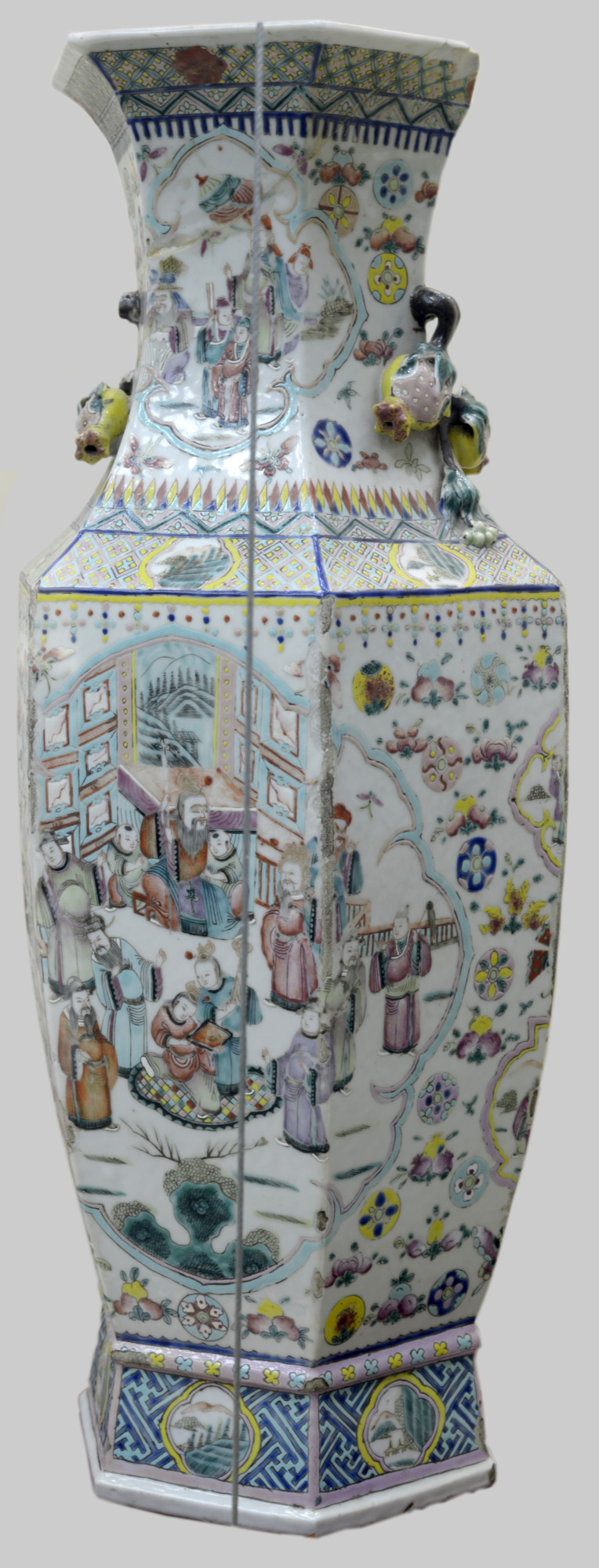


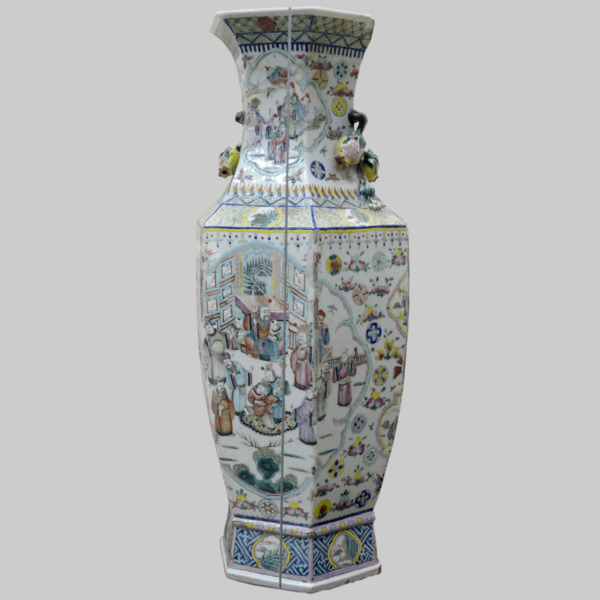
In front of us is a white porcelain vase with two small decorative plated handles on the neck. The body is hexagonal, cylindrical in shape, tapering at the bottom and smoothly turning into a wide neck at the top. The vase is decorated with multi-colored overglaze painting. The ornament is dominated by floral and geometric motifs: fruits, flowers, leaves, mosaics. Along the neck and vase’s body there are eight figured medallions of different sizes. Two of them are large, reflecting various leisure scenes of a small Chinese settlement. People are talking, walking, telling something to children. The rest of the medallions show one character each. The painting is so dense that it will take a lot of time to see all the details.
Porcelain has always held a special place in Chinese culture and art. The emperors passed on these fragile but durable items, because porcelain does not age. The first mention of porcelain in books dates to 620. For almost a thousand years, the Chinese kept the secret of its production. It is believed that hard porcelain was invented during the Yuan Empire (1271-1386), founded by the grandson of Genghis Khan, the Mongol Khan Kublai.
Such porcelain’s appearance was the result of the development and improvement of ceramics. Jingdezhen is still considered the world capital of porcelain. For a long time, China was a monopoly in the production of porcelain, sending it to different countries. This continued until the Europeans invented their own porcelain in Germany in 1708.
Two methods can usually be used to paint porcelain objects: overglaze painting and underglaze painting. In the second variant, the paint is applied to porcelain, which is not covered with glaze. This happens after the first firing, then the product is covered with a colorless glaze, subjecting it to another high-temperature firing. The peculiarity of overglaze painting is a richer array of colors. It is applied to already glazed porcelain and then processed in an oven. Due to this, the effect of a unique polychrome painting is achieved. Until the moment of firing, the porcelain maker sees the whole picture quite differently than after processing. He should always keep this in mind when applying the right paint to get the desired shade in the end.
The vase was donated to the Amur Regional Museum of Local Lore in 1990 by a museum employee.
Porcelain has always held a special place in Chinese culture and art. The emperors passed on these fragile but durable items, because porcelain does not age. The first mention of porcelain in books dates to 620. For almost a thousand years, the Chinese kept the secret of its production. It is believed that hard porcelain was invented during the Yuan Empire (1271-1386), founded by the grandson of Genghis Khan, the Mongol Khan Kublai.
Such porcelain’s appearance was the result of the development and improvement of ceramics. Jingdezhen is still considered the world capital of porcelain. For a long time, China was a monopoly in the production of porcelain, sending it to different countries. This continued until the Europeans invented their own porcelain in Germany in 1708.
Two methods can usually be used to paint porcelain objects: overglaze painting and underglaze painting. In the second variant, the paint is applied to porcelain, which is not covered with glaze. This happens after the first firing, then the product is covered with a colorless glaze, subjecting it to another high-temperature firing. The peculiarity of overglaze painting is a richer array of colors. It is applied to already glazed porcelain and then processed in an oven. Due to this, the effect of a unique polychrome painting is achieved. Until the moment of firing, the porcelain maker sees the whole picture quite differently than after processing. He should always keep this in mind when applying the right paint to get the desired shade in the end.
The vase was donated to the Amur Regional Museum of Local Lore in 1990 by a museum employee.


