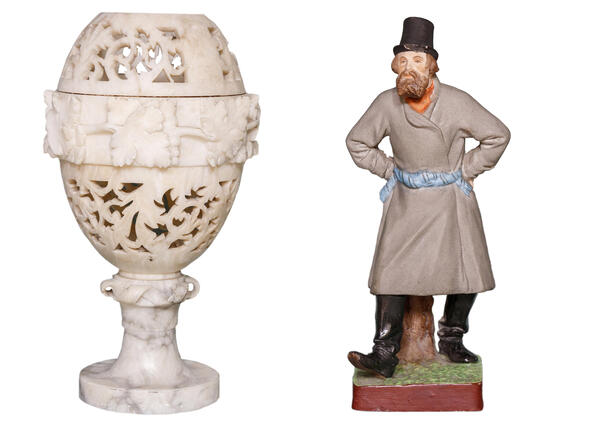
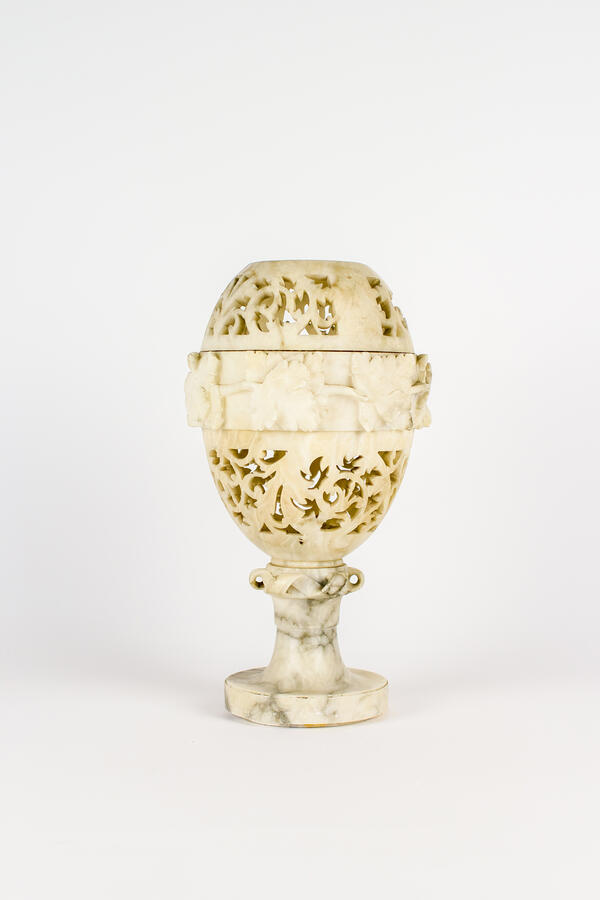
The egg-shaped marble vase with floral ornaments, according to researchers, belonged to one of the Tetyushi merchant families before the 1917 October revolution. After nationalization, it was transferred to the museum.
The patterns on the vase are made using the technique of openwork. The vessel rests on a grey marble stand.
The word “marble” came into Russian from Greek and in translation means “shining stone”. The first quarries appeared on the Balkan Peninsula in the archaic era. Marble was used not only to create sculptures but also in architecture. For example, the famous antique Parthenon temple was completely built from this material.
In ancient times, blocks of marble in quarries were marked with lines and chipped off with sharp iron or wooden gad pickers. Archaeologists claim that the Greeks used hand braces-- hand drills to work with marble. One person pressed on its support from above, and the second rotated the handle. To speed up and facilitate the process, water was constantly poured into the hole and quartz sand was filled up. The drills quickly grew blunt and it took over an hour to replace them — so it took a whole day to work with this tool. After that, the block, separated from the solid mass, was lifted using a complex system of levers and blocks. Pretreatment was carried out on-site, and then the workpieces were transported on rollers to construction sites or workshops.
In the sculptor’s workshop, the blank was placed next to the clay model. The artist carried out the markings, using a pair of compasses and a ruler, transferring the dimensions to the stone. He chipped off large pieces with a straight bit and further processed them with chisels, scrapers, and awl-shaped tips. Craftsmen carefully polished the stone surface to make the marble shine.
Since ancient times, marble vases have been one of the most popular interior decorations. In the 18th century, marble flowerpots were present in every noble house as a symbol of wealth and luxury.
The patterns on the vase are made using the technique of openwork. The vessel rests on a grey marble stand.
The word “marble” came into Russian from Greek and in translation means “shining stone”. The first quarries appeared on the Balkan Peninsula in the archaic era. Marble was used not only to create sculptures but also in architecture. For example, the famous antique Parthenon temple was completely built from this material.
In ancient times, blocks of marble in quarries were marked with lines and chipped off with sharp iron or wooden gad pickers. Archaeologists claim that the Greeks used hand braces-- hand drills to work with marble. One person pressed on its support from above, and the second rotated the handle. To speed up and facilitate the process, water was constantly poured into the hole and quartz sand was filled up. The drills quickly grew blunt and it took over an hour to replace them — so it took a whole day to work with this tool. After that, the block, separated from the solid mass, was lifted using a complex system of levers and blocks. Pretreatment was carried out on-site, and then the workpieces were transported on rollers to construction sites or workshops.
In the sculptor’s workshop, the blank was placed next to the clay model. The artist carried out the markings, using a pair of compasses and a ruler, transferring the dimensions to the stone. He chipped off large pieces with a straight bit and further processed them with chisels, scrapers, and awl-shaped tips. Craftsmen carefully polished the stone surface to make the marble shine.
Since ancient times, marble vases have been one of the most popular interior decorations. In the 18th century, marble flowerpots were present in every noble house as a symbol of wealth and luxury.