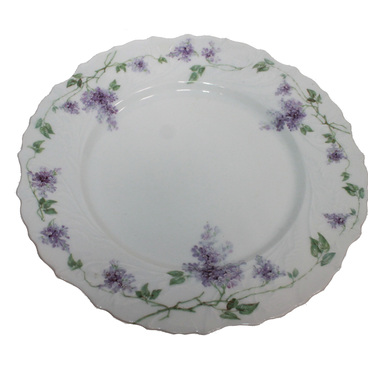
As evidenced by a customary print on the back, this plate was made and marked at the Dulyovo porcelain works owned by the M. S. Kuznetsov Partnership.


Plate
Creation period
Early 20th century
Place of сreation
Russia
Dimensions
3x24,5 cm
Technique
Molding, decal
Collection
Exhibition
1
Open in app#1
Plate
#3
#4
This porcelain company was founded by the merchant Terenty Kuznetsov from the Dulyovo wasteland (presently part of the Moscow Region) in 1832. As early as the first decades of operation, it became one of the leading porcelain factories in Russia. In 1864, the Dulyovo works became a property of Matvey Kuznetsov. The company reached its peak during the years of his management. In 1887, the factory joined the ‘Partnership for Production of Porcelain and Faience Items’, which was also founded by Matvey Kuznetsov. The items produced in those years were characterized by impeccable quality.
#5
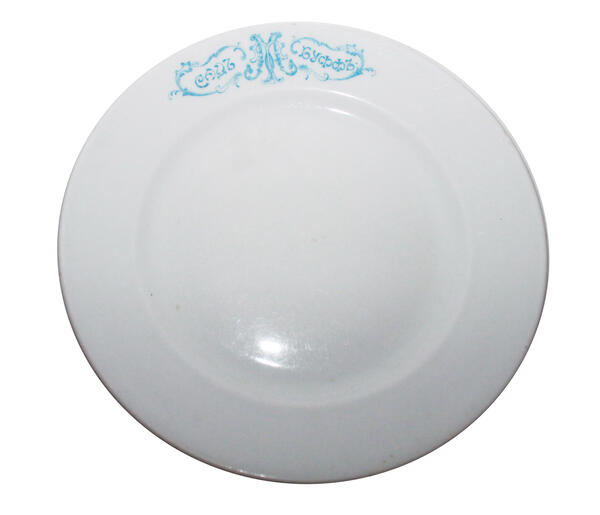
The plate from the museum’s collection is a mass-produced item lacking any ornamentation. In the Russian museum industry, such exhibits are known as “belyo” (literally: white goods). It is rather massive. The surface is covered with a thick layer of glossy, translucent glaze. The front side of the plate’s edge features a large light-blue print of its owner that was applied with the use of a stencil and consists of two intricate vignettes and the words ‘BUFF GARDEN.’ There is also a monogram of the letters ‘T’ and ‘M’ between the vignettes. Evidently, these are the initials of Tatiana Morozova. Furthermore, the markings indicate that the plate belonged to the Buff garden restaurant, which was owned by the wife of the wealthy merchant Vasily Morozov.
#6
What at first glance might seem like an ordinary faience plate used for public catering, is actually an item with historical significance for the city Tomsk. In the early 20th century, the Buff garden was one of the most popular spots among Tomsk citizens. Its history began in 1907, when the restaurateur Vasily Morozov acquired a preserved forest area in Tomsk after moving to the city from St. Petersburg. Morozov set up an entire park for recreation and entertainment, giving it a name that seemed unusual to the local population and translates from Italian as a ‘joke’, ‘fun’, or ‘mischief’. The park featured a summer theater with an indoor and an outdoor stage, as well as a shooting range, kiosks, a café, and a restaurant. One of the tableware items of that restaurant was our plate, produced at the factory of Matvey Kuznetsov’s partnership.
#7
Tomsk History Museum
read morehide
00:00
00:00
1x
Plate
Creation period
Early 20th century
Place of сreation
Russia
Dimensions
3x24,5 cm
Technique
Molding, decal
Collection
Exhibition
1
 Point your smartphone camera to open in the app
Open in app
Share