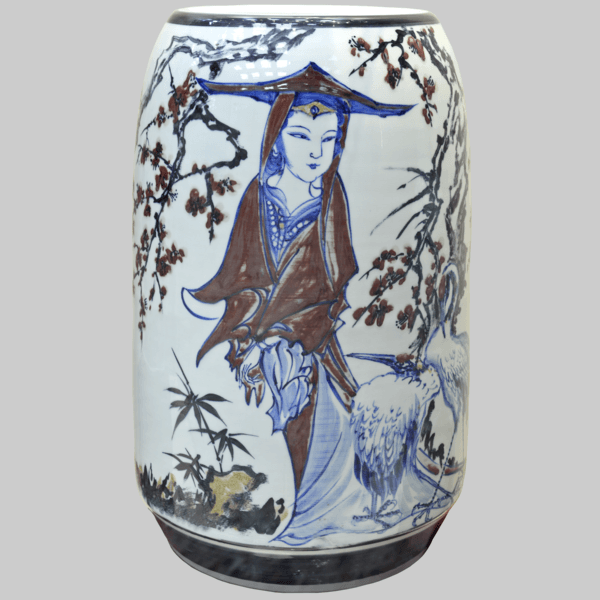
Decorative floor vase with painting was purchased in an art salon at the Harbin International Trade and Industry Fair in 1999. It is hand-painted in the artistic tradition of China. A blue-white porcelain vase has a cylindrical body, tapering downward, it smoothly merges into a small rim in the upper part. It is decorated with underglaze painting.
On one side of the vase’s body is a full-length image of a young woman, dressed in long national clothes of blue and red colors. She wears a wide-brimmed hat, similar to the roof of a pagoda, with a scarf hanging down. Next to the girl are two cranes, standing on the hem of her dress and preventing her from going further. Apparently, she persuades them to let her go. Around them are branches of wild plum. On the other side are hieroglyphs written in black and branches with red flowers.
Like all other porcelain items created in China, vases have always concealed a mystery, being something incomprehensible and mysterious, like everything oriental. They were often decorated with various stories: on friendship, on nature, on happiness. Porcelain items were supposed to bring people positive emotions, filling them with spiritual energy. The Chinese themselves spoke of porcelain as follows: it should be blue like the sky; sonant like a gong; thin as a sheet of paper and transparent as glass. The best porcelain samples from the Celestial Empire have always met the case.
Interest in such vases can be explained by the fact that oriental smooth forms provide a large area for artistic painting. They seem to become the canvas with which the artist works. The word “vase” in Chinese is similar in pronunciation to the word “world”, therefore they are a symbol of a harmonious peace, its undisclosed secrets and a sign of Buddha. The main feature of these items is the absence of sharp corners and straight lines. Depending on fashion and styles, the shape of the vases can change: the handles, bottom, base and neck change.
Each era in its own way imagined how vases should look. Once the narrow neck was the entrance to the other world of divine beings. It should be noted that the plots, the type of painting, the ornament had not only decorative functions, were not only decoration, but also endowed the item with a deep meaning. The symbols depicted on the vase could bring strength, luck and health to the owner.
On one side of the vase’s body is a full-length image of a young woman, dressed in long national clothes of blue and red colors. She wears a wide-brimmed hat, similar to the roof of a pagoda, with a scarf hanging down. Next to the girl are two cranes, standing on the hem of her dress and preventing her from going further. Apparently, she persuades them to let her go. Around them are branches of wild plum. On the other side are hieroglyphs written in black and branches with red flowers.
Like all other porcelain items created in China, vases have always concealed a mystery, being something incomprehensible and mysterious, like everything oriental. They were often decorated with various stories: on friendship, on nature, on happiness. Porcelain items were supposed to bring people positive emotions, filling them with spiritual energy. The Chinese themselves spoke of porcelain as follows: it should be blue like the sky; sonant like a gong; thin as a sheet of paper and transparent as glass. The best porcelain samples from the Celestial Empire have always met the case.
Interest in such vases can be explained by the fact that oriental smooth forms provide a large area for artistic painting. They seem to become the canvas with which the artist works. The word “vase” in Chinese is similar in pronunciation to the word “world”, therefore they are a symbol of a harmonious peace, its undisclosed secrets and a sign of Buddha. The main feature of these items is the absence of sharp corners and straight lines. Depending on fashion and styles, the shape of the vases can change: the handles, bottom, base and neck change.
Each era in its own way imagined how vases should look. Once the narrow neck was the entrance to the other world of divine beings. It should be noted that the plots, the type of painting, the ornament had not only decorative functions, were not only decoration, but also endowed the item with a deep meaning. The symbols depicted on the vase could bring strength, luck and health to the owner.