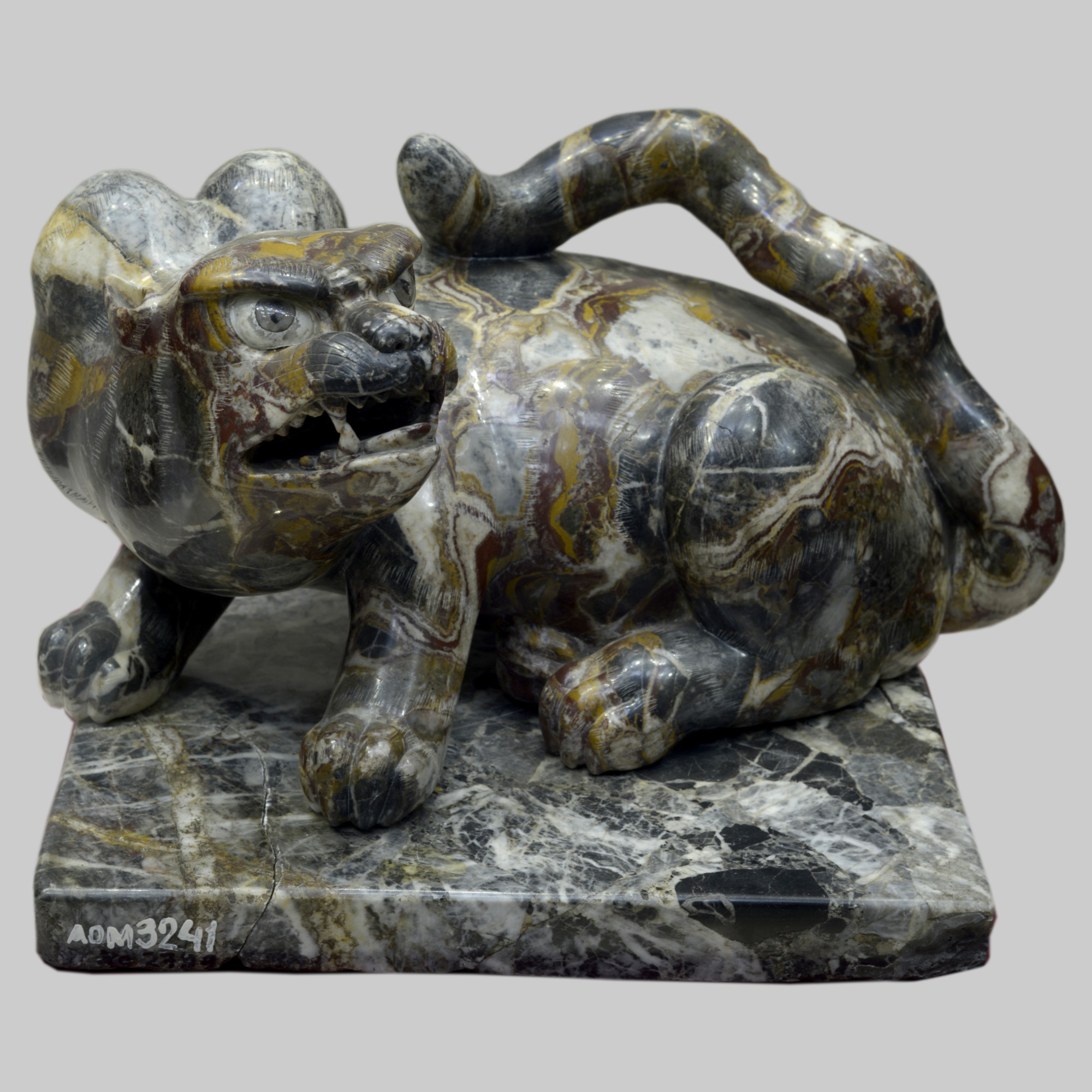


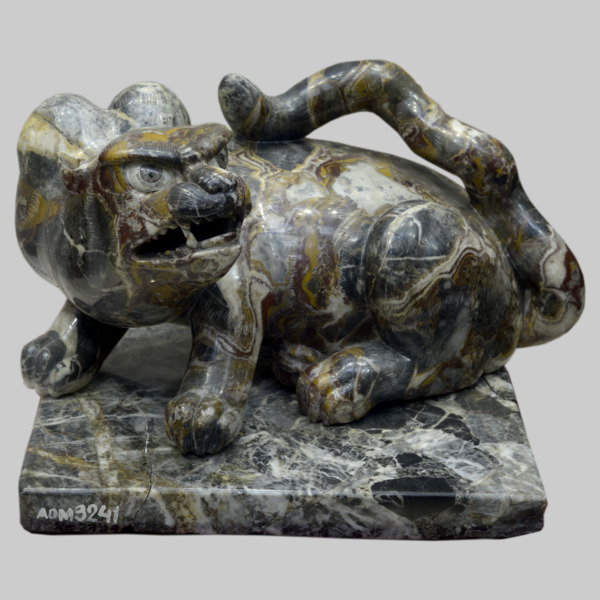
The sculpture of a tiger on a platform is an item from the first acquisitions of the Amur Regional Museum of Local Lore. It is made using the technique of stone carving and represents the figure of a tiger lying on a rectangular platform with a raised head, a bared mouth and a bizarrely curved tail. The stone combines dark gray, white and light brown tones.
It is generally accepted that stone carving is the oldest art form in China that appeared more than four thousand years ago. Today the artists carefully keep all the secrets, only they know how incredible works can be created from the simplest cobblestone. In the West, the stone is valuable for its even color, and in the East, stone-cutters are attracted by the whimsical form and original color combinations. An old proverb says that ‘the price of gold can be named, but jade is priceless’. In ancient times, it was considered a sacred stone. Its color can be completely different: from milky-white to dark green. Jade has always personified power; only residents of the Forbidden City could wear jewelry made of it.
Masters from the Celestial Empire also worked with jasper, or imperial jade, which was considered the embodiment of the creative power of Heaven and human virtues, it contained the Yang energy. In ancient times, rounded discs made of this material, like the firmament, and square shapes, like the sign of the Earth, were used in religious and cult rites. Jasper was used to make weapons for rituals, masks and decorations. Small particles of this stone were placed in the mouth of the dead, and his clothes were fastened with clasps made of it.
In course of time, the carving became more and more artistic: figures of real and mythological animals were made from jasper, they were used to make household items. The jasper seal was an integral attribute of the ruler and people close to him.
The jewelers used agate, chalcedony, rock crystal, amethyst, coral in their work. These stones were used to create all kinds of jewelry, utensils for storing medicines or cosmetics.
A distinctive feature of Chinese carvers has always been an attitude to the naturalness of the stone, so that it is the way nature made it. This is what inspires craftsmen to create real masterpieces. Therefore, when choosing a stone, the master studies it for a long time, and during the work uses everything that is in the stone — any spots and interlayers.
It is generally accepted that stone carving is the oldest art form in China that appeared more than four thousand years ago. Today the artists carefully keep all the secrets, only they know how incredible works can be created from the simplest cobblestone. In the West, the stone is valuable for its even color, and in the East, stone-cutters are attracted by the whimsical form and original color combinations. An old proverb says that ‘the price of gold can be named, but jade is priceless’. In ancient times, it was considered a sacred stone. Its color can be completely different: from milky-white to dark green. Jade has always personified power; only residents of the Forbidden City could wear jewelry made of it.
Masters from the Celestial Empire also worked with jasper, or imperial jade, which was considered the embodiment of the creative power of Heaven and human virtues, it contained the Yang energy. In ancient times, rounded discs made of this material, like the firmament, and square shapes, like the sign of the Earth, were used in religious and cult rites. Jasper was used to make weapons for rituals, masks and decorations. Small particles of this stone were placed in the mouth of the dead, and his clothes were fastened with clasps made of it.
In course of time, the carving became more and more artistic: figures of real and mythological animals were made from jasper, they were used to make household items. The jasper seal was an integral attribute of the ruler and people close to him.
The jewelers used agate, chalcedony, rock crystal, amethyst, coral in their work. These stones were used to create all kinds of jewelry, utensils for storing medicines or cosmetics.
A distinctive feature of Chinese carvers has always been an attitude to the naturalness of the stone, so that it is the way nature made it. This is what inspires craftsmen to create real masterpieces. Therefore, when choosing a stone, the master studies it for a long time, and during the work uses everything that is in the stone — any spots and interlayers.