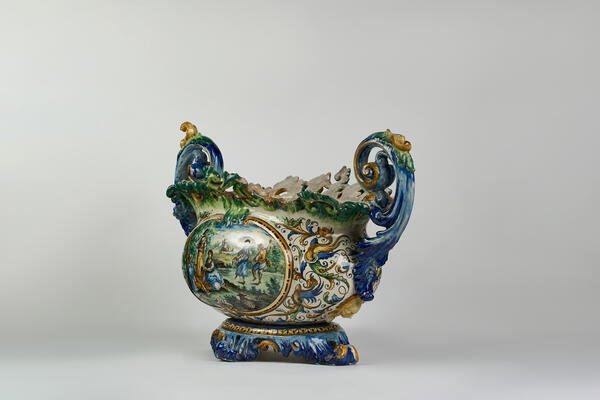
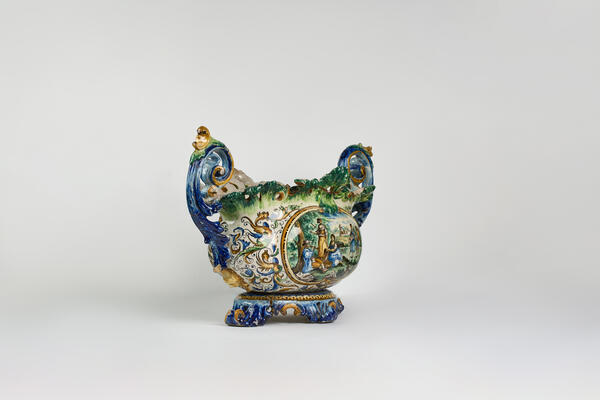
The wide vase with two handles entered the gallery’s collection in 1918. There are two medallions on its side walls that depict religious and genre scenes “The Appearance of Three Angels to Abraham and Sarah” and “Rural Scene with a Landscape”. It was kept in the collection of Otto Yakovlevich Wiblinger, an Austrian merchant who lived in Astrakhan from 1893 to 1914. He was engaged in the export of black caviar to European countries. On the eve of the First World War, in the summer of 1914, he left Russia and never returned. Wiblinger’s collection remained in his estate and subsequently formed the basis of the collection of the Astrakhan Art Gallery named after Pavel Mikhailovich Dogadin.
The art of painting dishes in European countries was primarily associated with earthenware, in particular, Delft pottery, Rouen and Turkish faience, and Italian maiolica.
European porcelain was invented in the 18th century. The article “From the History of European Porcelain”, published in the journal “Herald of Culturology”, characterizes porcelain production in Europe as follows,