Okimono art is a type of Japanese miniature sculpture that has recently begun to attract the attention of modern Orientalists. Since the late 20th century, there have been only minor mentions of okimono in research on netsuke (a small sculpture with holes for a cord), so attribution is rather challenging.
The term “okimono” has been used since the Kamakura era (1185–1333).
The collection of okimono statuettes housed in the Astrakhan Art Gallery probably includes artifacts made in the second half of the 19th century.
Okimono, as a type of miniature decorative sculpture, became widespread around the 16th century, when the Japanese began including a special niche — tokonoma — in their homes. A beautiful scroll, ikebana or small statuettes of Buddhas and Bodhisattvas were displayed in a tokonoma.
Over time, the themes and subjects of miniature statuettes expanded. The engravings of the Edo era (1603–1868) show a variety of okimono sculptures. Those were figures of saints, monks, animals of the Sexagenary cycle (12 creatures of the Eastern horoscope), and the seven deities of fortune. Such figurines were purchased not only to attract good luck, but also as a memento of a pilgrimage to a remote temple, and as a gift, or simply as an element of interior design.
The Japanese reforms and revolution during the Meiji era (1868–1912) had a significant impact on the development of okimono. It was, on the one hand, the time when Europeans discovered Japan, but on the other — it was the period when the Japanese actively learned and appreciated European culture. All spheres of life in Japan were reformed to one degree or another: economics, art, education and even everyday routines.
The spread of European-style clothing led to the gradual disappearance of netsuke as an obligatory element of the costume. So, the need for its mass production disappeared, and a significant number of craftsmen began making okimono. Today, okimono statuettes are viewed as collectibles by many European, American, and Russian private collectors and museums. Thus, it can be said that in the modern understanding of this term, okimono is the result of a dialogue between Japanese and European cultures. This craft is the least studied in Japanese visual art.
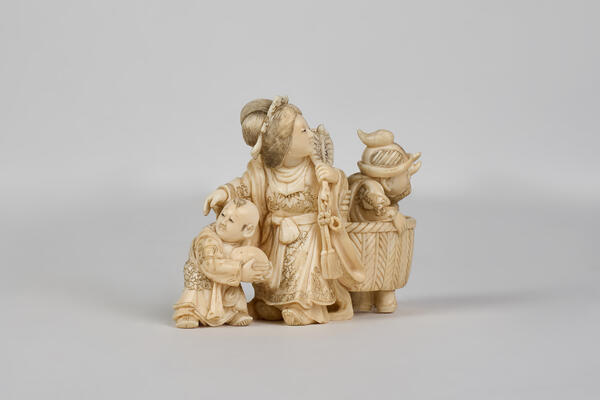
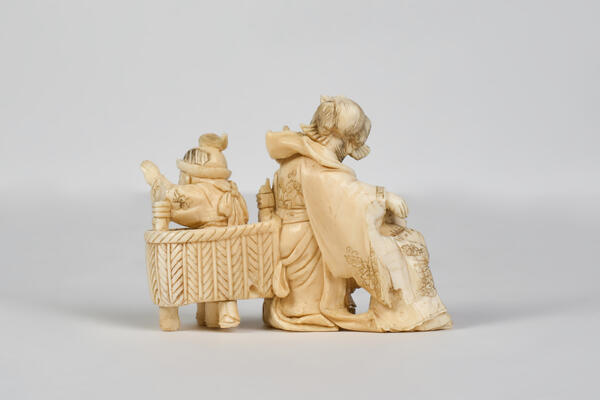
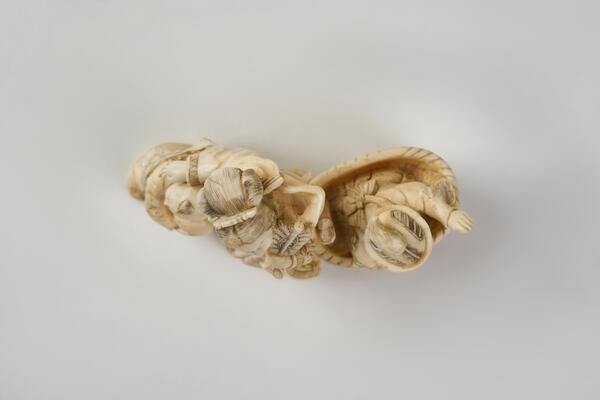
The okimono figurine presented in the Collection of Foreign Art is a finely executed genre scene: with one hand a woman hugs a child playing ball, while the second child sits in a wicker stroller and waves its hand.