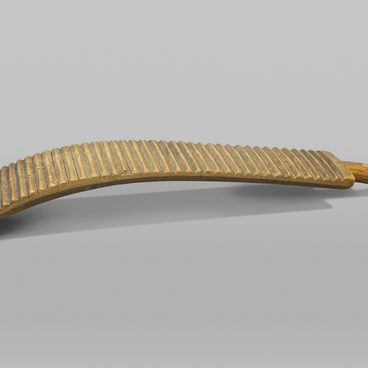
The paddle is an ancient hand tool made of wood that was used to speed up the washing and rinsing process. It was known in Russian under various names, like valyok, varda, kolotilka, lapta, portomoynik, and pralnik. The paddle was created in the shape of a curved wooden plate with a short handle that could be gripped with one hand. Traditionally, the plate tapered towards the handle.
To make a paddle, craftsmen used hardwood such as birch, linden, aspen, and white willow. The surfaces of the paddles were usually smoothed, although some were decorated with carvings on the upper surface. These were often made as gifts for girls and could be designed in the shape of a stylized female figure with a roller plate for the body and a handle with a rounded thickening at the end for the head and neck.
This device spread all over Russia. As a rule, the paddle was used for washing coarse items such as bags, rugs, bedding, quilts and sweatshirts. Laundry that was heavily soaked with washing solution or water (for rinsing) was arranged in a pile on a wooden platform over the river. The paddle, held by its handle, was used to hit with its lower surface against a piece of linen until it knocked the liquid out.
After that, the items were rinsed again in a washing solution or water and beaten until they were clean. Washing was traditionally a woman’s task. From early spring to late autumn, women would do this in running water outdoors, kneeling on wooden platforms. Each village usually had its own designated spot on the river where all the local women would gather at a certain time to do the laundry and talk about everyday life while they worked.
The housewives of the
past had a variety of “soap-free” laundry recipes up their sleeves. If the
linen lost its original whiteness after prolonged use, they would place it in
sour milk for two to three days. To wash, they used a decoction of beans, and
potato water, which was obtained by rubbing the tubers and adding the mass to
warm water. They also used egg yolk, which they would rub onto stains on wool
clothes before washing them.