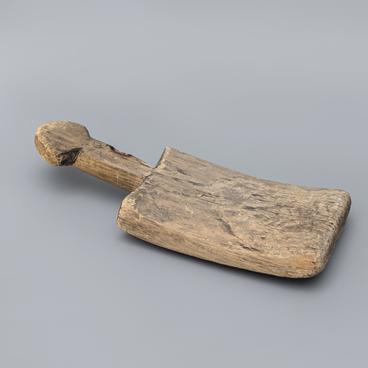
The rubel was a Russian ironing tool. It was a wooden plate, at the end of which there were one or, sometimes, two handles. On the working surface of the plate, craftsmen carved transverse, rounded grooves. The other side of the plate was usually smooth, but sometimes decorated with intricate carvings, such as floral or animalistic ornaments, tinted in different colors or a diverse geometric pattern.
Hardwood, such as oak, rowan, beech, maple, and birch, was used to make rubels. The wood was treated manually, and the ends of the rubel were sawn off smoothly, with sharp edges rounded with a file. A handle was cut from the same piece of wood as the board. The finished products had an even or slightly arched shape.
Rollers were cut out on the lower surface of the rubel. To do this, places for depressions were marked on the surface with lines at certain intervals, after which cuts were made to a depth of about one centimeter. The wood was cut from the edges of the grooves with a mortise chisel, and then the resulting sharp edges were smoothed, giving them a rounded shape.
In ancient times, washing was a tedious process that required a lot of patience from a woman. Back then, only lye was available for washing — a corrosive solution of ash that was used to soak laundry and boil it in a stove. After boiling, the laundry would be beaten out and then pressed by hand or wound on a roller or rolling pin and evened out using a rubel.
Freshly washed and still damp, laundry was wound around a rolling pin. A rubel was placed on the top, with its serrated side facing down. The rubel was rolled several times, with the wooden tool pressed with both hands, by the handle and the opposite end.
The rubel could be given
as a gift. Sometimes, a dedicatory inscription would be carved on the unused
surface. For example, a groom could present a rubel to a woman he wished to
marry, while also testing her skills. If a woman could handle the rubel with just
one hand, it suggested her strength and ability to manage a household.