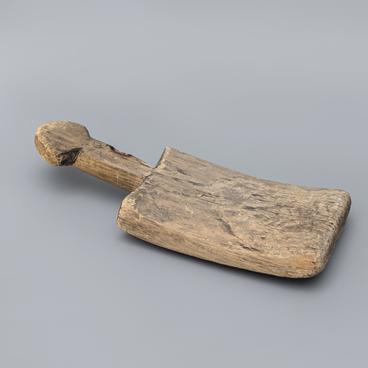
The first documented written mention of a metal clothes iron in Russia dates back to the mid-17th century. In the book of expenses of the tsar’s court, it was recorded that on February 10, 1636, the blacksmith Ivan Trofimov made a clothes iron for the royal chambers and was paid five altyns. During this time, Russia was reigned by Mikhail Feodorovich, the first Tsar of the House of Romanov.
It is known that the first metal irons were solid cast. To smooth clothes with such an appliance, the iron had to be pre-heated by placing it in a hot oven or on hot coals. It took about half an hour for the cast iron to heat and significantly less to cool, making the process of ironing rather difficult. Moreover, the iron’s handle also heated up. As a result, to iron the laundry, one had to wrap the handle in a potholder.
Over time, cast irons improved significantly. They started to be made in pairs. One handle was used with two metal soleplates. The handle could be inserted into the soleplate or attached to it as a clothespin. As a result, one plate could be heated, while the other one was used, allowing for an uninterrupted ironing process. This was also more economical in terms of metal consumption.
Irons were an expensive household item. Throughout the centuries, they were passed down from mother to daughter. A clothes iron was a symbol of wealth and prosperity. Sometimes, it was even displayed as a decorative item next to the samovar on a tablecloth. Some blacksmiths took a creative approach to iron making, turning a simple appliance into a true work of art. Irons could take the shape of dolphins or ships.
While the simplest irons were made of cast iron, the more expensive ones were made of bronze, which could even have silver inlay. To prevent the handle from heating, it was sometimes made of wood. The industrial production of cast iron clothes irons in the Russian Empire started in the 18th century at the Demidov factories. Before that, they were made in blacksmith’s shops.
The collection of the Nizhny Lomov Museum of Local Lore features several irons of this type. Despite its compact size, each of the museum irons weighs about three kilograms.