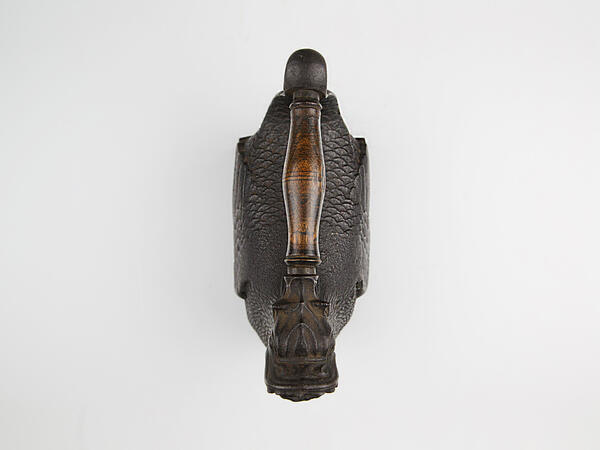
The Historical and Memorial Museum of the Demidovs presents an iron in the shape of a chicken produced at one of the Demidov factories. An iron could be made in the shape of anything (rooster, dragon) and decorated with inlaid copper on an iron base or silver pattern. Handles for these devices were most often made of wood and were mostly smooth, but could also be given a wavy shape.
Irons for smoothing clothes existed for a long time, but the first ones were very different from the ones used today. The first irons were made of a solid piece of cast iron. Boat-shaped irons were the most common yet not very convenient. Rich households could afford irons with original designs and shaped like fantastic animals, fish or birds. Such irons could weigh up to 5 or even 10 kilograms; when using them, the handle would get very hot and could cause burns. There were also miniature irons made of cast iron. They were heated on the stove and designed for removing creases in places where precision was needed. These small irons had a major flaw — they cooled down too quickly.
The middle of the 19th century saw the rise in popularity of charcoal irons. They were a bit like miniature stoves. Coals were collected with a special shovel and poured inside the iron, after which the lid was closed. For the coals not to go out and maintain the level of heat necessary for ironing, the sides of the iron featured special holes for allowing air inside. To ensure good ventilation, some irons were supplied with a pipe and even had a special name which translated to “oven iron” from Russian. Often they were adorned with decorative elements, and the iron stood next to the samovar as the pride of the household.
German alcohol-fueled irons began to appear in Russia in the 19th century. The way they worked was pretty simple: when operational, the alcohol went inside the iron and released heat during combustion. In Russia, they never caught on, due in some part to the rather high cost. To fan the coals, the iron had to be vigorously waved around from time to time. At the same time, one needed to maintain complete control of the situation, as an escaped piece of charcoal could burn clothes or cause a fire. Therefore, to increase safety, the design of the iron was slightly changed — instead of the coals, a blazing-hot piece of cast iron was placed inside the iron. Such irons too presented a number of disadvantages: they were heavy, bulky, were an injury hazard, and, last but not least, cost a lot of money.