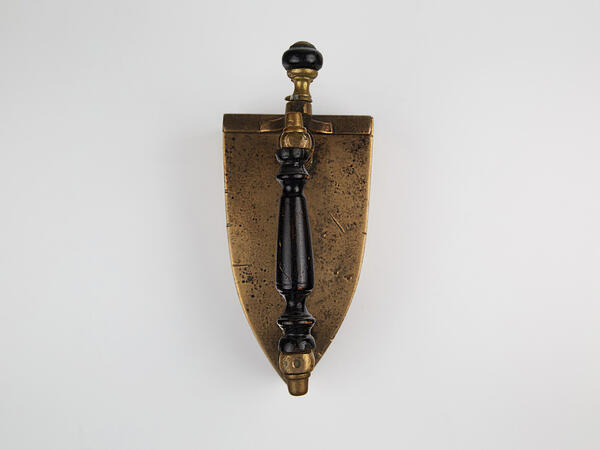
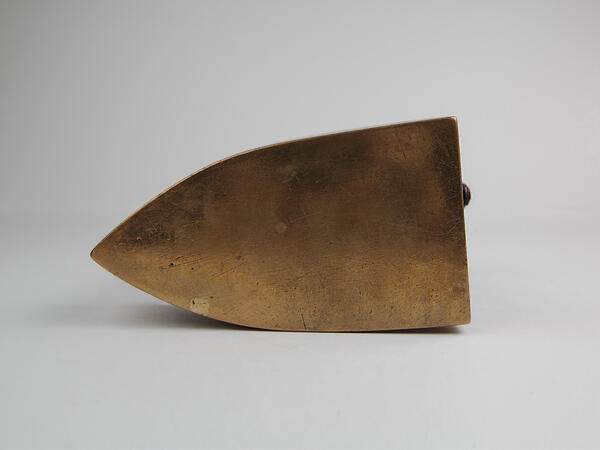
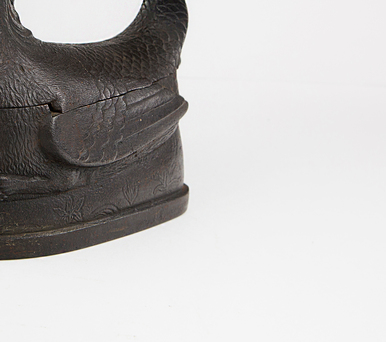
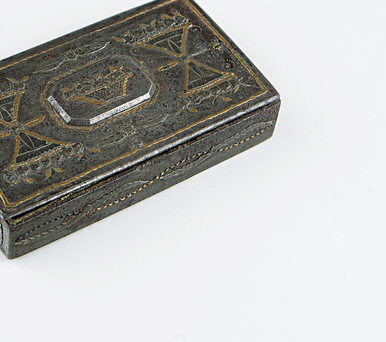
The Historical and Memorial Museum of the Demidovs presents one of the most important household items — an iron.
The first device for smoothing clothes was, most likely, a flat heavy stone. The rock paintings of the ancient Aztecs depict the clothes smoothing process as follows: clothes were spread out on a flat surface, pressed down with a stone and left under it for a while. An iron heated by burning coals inside appeared only in the middle of the 18th century. Before that, clothes were ironed with a tool very similar to a large frying pan. Some time later, people began using two irons: while one was being heated on the stove, the other was used for ironing.
At the end of the 19th century, gas irons were introduced. They worked the same way a gas stove does — the iron was heated by burning gas. A metal tube was inserted into the body of such an iron, with the tube’s outer end connected to a gas cylinder. The gas pump was located on the lid of the iron. The pump was used to push the gas inside the iron, where it would burn and heat the sole of the iron. The closest predecessor of the modern iron was the charcoal iron. At the beginning of the 20th century, a safer alcohol-fueled iron, which was safer than the gas iron, became increasingly popular. In 1913, it was advertised in magazines. It used the same principle as the kerosene lamp: the alcohol inside the iron was lit, thus, heating the surface of the iron. It didn’t take much time to get such an iron hot and it was fairly light, however, it cost much more than one would wish to spend.
The iron on display in the museum was named “Empire”, after the style popular in the architecture and decorative art of the first decades of the 19th century. In Russia this style was very short-lived, however, it managed to absorb the essence of the time period, with all its variety of crafts and techniques. Empire style in 19th-century Russia manifested itself most vividly in architecture, interior design, decorative and applied art of the Empire’ capital. Empire style is rightfully called “royal” or “imperial”, as it sought to convey all the power and majesty of the state.