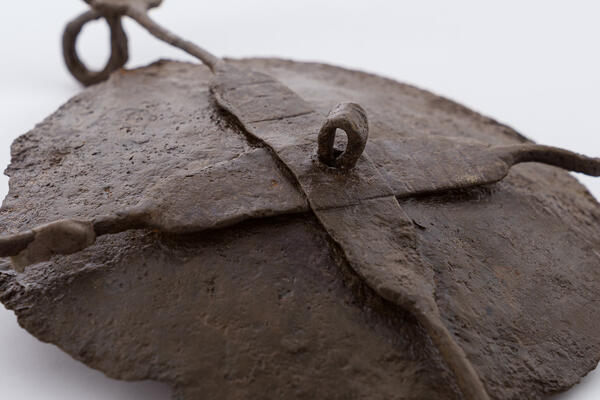
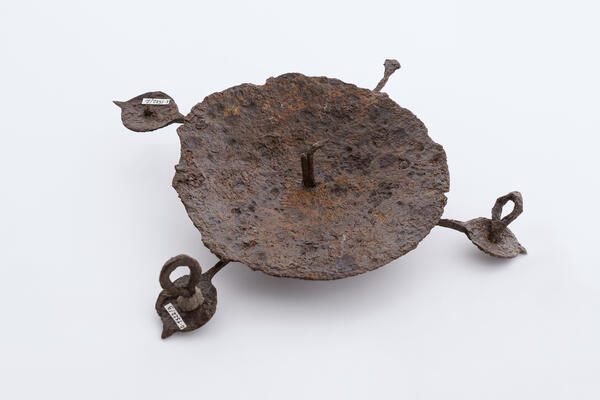
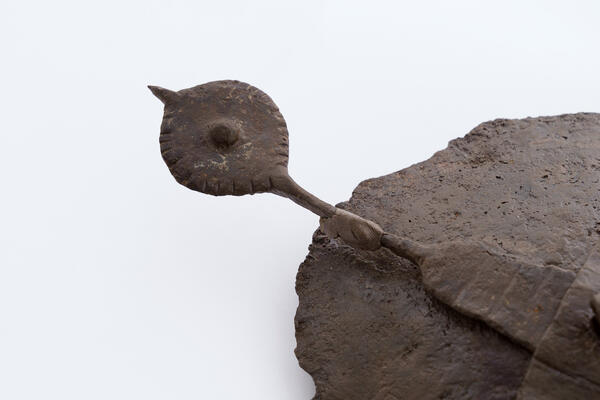
The hall “Rus and Horde: 14th Century Warfare” of the State Museum-Reserve “Kulikovo Field” features an iron shield boss (also known as umbo) with its related forged ironwork.
Due to the fact that the base of the shield was made from organic materials — wood and leather — which did not survive well in the ground, archaeological research has revealed mainly metal parts of the shield — the boss, as well as the edge metalwork.
Judging by the available evidence, the manufacture of shields in Russia was widespread during this period. Written sources mention shield makers more than once and in different regions, indicating a significant presence of this craft. However, actual Russian shields from this era have not been preserved in archaeological records, making it difficult for scholars to study them in detail. Instead, researchers must rely on visual representations such as images and descriptions to form an understanding of these shields. These images mostly depict fairly large triangular shields, with less common examples of rounded shields also existing. Detailed images suggest that these shields were deep in design and resembled a flattened funnel in shape.
The modern idea that Russian shields from the period of the Battle of Kulikovo, following the model of West European shield makers, were painted with various scenes or heraldic symbols, is erroneous. Based on frescoes and miniatures from the second half of the 14th century, it can be argued that these Russian shields were painted in bright but monochrome colors and had no metal reinforcing elements.
The shield boss presented in the museum-reserve is referred to the armory adopted in the army of “temnik” (general) Mamai. It was a metal element of a wooden shield that was round or rectangular in shape. The owner of this shield was an Adyghe warrior. Metal elements like this were relatively common finds in the burials of the North Caucasus at that time, which was the territory where the Adyghe tribes lived. According to written sources, it was the Circassians, one of the Adyghe tribes, that Mamai, the commander of the Golden Horde, recruited as mercenaries into his army. As for the Tatars themselves, all sources from that period indicate that they did not use shields.