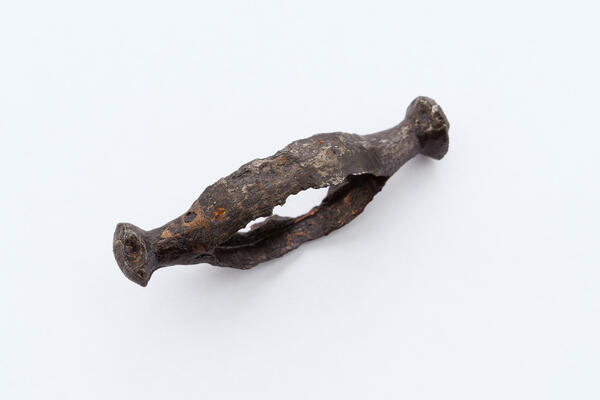
The saber guard on display at the State Museum-Reserve “Kulikovo Field” is part of a saber, a long-bladed offensive weapon from the 13th–14th centuries.
A saber is a weapon with a long, curved blade that has one side sharpened, and a handle tilted towards the blade. Swords were originally designed as horsemen’s weapons, and until the 15th century, they were exclusively used by mounted warriors. The saber is a relatively young type of weapon.
Appearing in their current form at the turn of the 8th century, they quickly spread from Japan to central Europe and the Balkans. They initially became widespread in the military cultures of nomadic societies.
During the 13th and 14th centuries, both the saber and the sword were popular in Russia, but by the mid-15th century, the sword had fallen out of use among Russian soldiers. For the Golden Horde warriors, however, the saber continued to dominate their weaponry throughout the history of their state.
The displayed guard is quite a sophisticated product, as several techniques were used in its production, including forging, swaging, copper soldering, and complete copper plating. Copper soldering was less energy-intensive than forging welding and required less skill from the craftsman, making it possible to mass-produce the necessary product. This demonstrates the advanced level of the Golden Horde’s workshops, or “karkhane”, which were effectively factories where craftsmen specialized in specific tasks.
Similar craft centers were discovered during archaeological surveys at the site of Old Sarai, one of the largest cities of the Golden Horde. Archaeologists identified a process pond, from which water was taken for production needs. As for the presence of craft workshops in the Horde, it is confirmed by indications of workshop positions on funerary tombstones in Crimea during the rule of “temnik” (general) Mamai.