The Sarmatians were a group of Iranian-speaking tribes who were related to the Scythians and Sauromatians.
They originated in the steppes of the Volga and Southern Urals regions, and eventually spread across the Eurasian Steppe from the Tobol to the Danube rivers. The Sarmatians first appeared in the Don and Azov steppes in the 4th century BCE.
In the area around the Alitub farm in the Bagayevsky district of the Rostov region, a significant group of burial mounds from the Sarmatian period has been excavated. In one of these kurgans, known as “Krestovy”, the remains of a rich nomadic woman were discovered. This woman was a member of the elite in one of the Sarmatian tribes. Her clothing, headdress, and bag were decorated with gold plaques.
There was a golden torc on the neck vertebrae of the individual. The torc is made from wire that is circular in cross-section. A beaded necklace made of carnelian and glass was also discovered there. Some beads were located near the cuffs of her sleeves. In addition, there were large multicolored glass beads and a bronze bracelet.
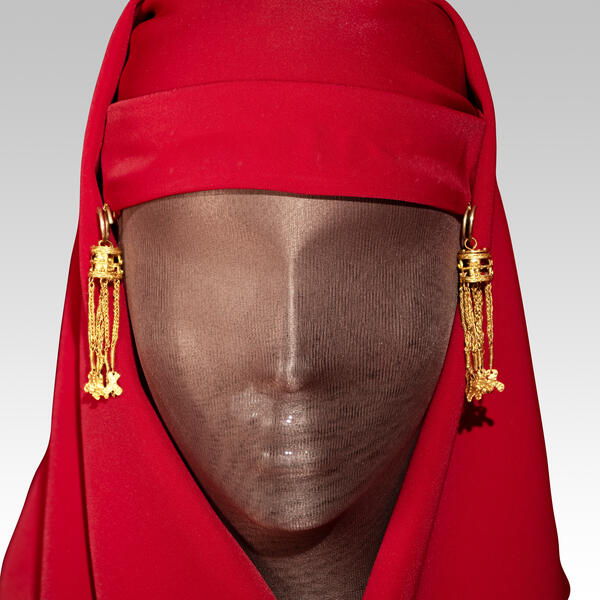
Two elegant golden earrings lay near the temporal bones of the woman. They are cylindrical in shape. On one side, there is a ring made of wire for attaching to a headdress. On the other side, chains with curled plates are suspended from the cylinders. The earrings are made in the filigree technique and are decorated with granulation — small golden granules.
Filigree is a technique that involves creating openwork patterns or soldered designs using wire. Most often, filigree work was done in silver, although the patterns could also be made from gold and other metals. Both silver and gold are soft metals that can be easily drawn into very fine wires.
The wires for decorative patterns could be smooth or twisted into ropes or spirals. Filigree products were often additionally decorated with granulation — tiny gold or silver granules.
The grave goods also included weapons, such as trilobate socketed iron arrowheads. This allowed the researchers to classify the burial as one belonging to the so-called “Amazon” warriors.
The burial from the “Krestovy” kurgan is associated with the final period of the Early Sarmatian culture, and is dated to the 2nd–1st centuries BCE.