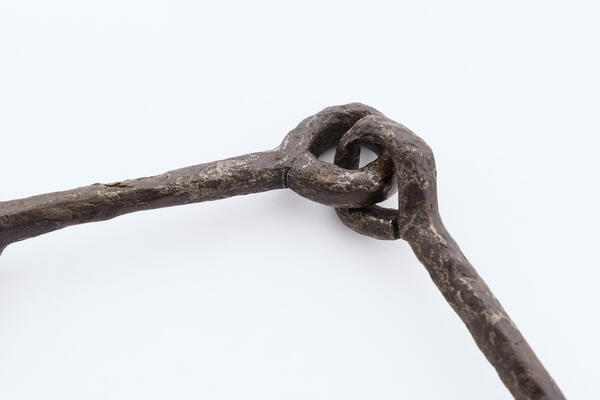
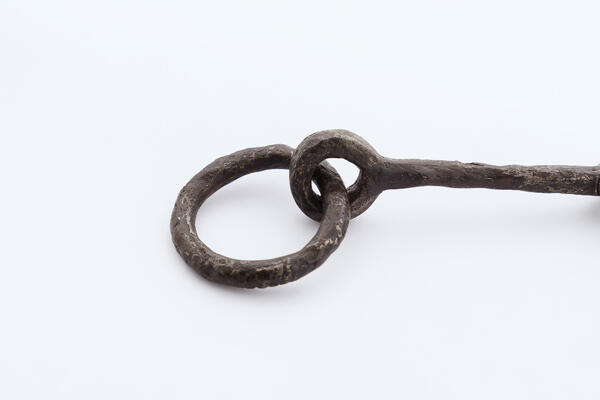
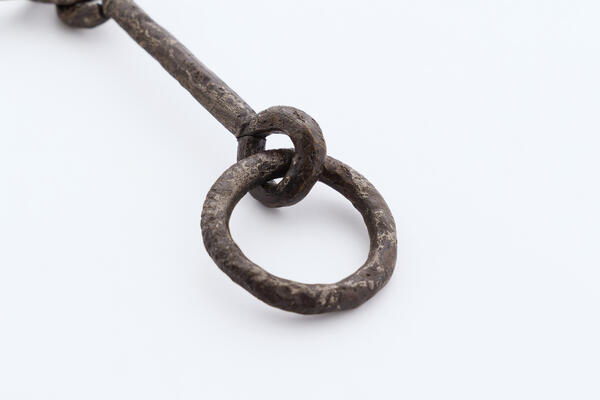
The bit presented at the State Museum-Reserve “Kulikovo Field” in the hall “Rus and Horde: 14th Century Warfare” is part of a horse’s tack — a detail of a bridle from the 11th–17th centuries. It consists of a pair of mouthpieces with a hinged joint and two snaffle rings. The cross-section of the mouthpieces is rounded, and that of the snaffle rings is oval. Both mouthpieces are made in the form of a rounded bar with rounded loops at each end.
Over the centuries, humans have developed a number of tools to help them control horses. One of these tools is a bridle, which is a piece of harness placed on a horse’s head to help control it. A bridle consists of straps made from leather or fabric, metal bits, and reins. The bit is the most important part of the bridle, as it is what actually controls the horse. When the reins are pulled, the bit forces the horse’s head and then the entire body to turn in a specific direction.
There are three types of bits based on their strength of effect on the horse: a snaffle bit, a curb bit, and a pelham bit. A snaffle bit consists of a mouthpiece and two rings that are attached to the bridle cheekpieces. This type of bit was most commonly used in Ancient Rus. The bit on display at the museum-reserve is a snaffle bit.
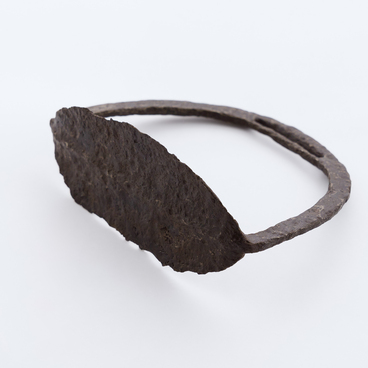
Farriers (“uzdniki”) were engaged in the manufacture of horse harness, which was a widespread item. This specialization dates back to the 10th century. Fishing gear smiths (“udniki”) made fishing gear, such as hooks, spoon lures, and harpoons. Armorers (“bronniki”) made chain mail and coifs, while bladesmiths (“oruzheyniki”) produced swords, sabers, daggers, and blades. Toolmakers crafted files, chisels, cutters, and stamps, as well as calking tools and tweezers. Ax smiths (“sekirniki”) made items like axes, adzes, wood chisels, plowshares, and barking knives. Farriers made bridles, stirrups, horseshoes, fetters, spurs, scrapers, whips, decorative tack accessories, harnesses, and other items of equipment for war horses.
Literary accounts of the Kulikovo cycle, including chronicle evidence of the Battle, describe Russian troops as exclusively mounted on horses. Khan Mamai’s army also consisted exclusively of mounted soldiers.