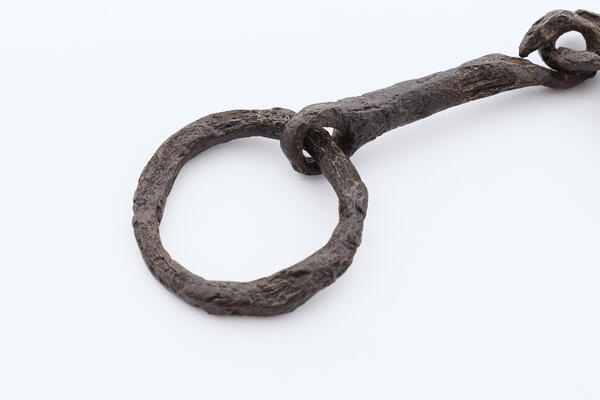
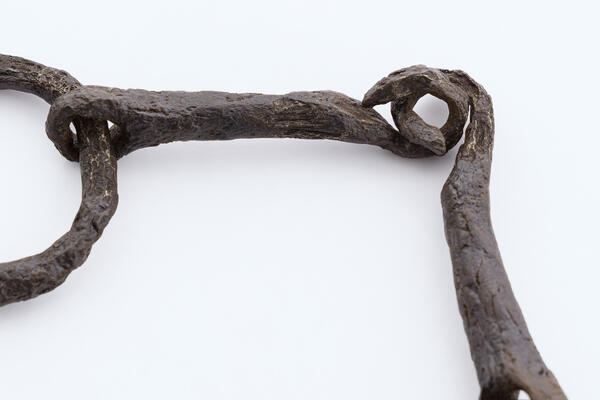
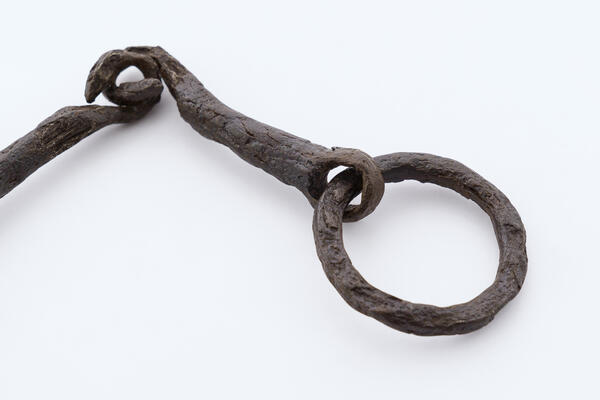
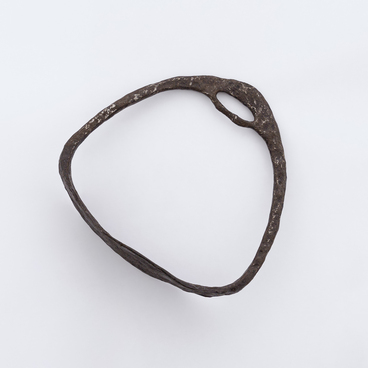
The bit is an item of a horse’s tack and a detail of the bridle from the 13th and 14th centuries. The bit on display at the exhibition consists of two mouthpieces and two snaffle rings. The item was discovered during the excavation of the Timofeyevka settlement, Dubensky District, Tula Oblast, which is also known as the chronicled city of Volkonesk and the capital of the Volkona principality.
Humans learned to control horses a long time ago, but until the 19th century, horse riding was closely associated with warfare. Over the course of many centuries, humans have developed a number of tools to help them control horses. One of these tools is the bridle.
A bridle is a type of harness placed on a horse’s head to control it. It consists of leather or fabric straps, metal bits, and reins.
The bit is the main structural element of a bridle, which is a device used to control a horse. There are three types of bits based on their strength of effect on the horse: a snaffle bit, a curb bit, and a pelham bit.
A snaffle bit consists of a mouthpiece and two rings that are attached to the bridle cheekpieces. This type of bit was most commonly used in Ancient Rus. A curb bit is a solid piece of iron that has a stronger effect on the mouth of the animal than a snaffle. It can be bent in order to affect the palate of the horse. The more curved the mouthpiece is, the stricter it is, which means it provides more precise control. A pelham bit has a movable mouthpiece and is similar to a curb bit, but with a snaffle. In terms of pressure exerted, it occupies an intermediate position between a snaffle bit and a curb bit.
By the type of bit used, experts can determine the battle tactics employed by one side or the other. For example, heavy cavalry using linear tactics, also known as “ramming, ” was a feature of European knights, distinguishing them from warriors in other regions who used mouthpiece bits for more rigid control over their horses. In Rus and the Golden Horde, ordinary bits with snaffle rings were used.
Clashes between Russian and Golden Horde warriors occurred in a different way than in Europe, where cavalry would line up to attack. This can be seen from the few references in chronicles that indicate Russian detachments formed in wedges.